The new Sydney-Emden exhibition draws on sailor accounts of the 1914 naval battle.
The first sea battle for the Royal Australian Navy took place on 9 November 1914 between the Australian cruiser HMAS Sydney (I) and the German raider SMS Emden.
Historians have used the battle to illustrate how victory at sea can have far-reaching strategic consequences in war, but the battle is also noteworthy for the many personal accounts that it inspired. Unusually for a naval battle, men on both sides recalled the action in contemporary letters, testimonies, and later reminiscences.
Historians often write naval battles as the actions of ships or their captains. The numerous personal recollections of the Sydney–Emden battle offered an opportunity for the Memorial’s curatorial team to tell the story as seen from the guns and belowdecks. Australian and German officers and ratings alike recorded their memories of the battle, creating a confronting picture of war at sea.
These sources form the focus of a newly commissioned film, Voices from the Sydney–Emden Battle, which can be viewed in the new Sydney–Emden battle exhibition.
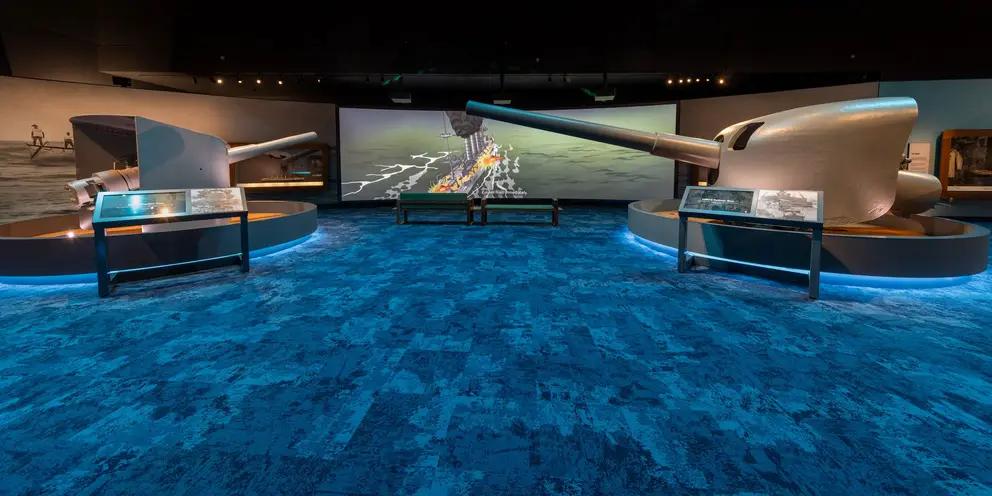
Both guns and the Voices from the Sydney–Emden Battle film in the gallery.
By October 1914, the German light cruiser Emden, under Captain Karl von Müller, had captured or sunk 25 allied steamers and two warships. Emden was a member of the German East Asia Squadron, but von Müller had convinced his commanding officer that the raider would be more effective if it was detached from the squadron. Having slipped past British forces in the Pacific, von Müller operated in the Indian Ocean, dogged by allied warships keen to stop the raider’s depredations. Insurance rates soared, commodity prices rose, and merchants across the Indian Ocean kept their ships in port.
Australian authorities delayed sending the first contingent of Australian and New Zealand troops to the European fronts, because they did not know the whereabouts of Emden or the East Asia Squadron. When the first ANZAC convoy finally sailed from Albany on 1 November 1914, HMAS Sydney was one of four cruisers escorting it, steaming on the port (west) side of the three columns of transport ships. In addition to the four cruisers escorting the convoy, a further nine allied warships roamed the Indian Ocean, all of them searching for the rogue raider.
Emden's raid on Direction Island
At daybreak on 9 November 1914, Emden arrived at Direction Island in the Cocos/Keeling Islands. Von Müller was seeking to destroy the British wireless station and undersea communication cables connecting Australia and Britain.
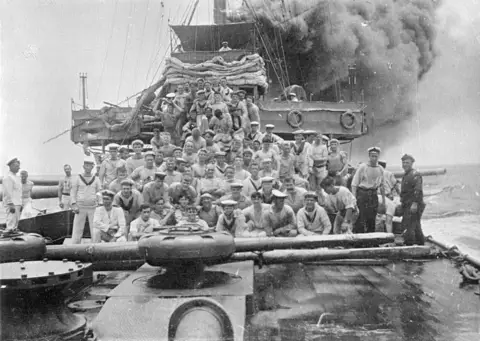
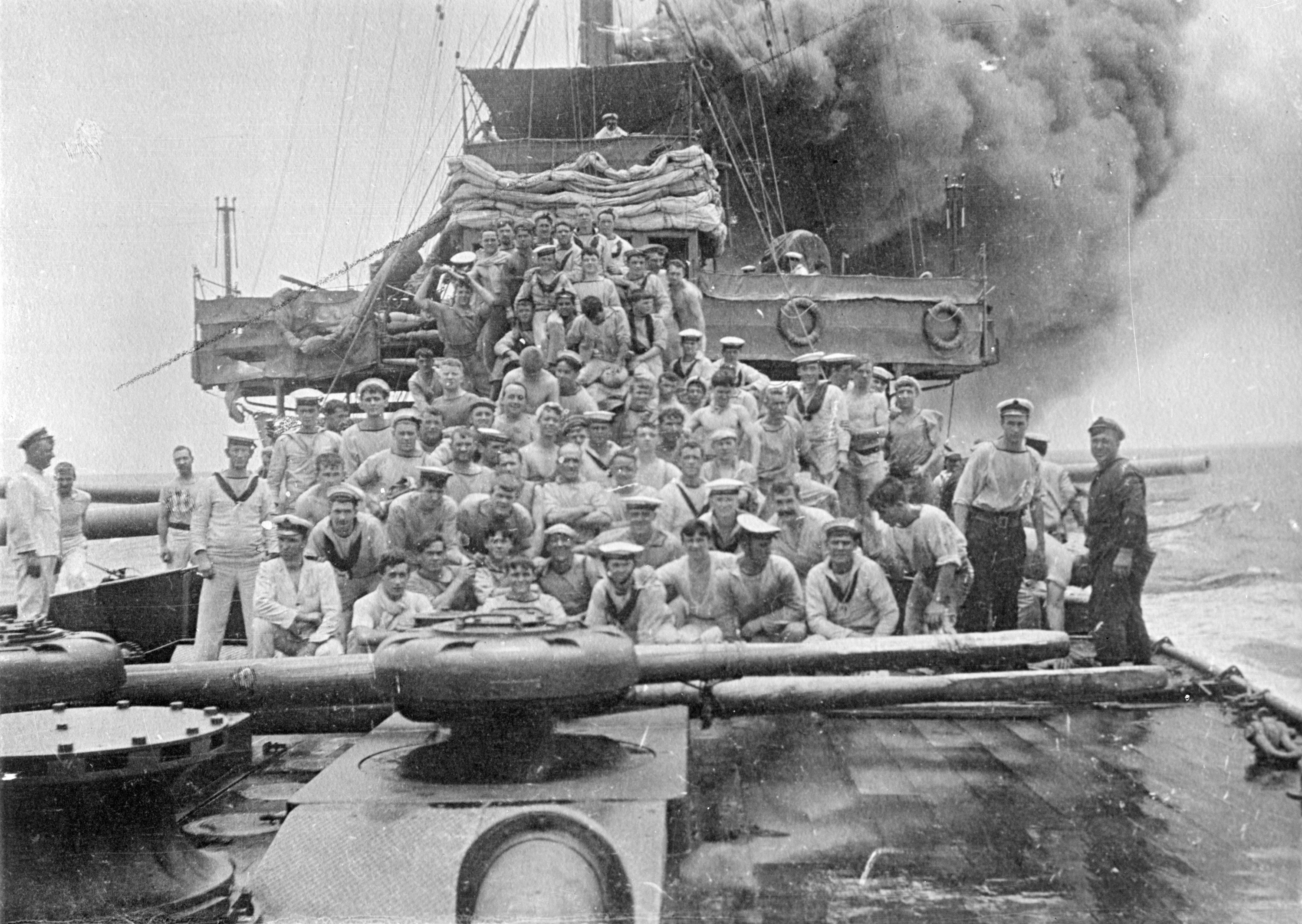
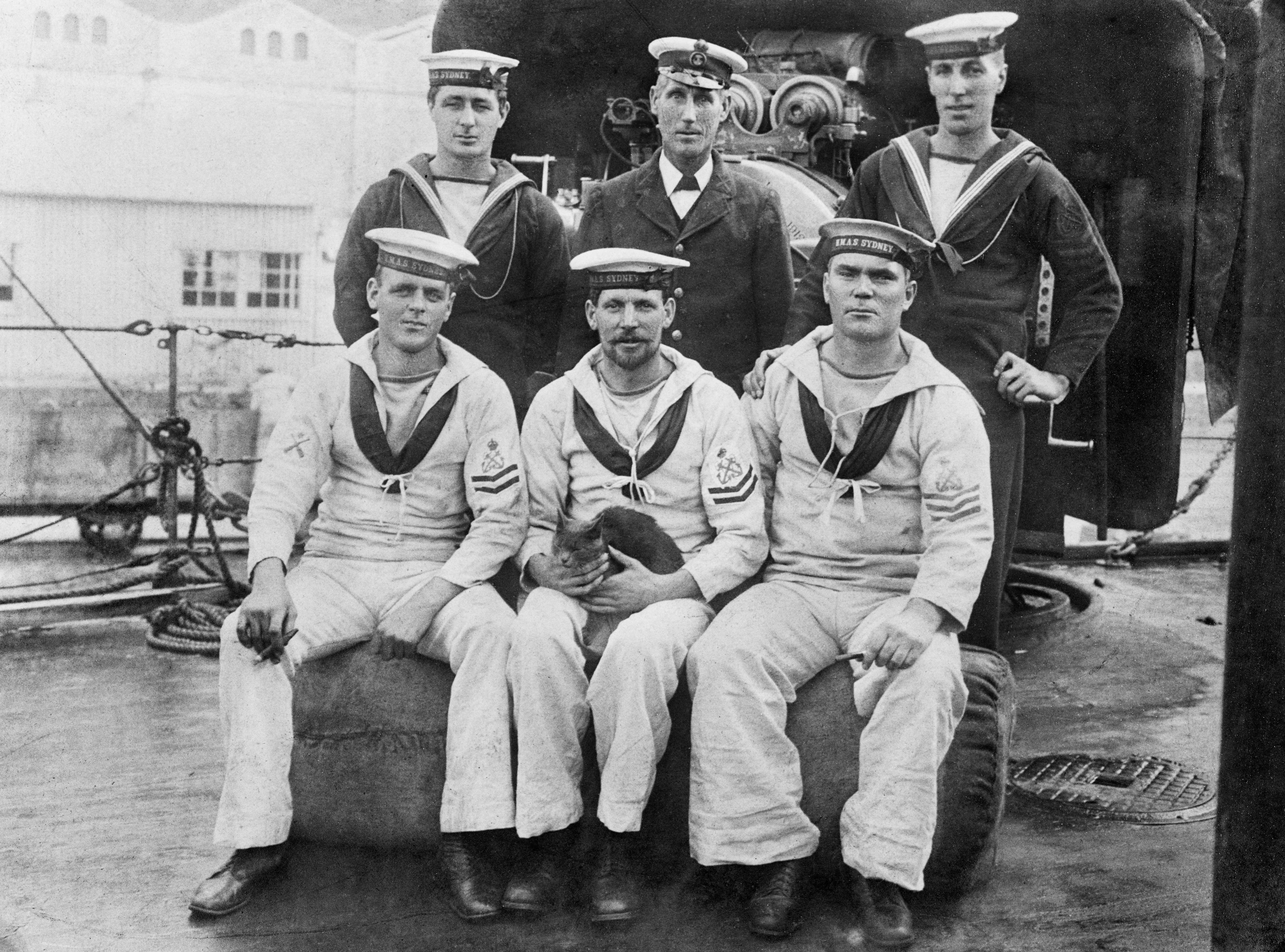
Group portrait of unidentified seamen on board HMAS Sydney. Ten minutes earlier, the cease fire had been given in her battle with the German cruiser Emden, which had run ashore onto a reef on North Keeling Island in the Cocos (Keeling) Islands.
As Emden approached, the wireless station on the island transmitted an urgent message, but it was not clear to those on the island whether any friendly ship had received it. Launching in small boats, a heavily-armed German landing party of 50 men went ashore from Emden to destroy the station communication cables.
The Superintendent of the Eastern Extension Telegraph Company island was a man named Dover Farrant. He later remembered, “Armed guards ran to all the buildings, and the office was taken possession of in force and the staff ordered out.”
The German officer in command of the landing party, Lieutenant Hellmuth von Mücke, told Farrant that the island was now under German martial law, and that any attempt to communicate with the British would be severely punished. A member of the landing party recalled, “As soon as we landed on the island we got to work in double quick time … we fished up the cable and cut it through. The Wireless Telegraph mast was blown up and also a house with spare cables.”
Just as it seemed that the landing party had achieved its objectives, the drama unfolded. In the words of one of its members:
The landing party returned to the island and commandeered a sailing vessel, improbably making their way over many months back to Germany. But for those aboard Emden, the ordeal was only beginning.
Battle
Lieutenant Rupert Garsia in Sydney adopted a jocular tone when he wrote one of the first published accounts of the battle in December 1914. “I was just taking a bath,” he wrote, “when my ship-mate came in with news that the enemy was within 40 nautical miles of us.” At first Garsia regarded the news as a practical joke, but it quickly became clear that his fellow officer was serious.
Just before 7 a.m., Sydney had received the urgent radio signal from the island: “strange cruiser at entrance to harbour”. Leading Signalman John Seabrook, aboard Sydney, recorded that this message was sent in amongst others from the island, but because the “strange cruiser” was jamming the radio waves, this was the only part of the signal that got through. The captain of HMAS Melbourne, leading the convoy, sent Sydney to investigate. The crew’s suspicions were soon confirmed – the strange cruiser was indeed Emden.
Emden fired first, scoring hits. Ordinary Signalman Arnold Mellor described the opening of the engagement from Sydney:
The gunners on both ships bore the brunt of industrialised warfare at sea. Able Seaman Arthur Hooper was at one of the eight 6-inch guns that formed Sydney’s main armament. “I was at my post with my eye along the sight,” he wrote to his family, “waiting for the Emden to come under observation when suddenly a shell burst in the rear of our gun, and I felt a stinging pain in my arm. I glanced down and saw that a hunk of flesh had been torn out.” No-one in Hooper’s gun crew came through unscathed. “So intent was I upon the sight, that I did not know what was going on at the rear of the gun,” he wrote.
“Then I felt a terrific heat, and the silence of the crew induced me to look back. I shall never forget the sight. Everything around the gun was on fire, and I looked like being roasted.” Hooper rushed through the flames and dragged two wounded comrades to safety.
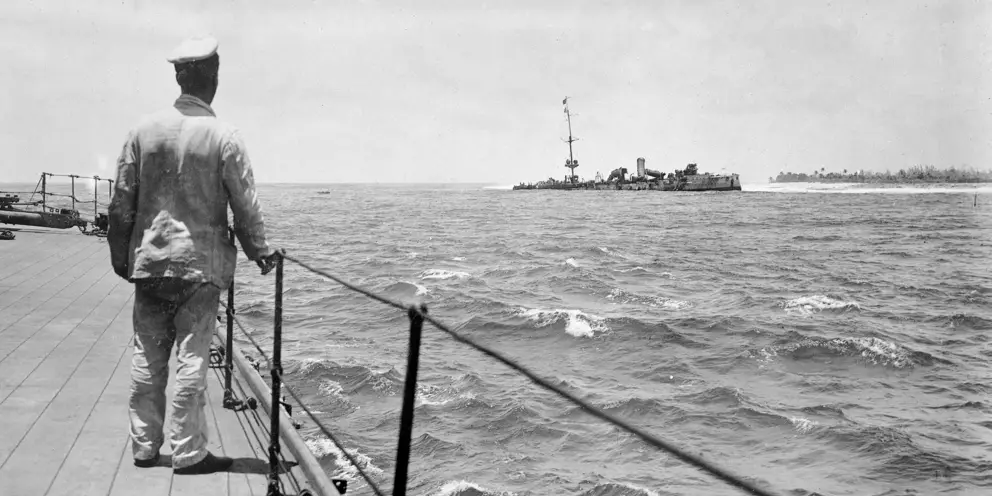
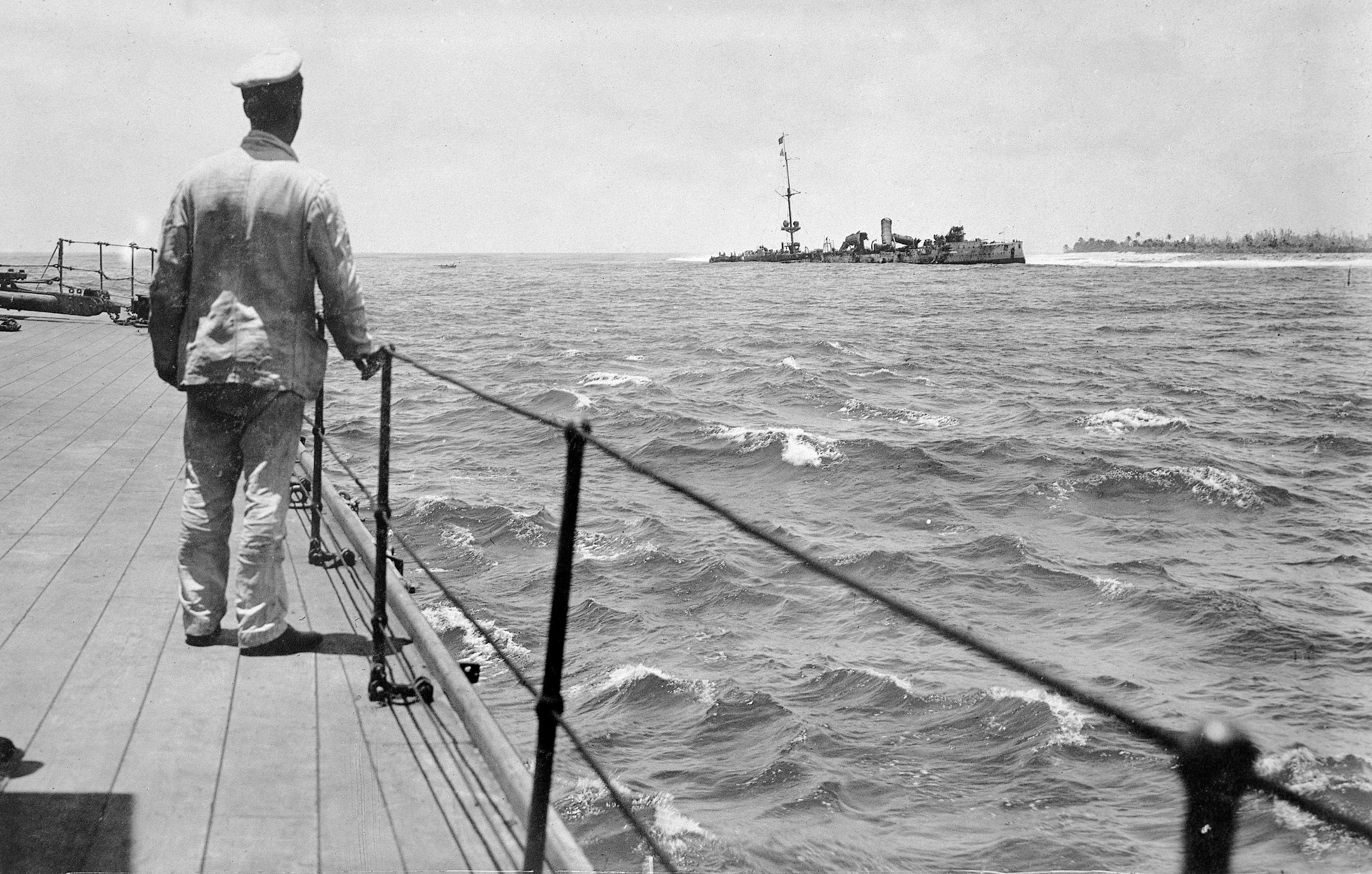
A sailor of HMAS Sydney looking at the wreck of SMS Emden, beached off North Keeling Island, November 1914. Photographer unknown AWM EN0401
By this point, Sydney had found Emden’s range, and was returning fire. Far over the horizon, HMAS Melbourne received terse radio updates; at 10:30 a.m., Sydney signalled: “Am engaging the enemy briskly.” Sydney’s guns fired a 6-inch (15.2 cm) diameter shell; Emden’s armament was smaller at 4.1 inches (10.5 cm). In the initial salvoes, Sydney suffered four killed and more than a dozen wounded, but these were the only Australian casualties. Having found the range, Sydney’s Captain John Glossop kept his ship at close to the maximum range, using his faster speed and heavier guns to dominate Emden.
Those aboard the German raider suffered as Sydney’s guns found their mark. Ordinary Seaman Friederich Lochau, serving at one of Emden’s guns, had a similar experience to Hooper’s.
Another German sailor wrote, “Blood was flowing in streams on the deck and terribly mutilated corpses were lying about. We answered the fire of the enemy, already feebler.”
Belowdecks in Sydney, Shipwright William White described the work necessary for the cruiser to maintain her speed: “The heat below was unbearable, and in our condenser rooms the Engine Room Ratings were obliged to have wet cloths tied over their mouths, the air being too hot to breathe.” One of Sydney’s surgeons, Leonard Darby, wrote in his journal that the first wounded sailor arrived for treatment within ten minutes of the battle starting. “He had a fractured right leg and thirteen shell wounds besides. He was in great agony, and I gave morphine… By this time a constant stream of wounded men, who required urgent attention was being brought below.” The medical team carried out their work in cramped conditions, with the temperature reaching 40° Celsius.
Aftermath
Hoping to save the lives of the remainder of his crew, Captain von Müller chose to run Emden ashore at North Keeling Island to avoid being sunk in deep water. The raider ground to a halt on a treacherous reef some hundred metres from shore. Machinist Peter Henseler in Emden remembered, “there was a panic and the cry was raised: ‘Abandon ship’. Some of the men jumped into the water from the hatch. Suddenly in the crush I was pushed overboard.” He was one of the fortunate ones. A comrade on deck saw him struggling in the water and lowered a rope, and Henseler clambered back aboard. Other German sailors drowned in the heavy surf. Some twenty Emden men made it to the island, where they languished for nearly two days without water. Enormous crabs and birds ate the bodies of the dead as they washed ashore, and attacked some of the wounded.
Sydney left Emden beached to find the raider’s collier Buresk, but the crew of that vessel had begun the process of scuttling the ship, to prevent the ship and coal from falling into British hands. Sydney took Buresk’s company aboard as prisoners, and returned to Emden in the afternoon. Emden’s flag remained flying at the mast, meaning the ship was still a combatant, and Emden had not yet fired any torpedoes, which meant Sydney could not approach. After some inconclusive signalling, Captain Glossop heard from the Buresk’s German officers that von Müller would never surrender. He ordered two salvoes fired at the beached ship. Ordinary Seaman Friederich Lochau of Emden looked on in horror from the island. “Finally I saw a young fellow climb the mast,” he wrote. “Our ensign was still fluttering even though in tatters. Pull by pull he at last reached the point, tore it down, and dropped it into the surf. Instantly the gunfire ceased.”
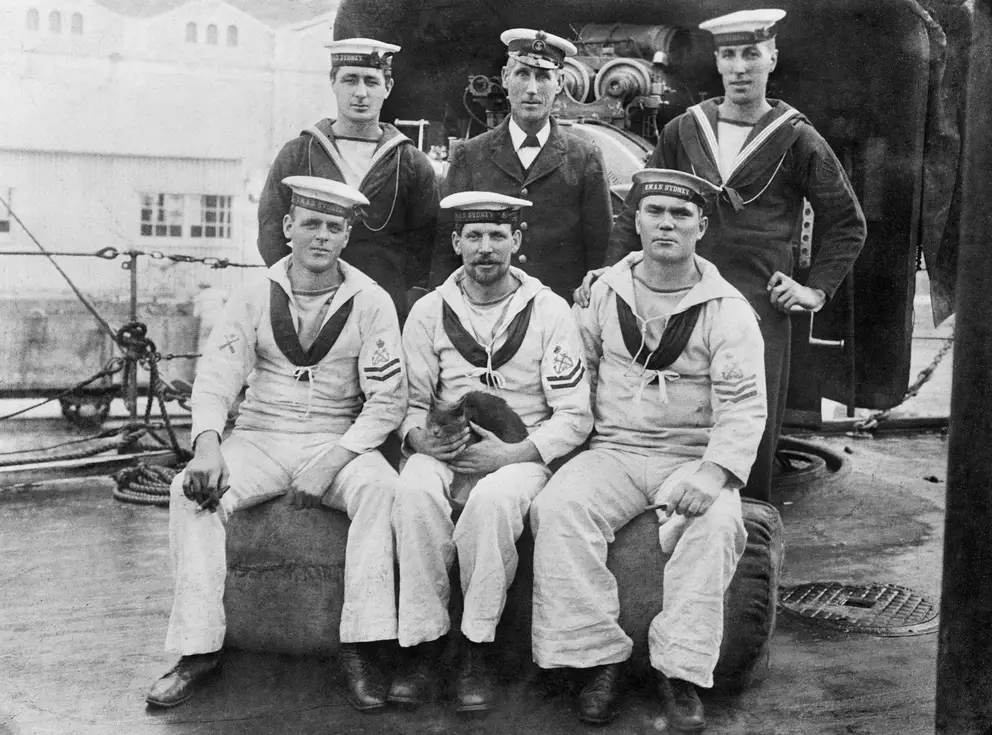
Gun layers of HMAS Sydney who survived the Sydney–Emden action, December 1914.
Photographer unknown.
Lieutenant Robert Witthoeft of the Imperial German Navy was on the deck of Emden at the end. He described the aftermath aboard the once proud raider.
Wounded German sailors were gradually brought aboard Sydney and treated. Shipwright William White remembered that Sydney’s surgeons operated continuously for thirty-six hours. More than one sailor commented that once the battle was over, the animosity seemed to fade. Ordinary Seaman Nicolaus Mayer of Emden was laid out on a stretcher next to a Sydney sailor who had lost his right foot. The two shook hands. One of the German sailors stranded on the island later wrote, “I shall never forget how delicious was the cup of tea we were given.” Sydney’s chaplain Vivian Little mused on the absurdity of war. “One day we are scientifically blowing them to pieces,” he wrote, “next day we mend them and treat them as brothers.”
Emden lost more than 130 men killed and some sixty wounded, while Sydney had four men killed and more than a dozen wounded. Emden’s survivors became prisoners of war, and spent the rest of the war in prison camps around the British Empire, including some in Australia. Sydney’s defeat of Emden, coupled with allied naval actions off the east coast of Africa, ensured allied command of the Indian Ocean during the Great War. But the battle holds the place it does in Australian and German naval histories not for its strategic context, but because of the personal accounts from sailors of both ships. Through their words, we perceive the horror of industrial warfare at sea.

About the author
Dr Thomas J. Rogers
Dr Thomas J. Rogers is a historian in the Military History Section of the Australian War Memorial.