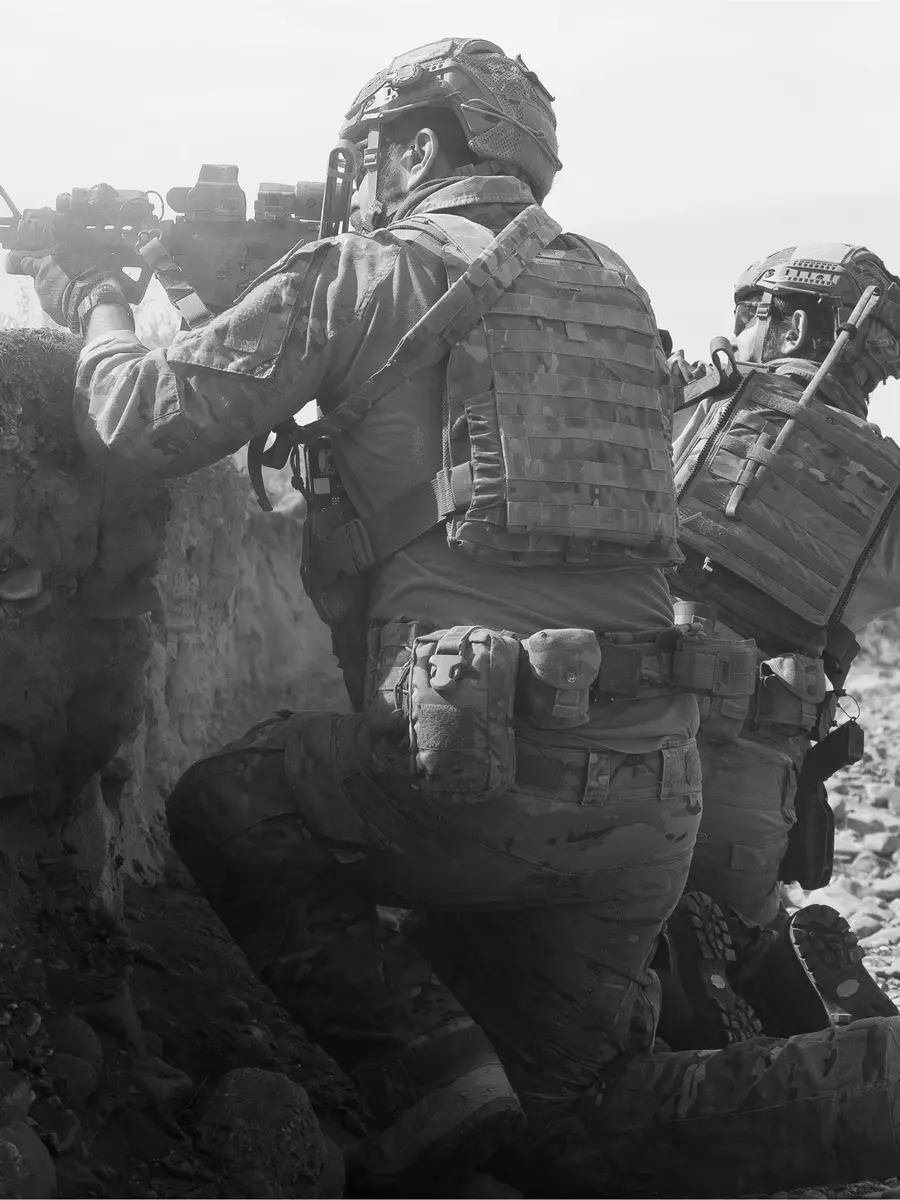
Art in the new Afghanistan gallery demonstrates the power of art: as an eye-witness record, to share experiences, seek to heal, or interrogate meaning.
With the unveiling of the Afghanistan galleries, we are finally able to showcase artists’ responses to this war. Some are famous, others anonymous, but all used the power of art to help us understand war.
Viewing art among historical objects, photographs and documents is very different from seeing it on the nice white walls of art galleries. The exhibition curators carefully selected every item to tell a complex story of a long war, one that forged connections across the globe. Art provides unique, often very personal, perspectives on this conflict and its consequences.
This sample of the works on display showcases over 20 years of commissioning and collecting art in response to the Australian experience of the war in Afghanistan.
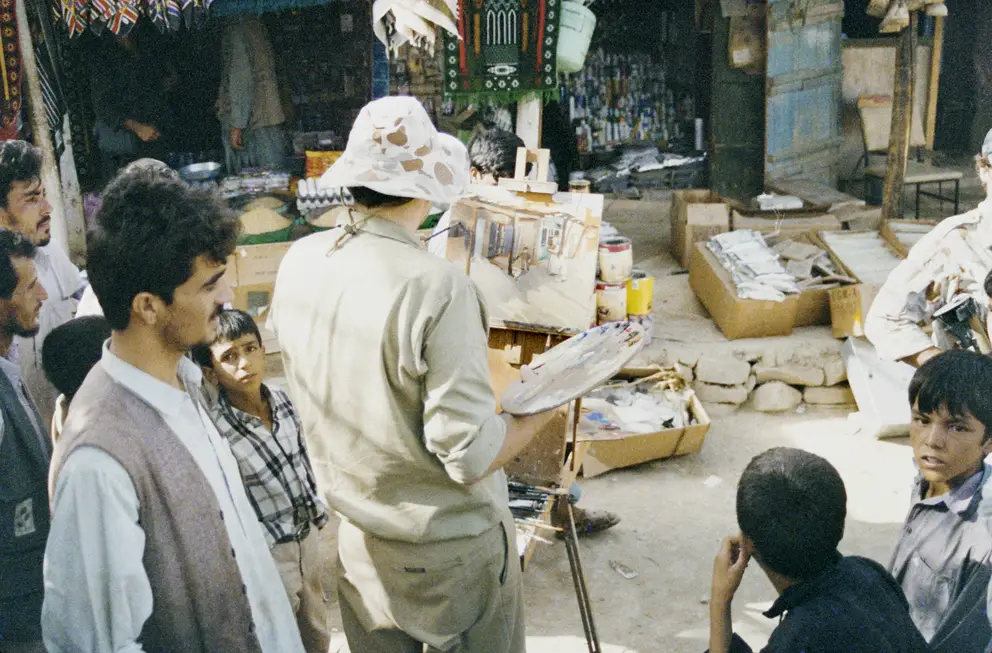
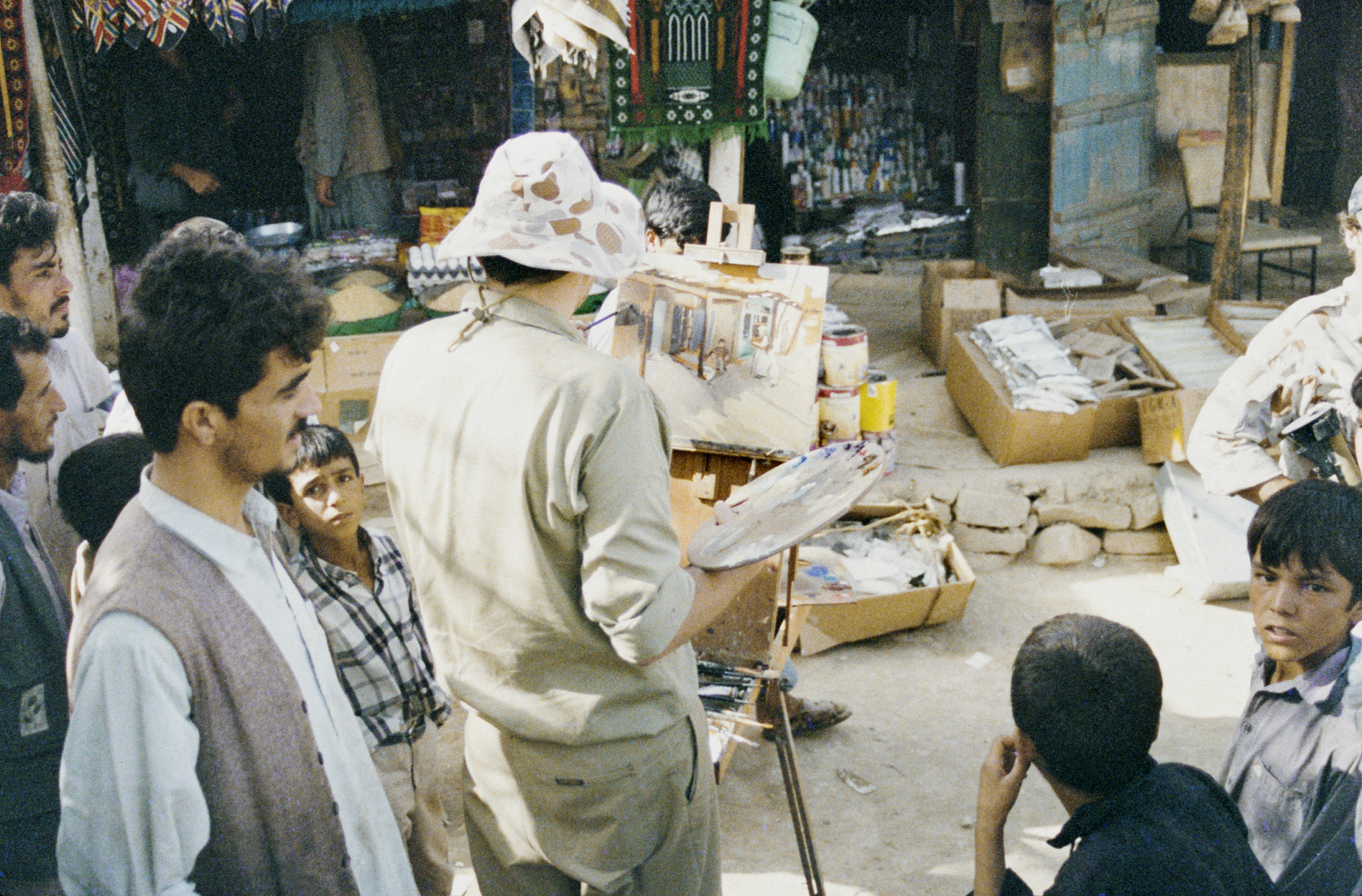
Peter Churcher painting SAS soldier in village at Bagram, September 2002. Photograph by Neil Dailey. P03937.005
Peter Churcher, 2002
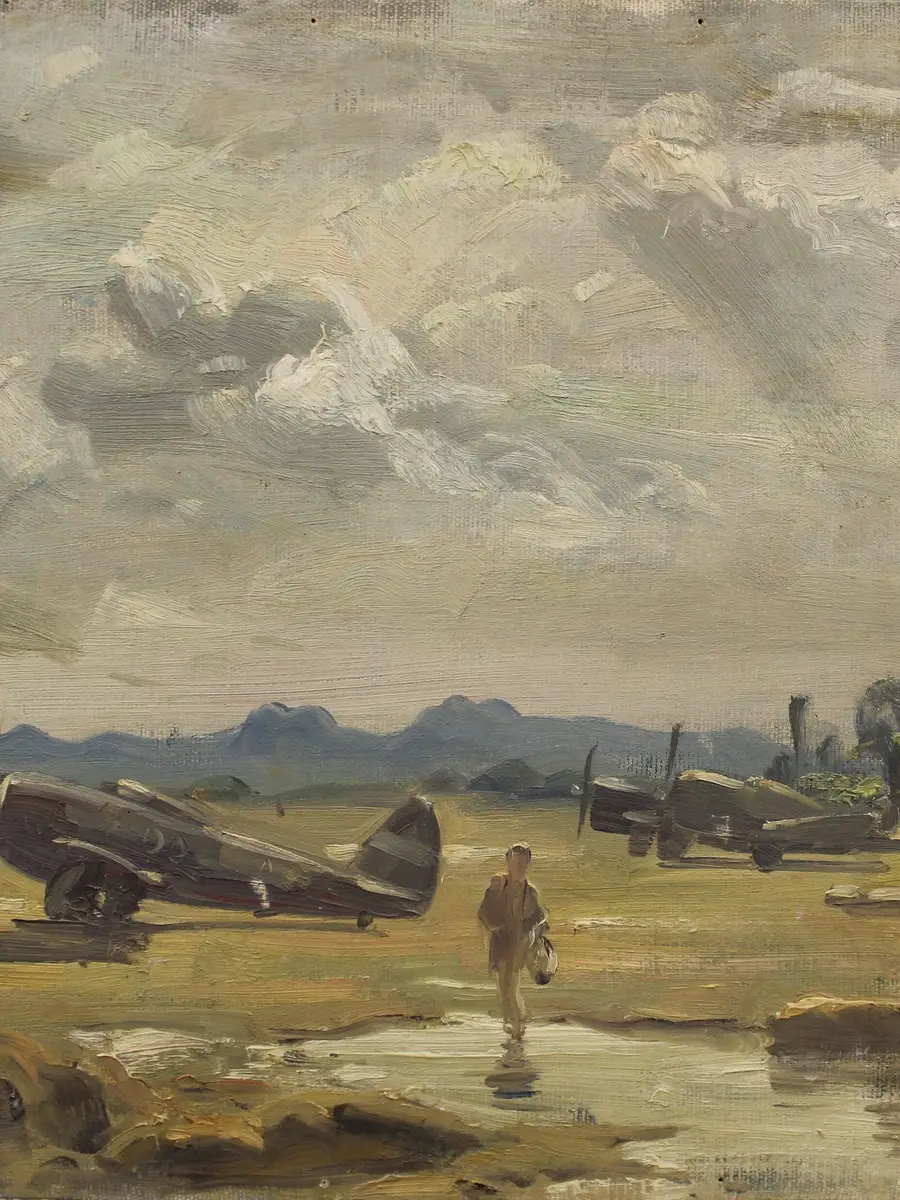
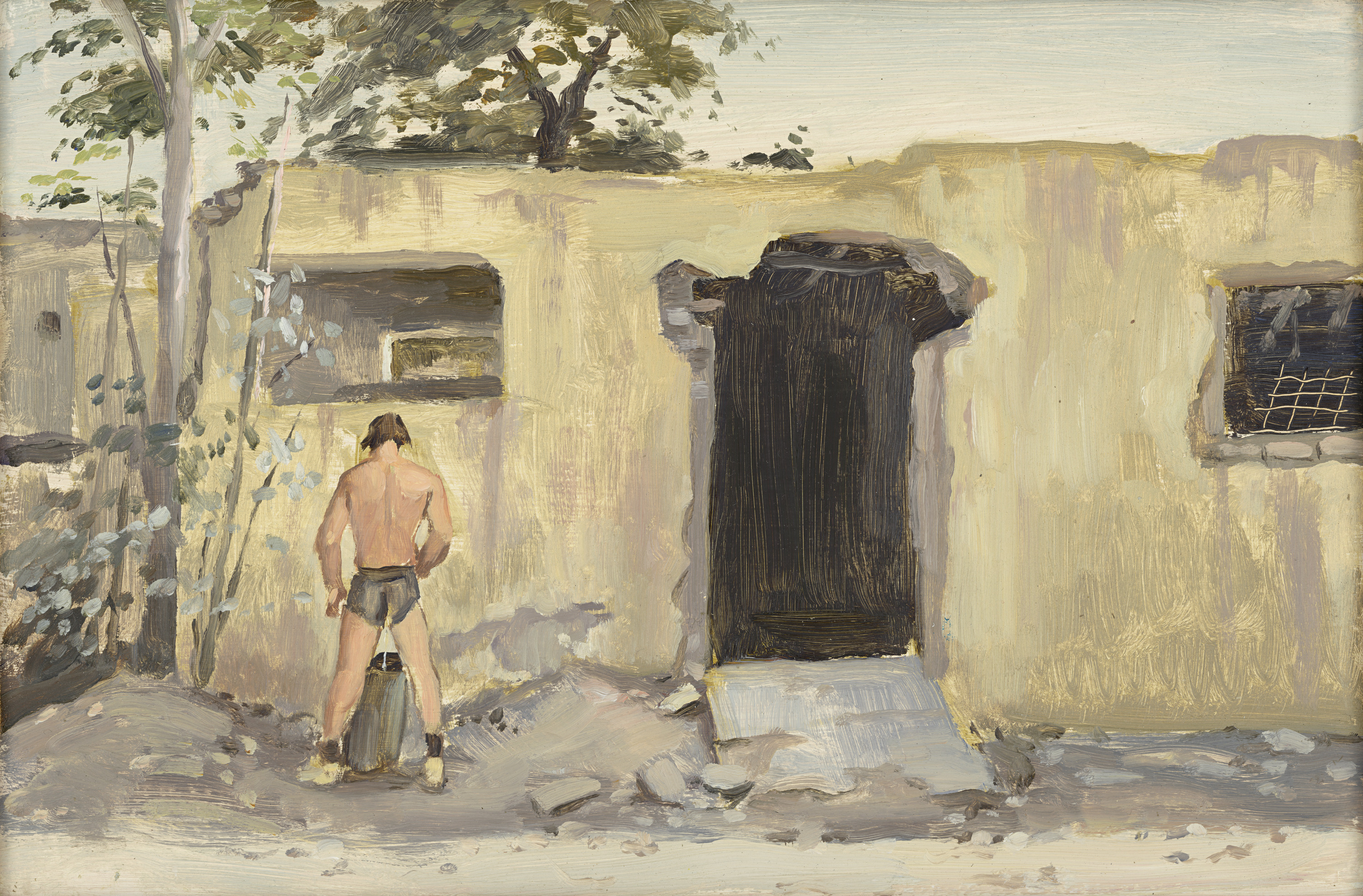
Some of the earliest are paintings by official war artist Peter Churcher. Appointed in January 2002, he deployed in February to witness the International Coalition Against Terrorism in the Middle East: with the RAAF at Diego Garcia; alongside the navy on the HMAS Kanimbla in the Persian Gulf; and then among the army at Bagram in August.
Churcher was the first of the exceptional Australian artists deployed as official war artists to Afghanistan: Lyndell Brown and Charles Green (2007), Shaun Gladwell (2009) and Ben Quilty (2011). Since the First World War, the Memorial has commissioned official war artists to ‘record and interpret the Australian experience of war’; they are free to choose their subject matter.
Just as the nature of war has changed through history, so has art. Contemporary official war artists have created innovative works that give us eyewitness records, responses to the changing technology and geopolitical environment, and the long-lasting legacy of war for many service personnel. Deployed with the military, the official artists gain a perspective few civilians experience. To offer Memorial visitors a fuller picture of the conflict and its consequences, their works are shown alongside artists with different experiences and backgrounds.
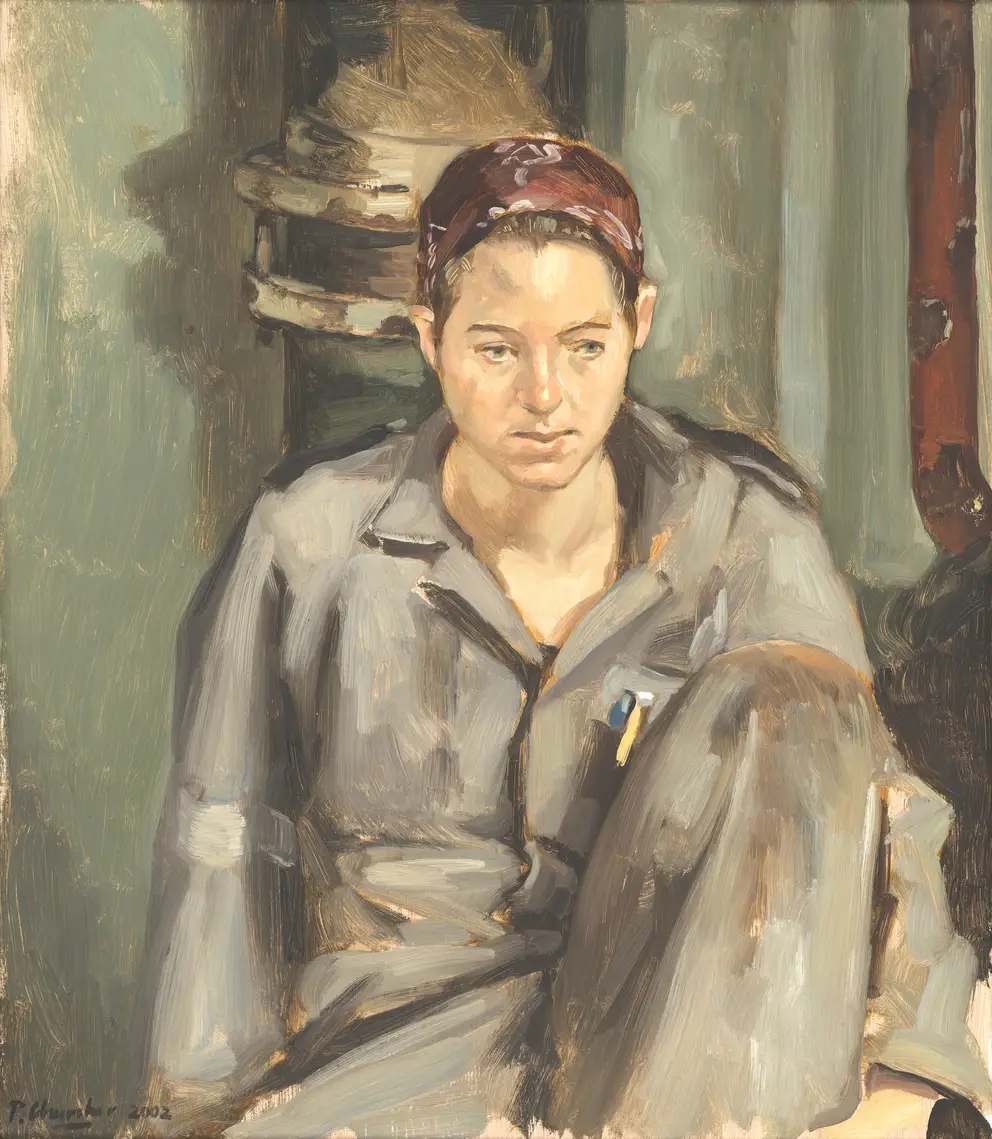
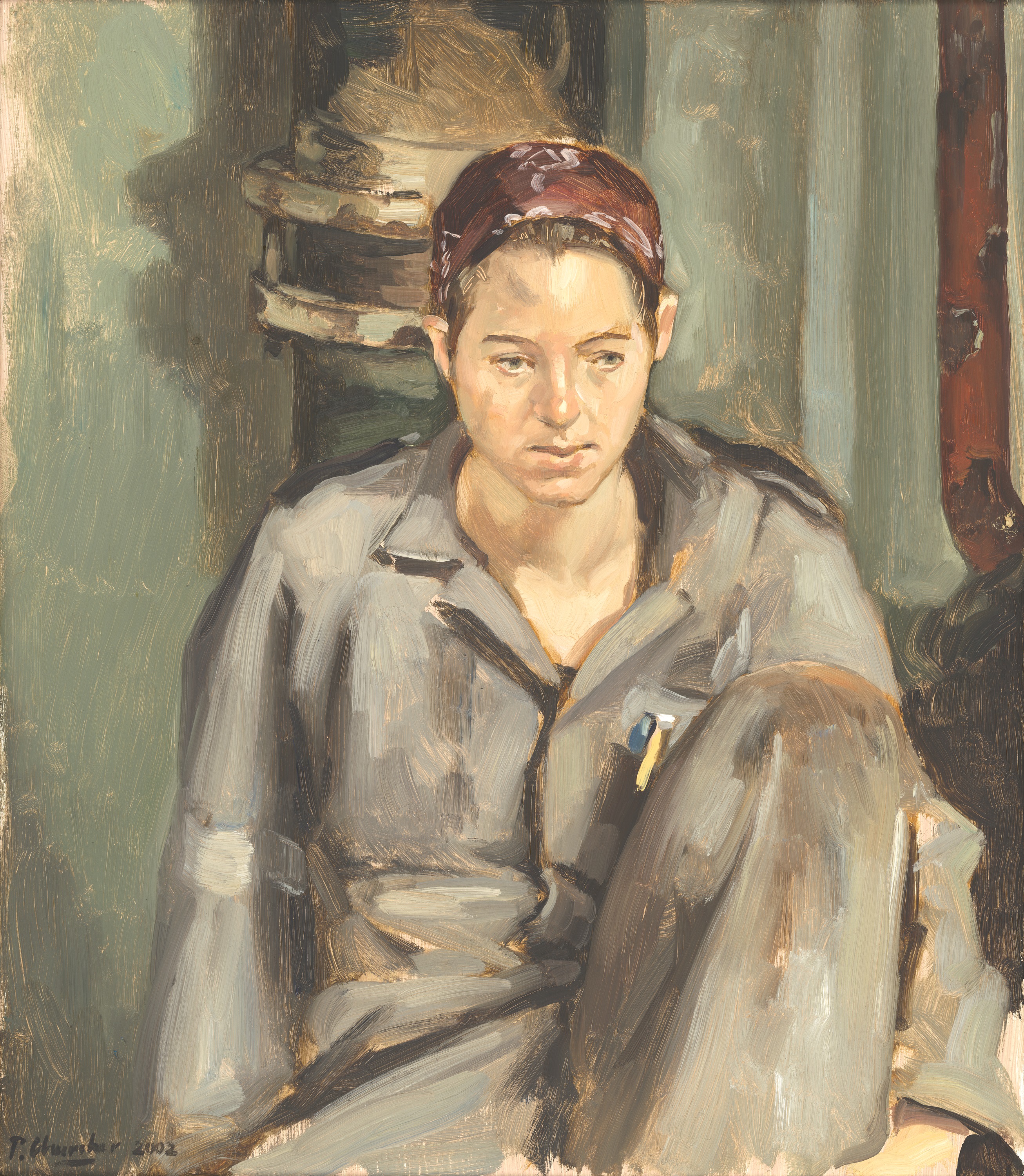
Peter Churcher, Stoker Emma Conway: the engine room, HMAS Kanimbla (18 February 2002, oil on hardboard, 40 cm x 35 cm)
"Emma was the only woman who voluntarily worked as a stoker. The engine room is an environment that does not normally suit women or people of frail sensibilities. It is very cramped and very hot and extremely noisy and one is working with grease and nuts and bolts and heavy-duty tools. Emma loved working down in there. It’s deep down in the bowels of the ship … She absolutely gained the respect of the men. The men told me that she was as reliable and as hard working as anyone else in the engine room … I had ear protection when I was painting. The engine noise is extremely loud. They are enormous engines. The ship is a big bloody thing to push in the water so a lot of power is needed to push it along. They can sail around the world two and a half times without re-fuelling."
Peter Churcher
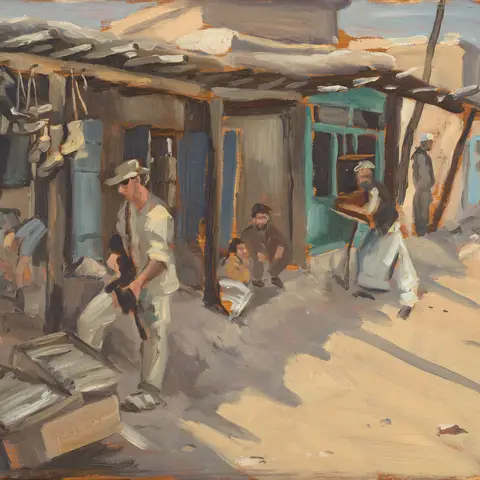
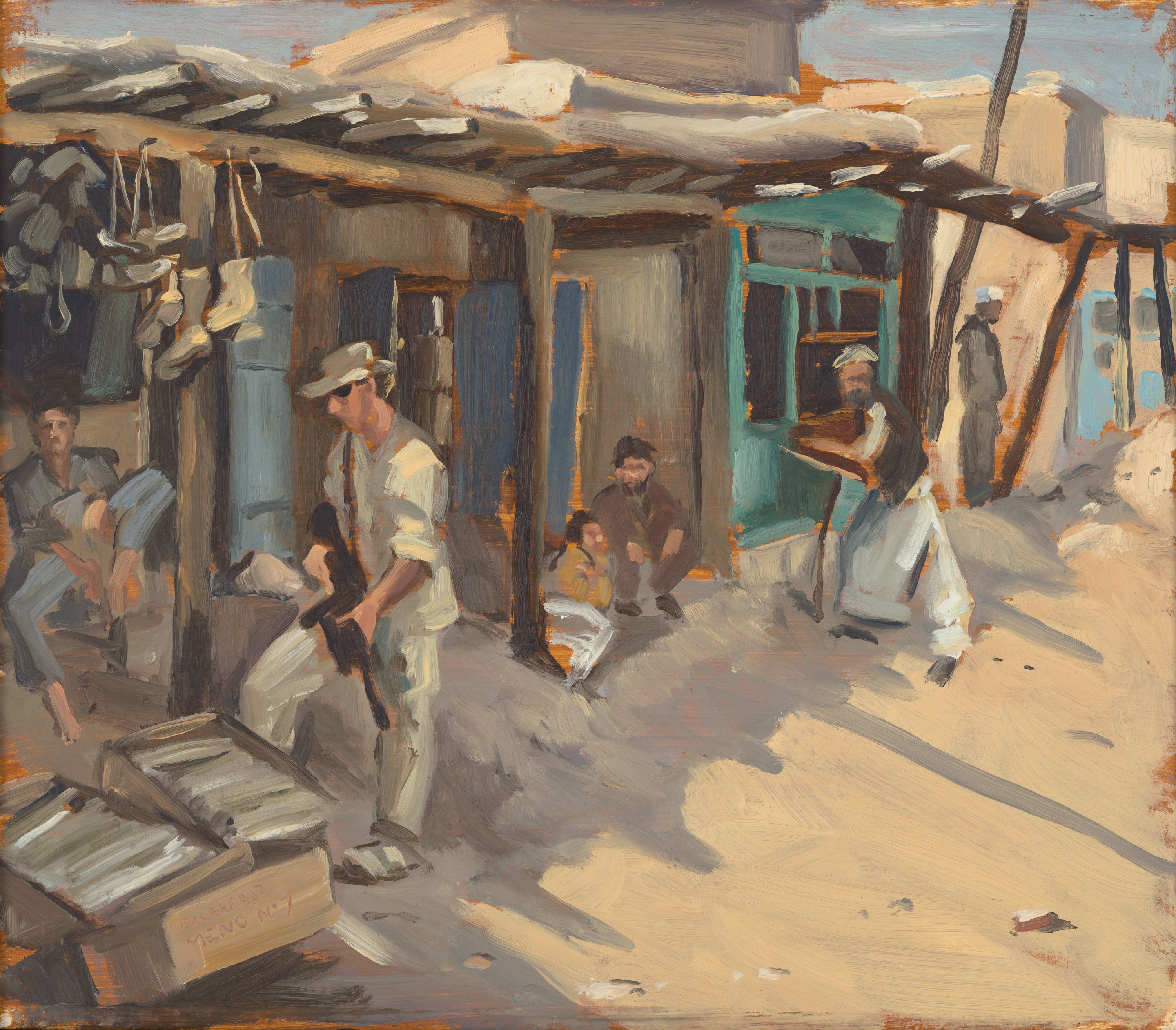
Peter Churcher, SAS soldier in the village of Bagram (25 August 2002, oil on hardboard, 35 cm x 40 cm)
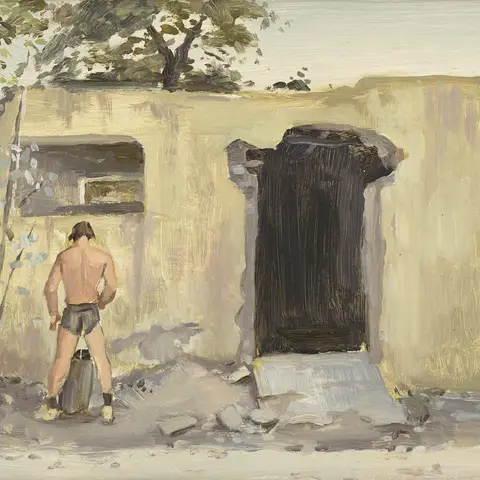
Peter Churcher, The 'piss-a-phone', outside bombed building, Bagram (22 August 2002, oil on hardboard, 20 cm x 30 cm)
Witnessing 9/11
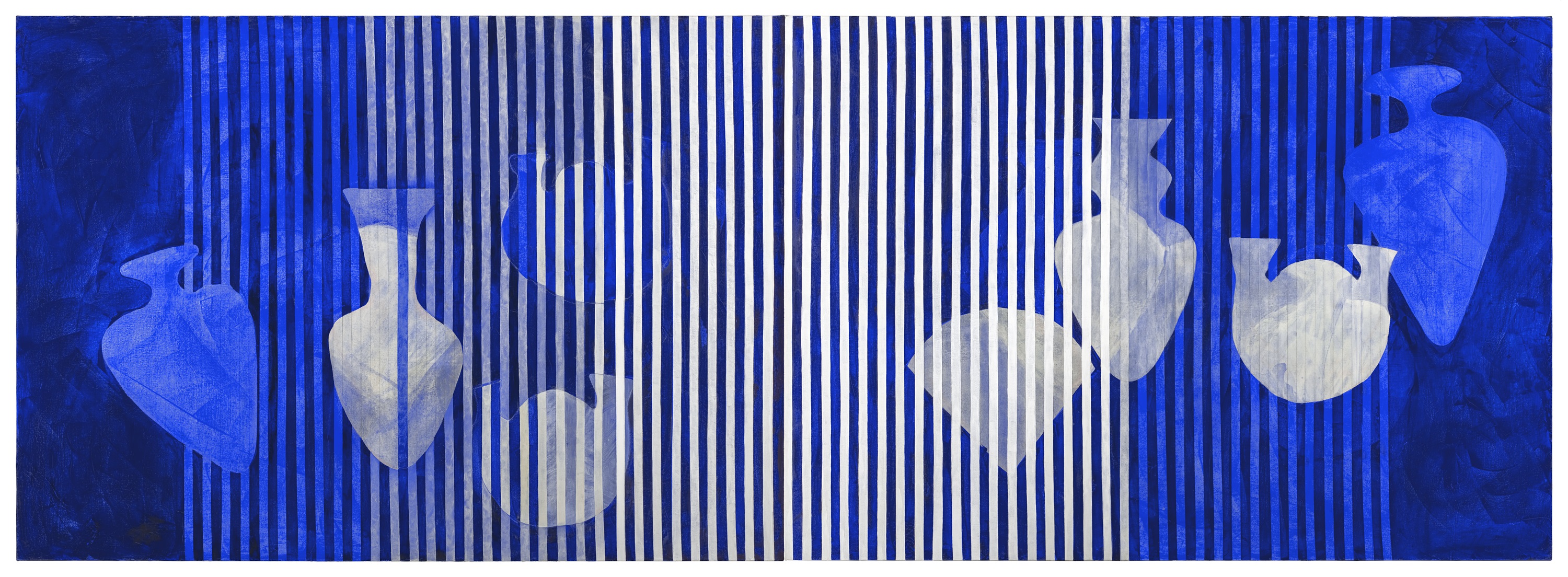
One of the most unexpected works is the one that greets us at the entry: a large abstract painting in gorgeous blues, shapes of amphorae and fans scattered across the surface, blending into stripes at the centre. Beautiful, but with no obvious connection to war until we understand the story of its creation.
Australian artist Denise Green was hard at work in her New York studio on the morning of 11 September 2001. She had developed a recognisable style since the 1970s, with paintings that combined abstraction with symbolic figurative elements. Witnessing 9/11 from her studio window changed her life in ways she could not have predicted. The first was a rupture in her practice: the stripes dissecting her usual washes of colour. The stripes refer to the panelling of the Twin Towers she had just seen destroyed. Over the years since then, she has realised how the ‘stripes’ motif resonated with other traumatic memories from her life, including during her childhood in the wake of the Second World War.
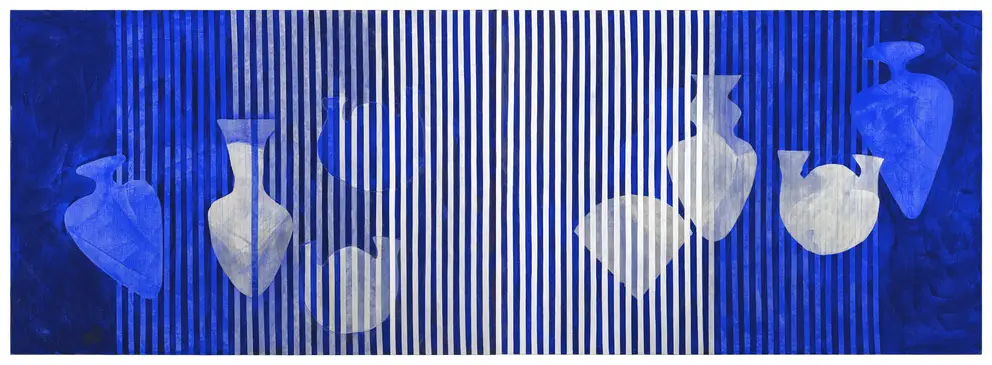
Denise Green, Blueshift (2001, synthetic polymer paint on canvas, 111 x 314 cm) AWM2023.473.1
As part of a display about the War on Terror, the painting, accompanied with her words as an eyewitness to 9/11, offers insight into the complexity of the events that unfolded in response to that attack: impossible to predict, and profoundly shaping the lives of individuals and whole countries.
"My first indication that something was wrong was the sound of sirens … [from] my studio, [I] stared in disbelief at the gaping black hole in the north tower of the World Trade Center. I sat on the large ledge outside the window and watched. Then the second plane hit the other tower, and I saw the flames and smoke billowing up. And then one of the towers collapsed into a huge cloud of smoke … At the time, I didn’t understand that this was a major catastrophe, and I couldn’t understand or describe how this event had affected me. I was just overwhelmed. I now realize that I had dealt with the trauma of witnessing this tragedy by painting. Perhaps I was processing the event through this act."
Denise Green
Lyndell Brown and Charles Green, 2007
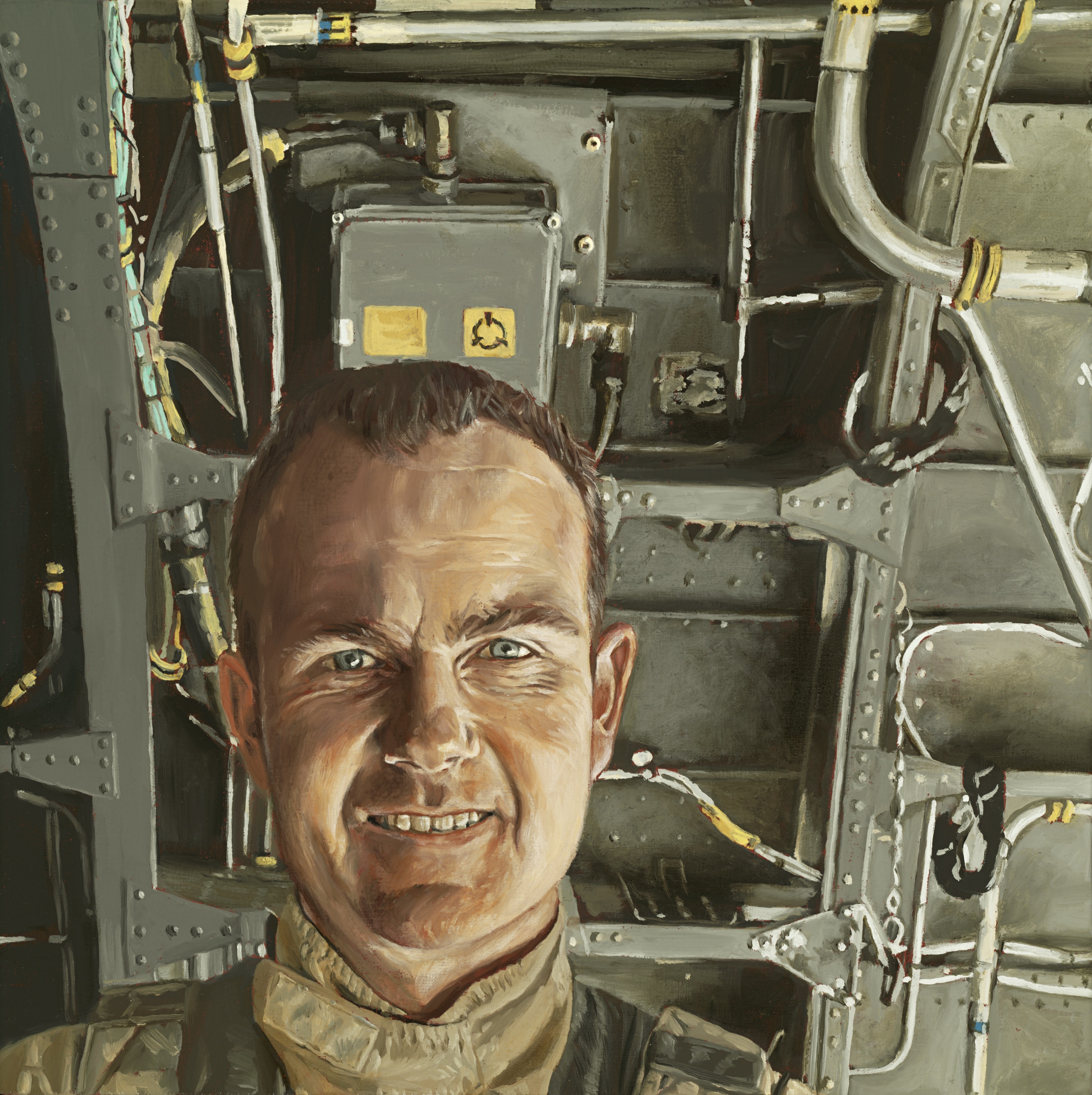
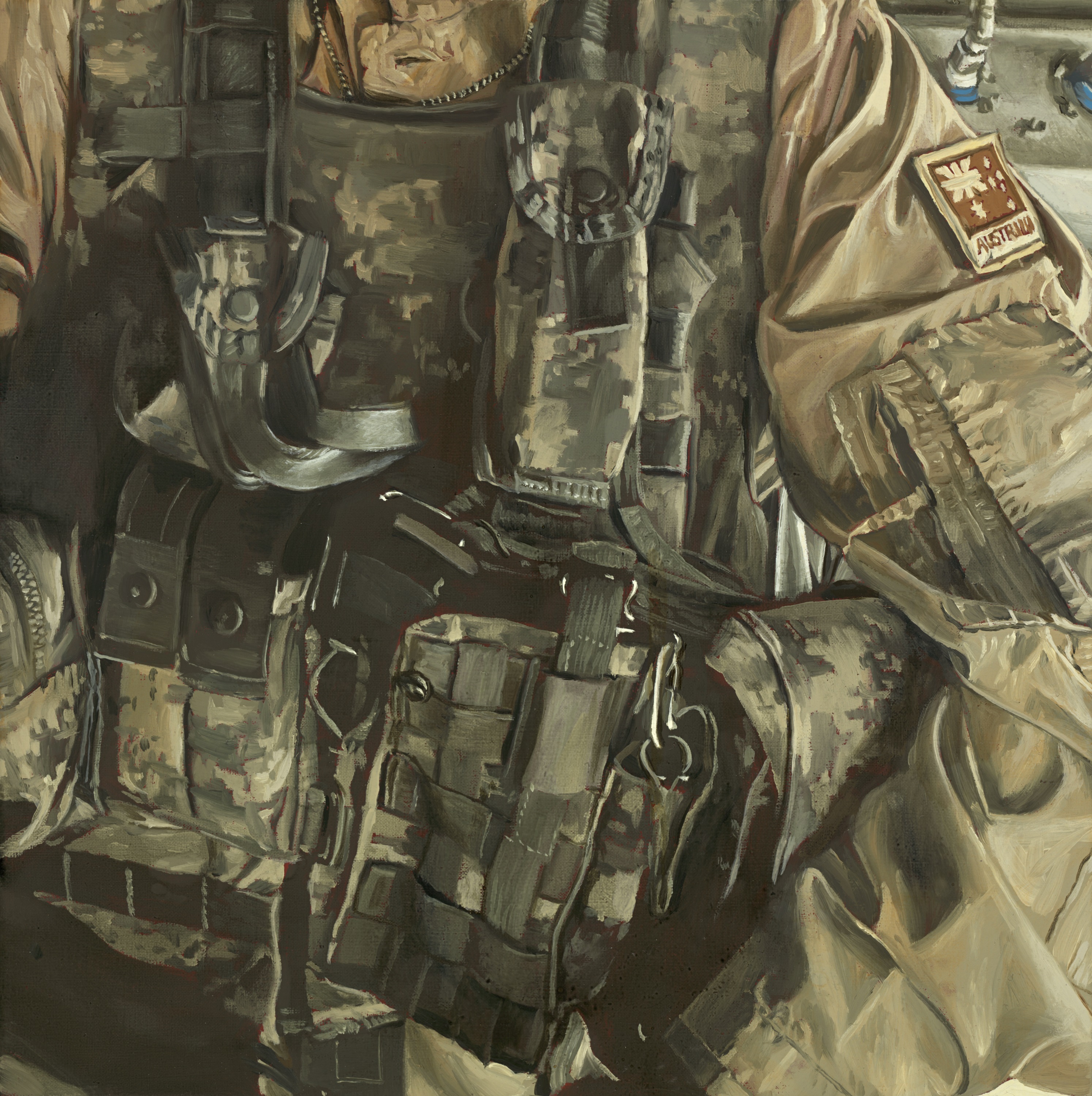
Official war artists Lyndell Brown and Charles Green met many ADF members during their deployment to Afghanistan in 2007, and deeply respected the “low-key idealism, caution, compassion and smartness of much of the Australian military, [and] their genuine sense of service.” They painted portraits of pilot Colonel Kevin Humphreys and gunner Corporal Richard "Scooter" Wakelin of 5th Aviation Regiment to express their gratitude for flying them around Afghanistan, which gave them a far deeper understanding of the place and Australia’s role in the conflict.
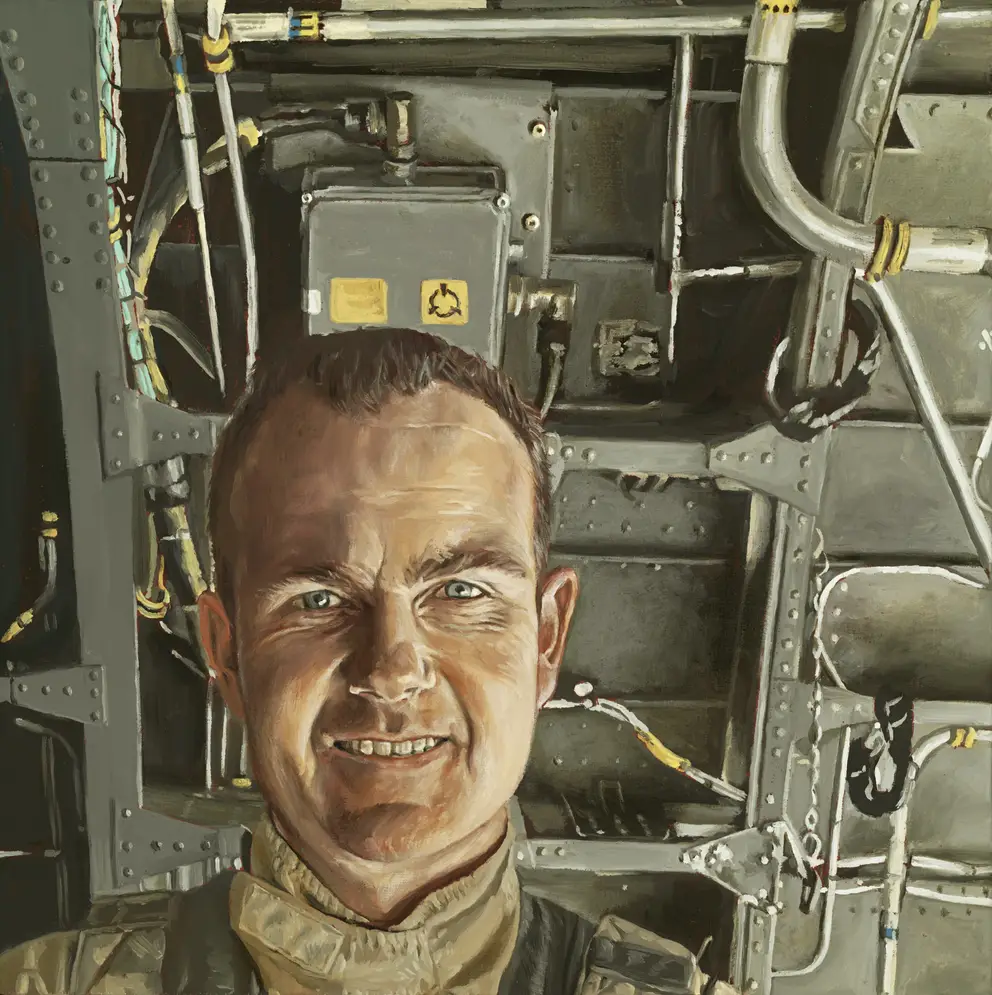
Lyndell Brown & Charles Green, Portrait, Colonel Kevin Humphreys, CO, Army Chinook Squadron, Kandahar (2007, oil on linen, diptych, each: 31 x 31 cm)
ART93309
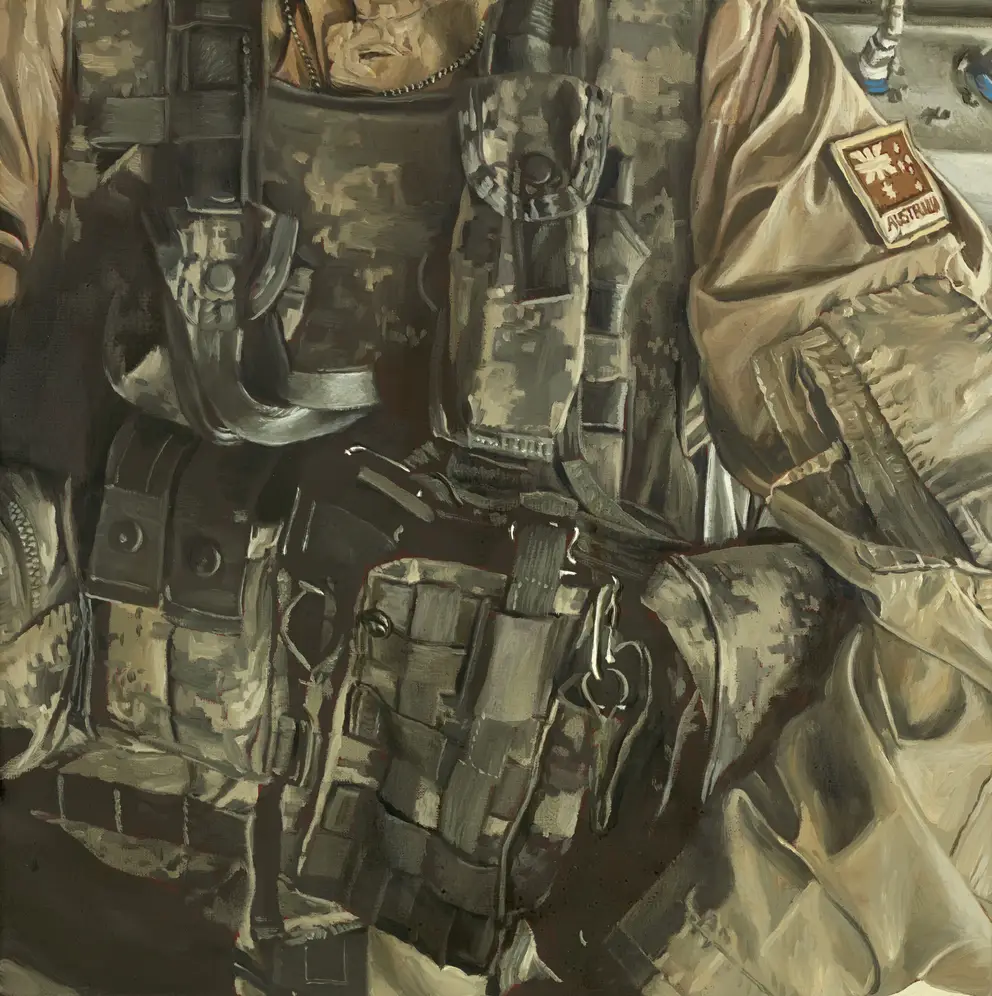
Lyndell Brown & Charles Green, Portrait, Colonel Kevin Humphreys, CO, Army Chinook Squadron, Kandahar (2007, oil on linen, diptych, each: 31 x 31 cm) ART93310
“For Lyndell and Charles to even consider me for a portrait was an honour; to see it complete was like stepping back in time. Although I did wonder why so many wrinkles, my wife told me that despite being only 33 years old at the time, that’s exactly how I looked when I got home. I wish every individual that has served our nation could be captured in this way – their service is just as important as mine.”
Kevin Humphreys, 2022
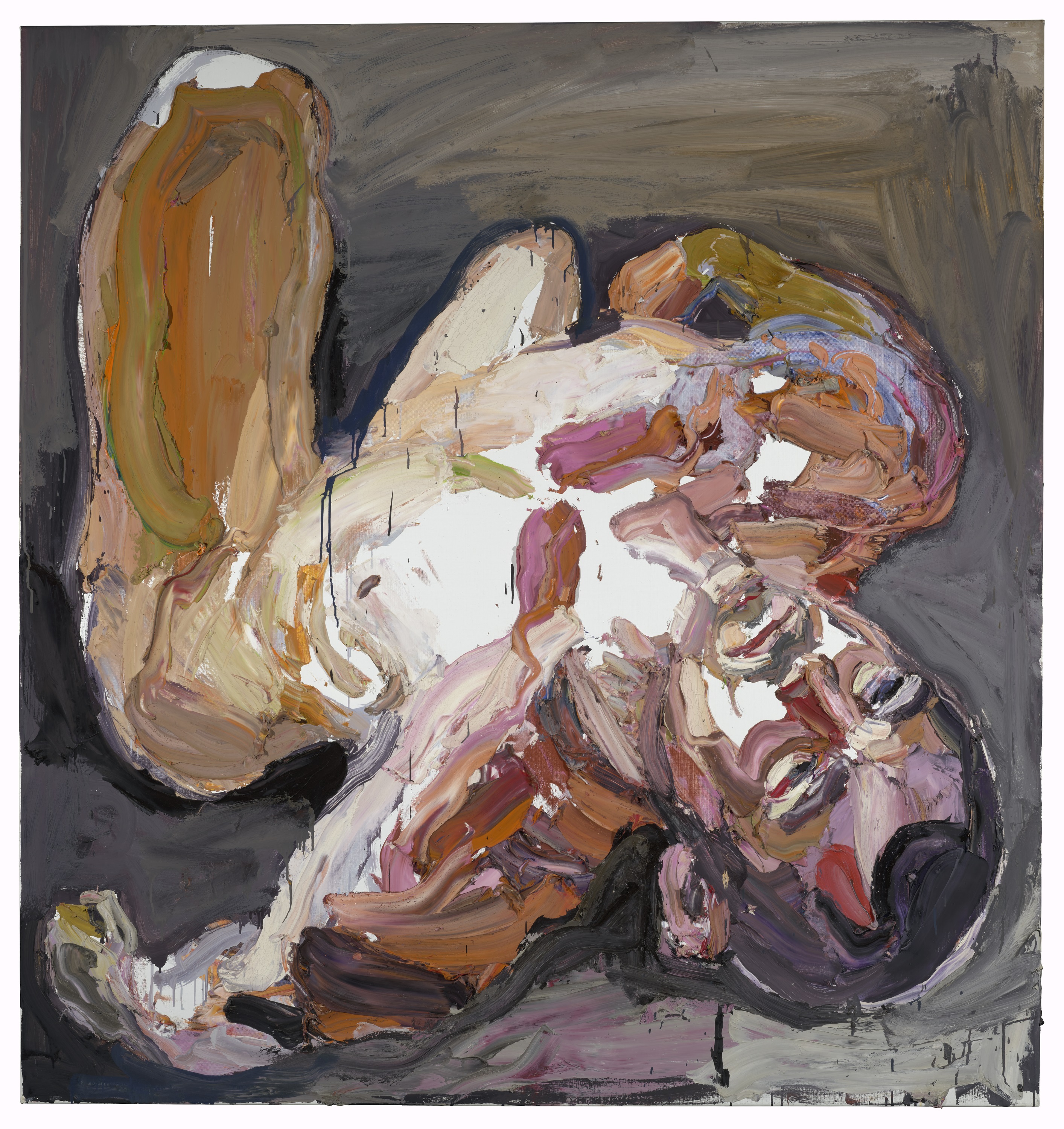
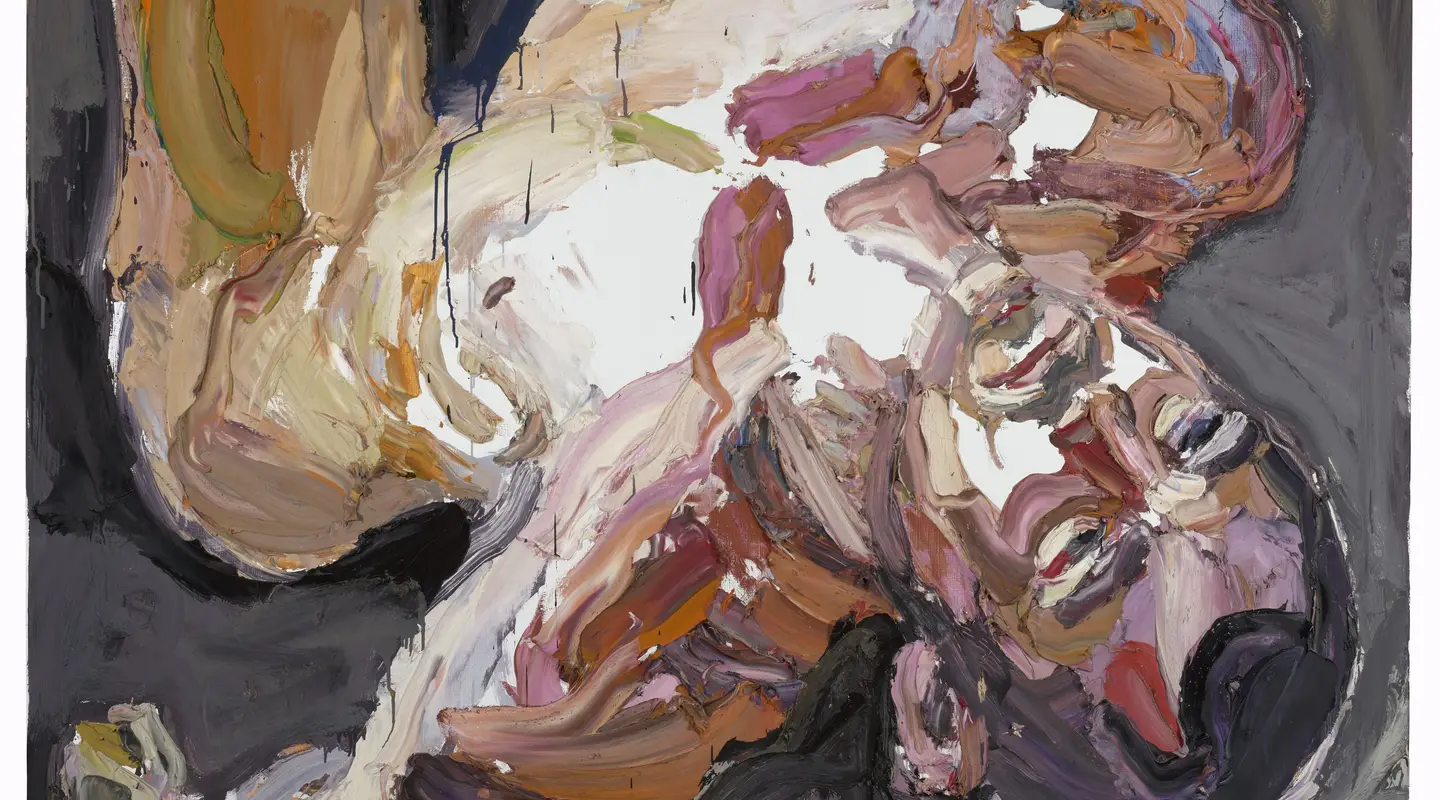
Ben Quilty and Mark Noble, 2011
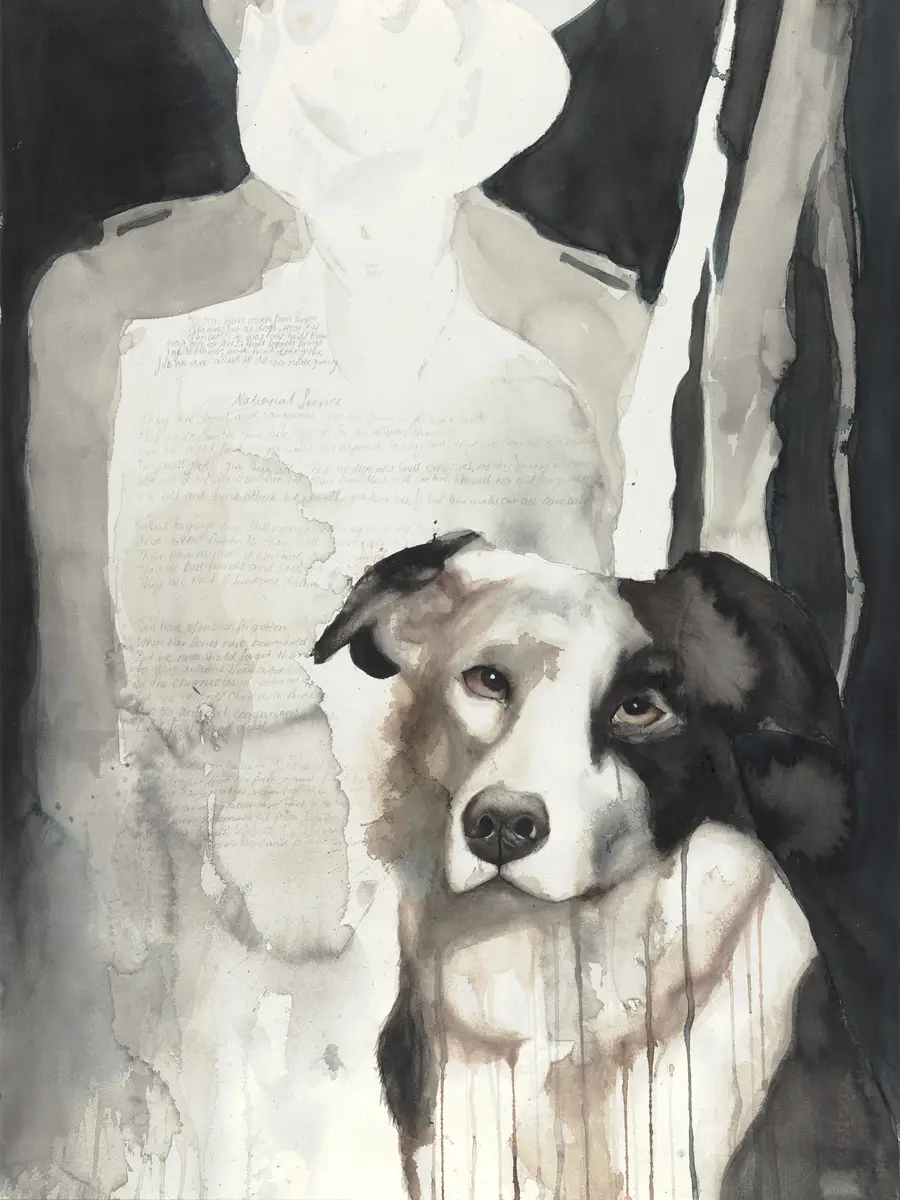
Official war artist Ben Quilty met Lance Corporal Mark Noble on deployment in Afghanistan. Noble first deployed aged 21 in February 2009 as an explosives detection dog handler and combat engineer with the Incident Response Regiment. Two days into his first patrol in the valleys of Uruzgan his sergeant, Brett Till, was killed by an IED.
After returning from Afghanistan, Noble sat for Lance Corporal M. Quilty invited soldiers to his studio to share their stories and sit for him: “I wanted [them] to be naked, showing not only physical strength but also the frailty of human skin and the darkness of the emotional weight of the war.”
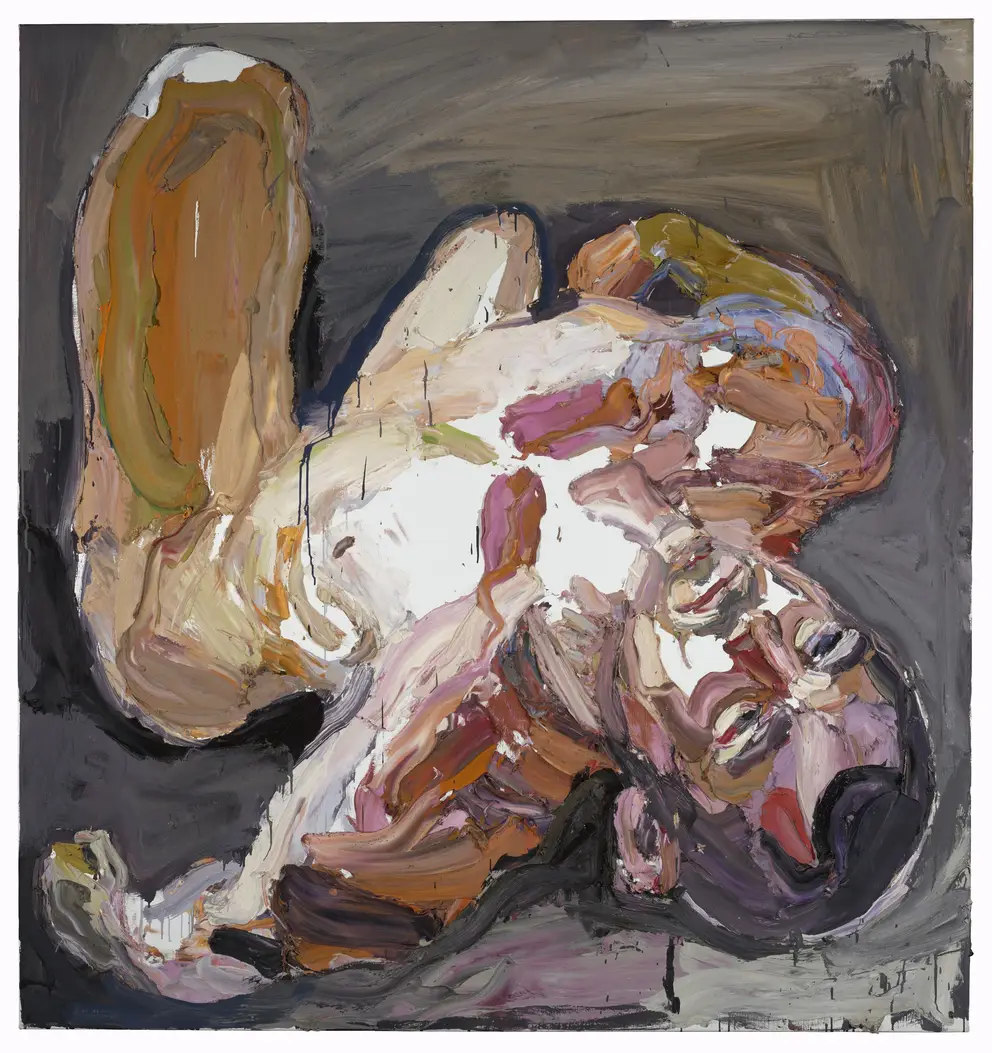
Ben Quilty, Lance Corporal M, after Afghanistan (2012, oil on linen, 180 cm x 170 cm). Donated through the Australian Government's Cultural Gifts Program by Ben Quilty, AWM2018.888.1
“After the painting with Ben in 2012 it still took me years to … understand the power of talking, it was a huge weight lifted off my shoulders. This is something many veterans struggle with but need to know it’s ok, it’s your story to tell and it is a key part of the healing process … It’s not until recently that I’ve started telling stories and it does help a lot ... a lot of people won’t talk, and I think talking is one of the biggest things that helps guys out.”
Mark Noble
War rugs
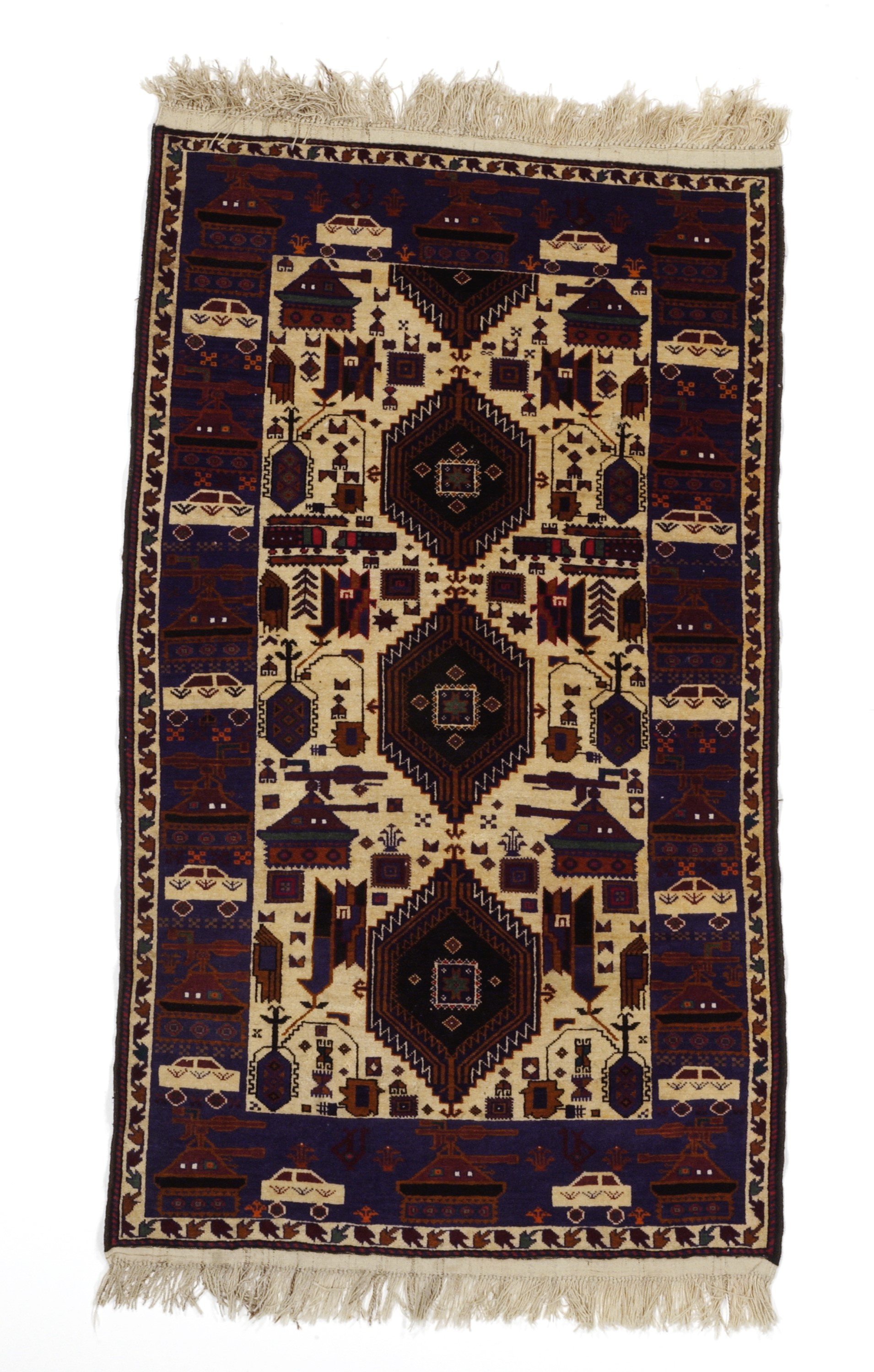
Woollen rugs are an ancient practice in Afghanistan; their designs express the culture of their makers. Traditionally they are often made during winter by women at home. In response to the 1979 Soviet invasion, military iconography started to appear. This c.1980 example was made by the Baloch people in the west of Afghanistan. Among their customary stylised floral designs are woven tanks, armoured vehicles and grenades. The rugs became popular as souvenirs from the region, and then among collectors internationally – so they were made en masse in refugee camps in Pakistan. Rugs made in camps and homes have continued to respond to historical moments and changing technology.
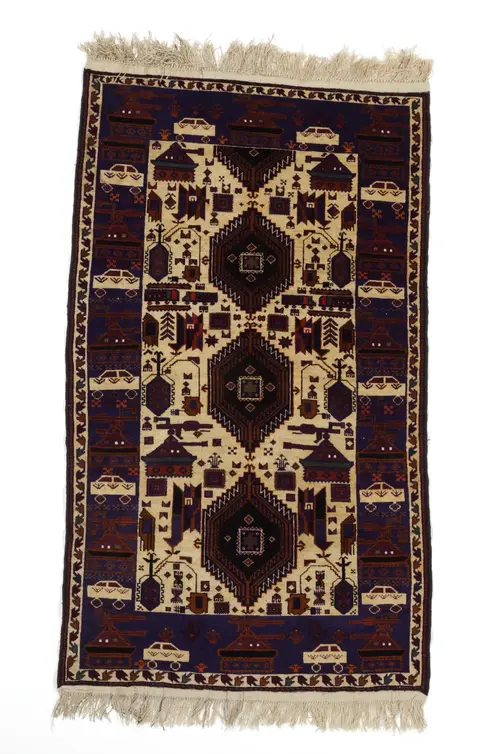
Unknown artist, Afghan (Balochi) war rug (c 1980, wool, cotton and goat hair, 1200 x 2170 mm)
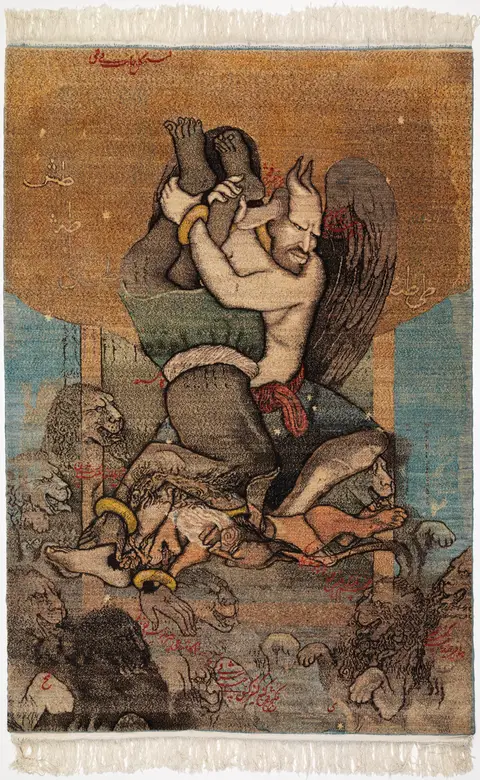
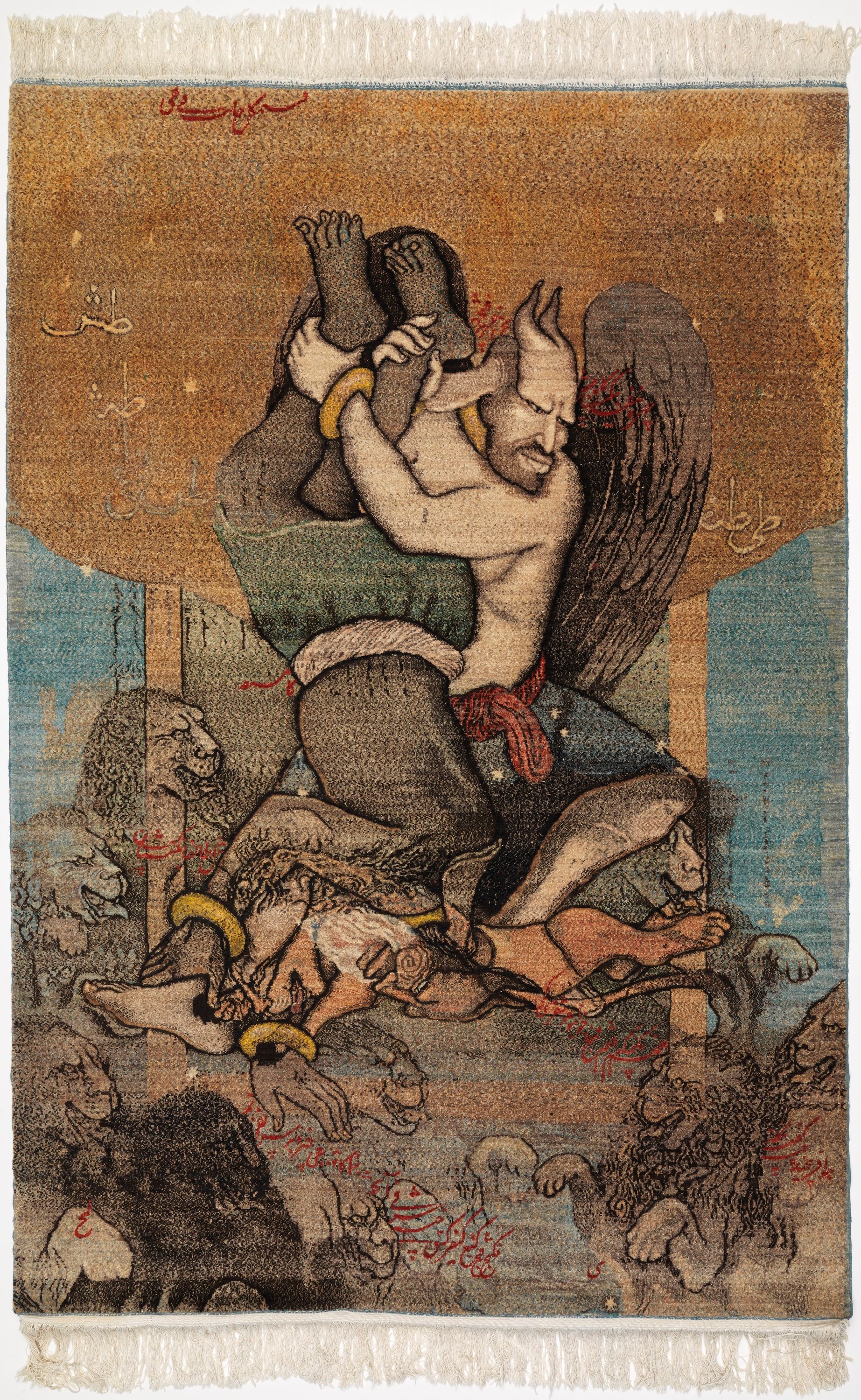
Khadim Ali, Transition/evacuation (2015, woven woollen carpet, 308 x 186 cm)
Khadim Ali, 2014
This monumental woven carpet has been revealed for the first time in the gallery. Hazara-Australian artist Khadim Ali established a weaving workshop in Kabul and is acclaimed for his adaptation of traditional rug making to express contemporary concerns. The Memorial commissioned him in 2014 to make a piece about the contemporary situation in Afghanistan; his work uses imagery from the 10th century Persian epic Shahnameh but instead of heroes fighting demons, both sides are demons.
Traditionally, lions were symbolic of a strong, proud nation, but here they are circus lions, kowtowing to international and fundamentalist influences. The calligraphy is a jumble of words and languages, reflecting the breakdown of traditional culture. The work expresses the lack of agency experienced by many Afghan groups, which often leads to further violence.
Ali’s Kabul studio created economic opportunities for Hazara weavers and to recognise their skills, which had become associated with mass production of rugs in refugee camps. After the studio was forced to close after the fall of Kabul, Ali supported many staff to find safety abroad, including in Australia.
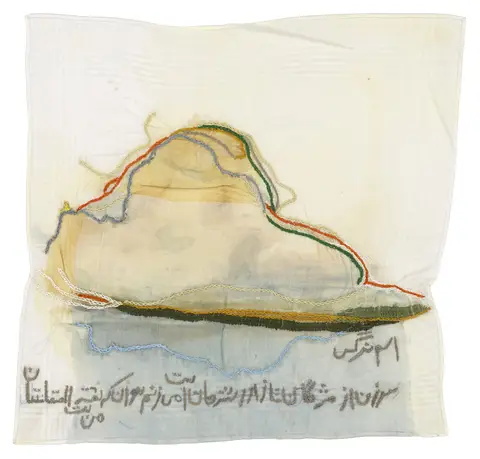
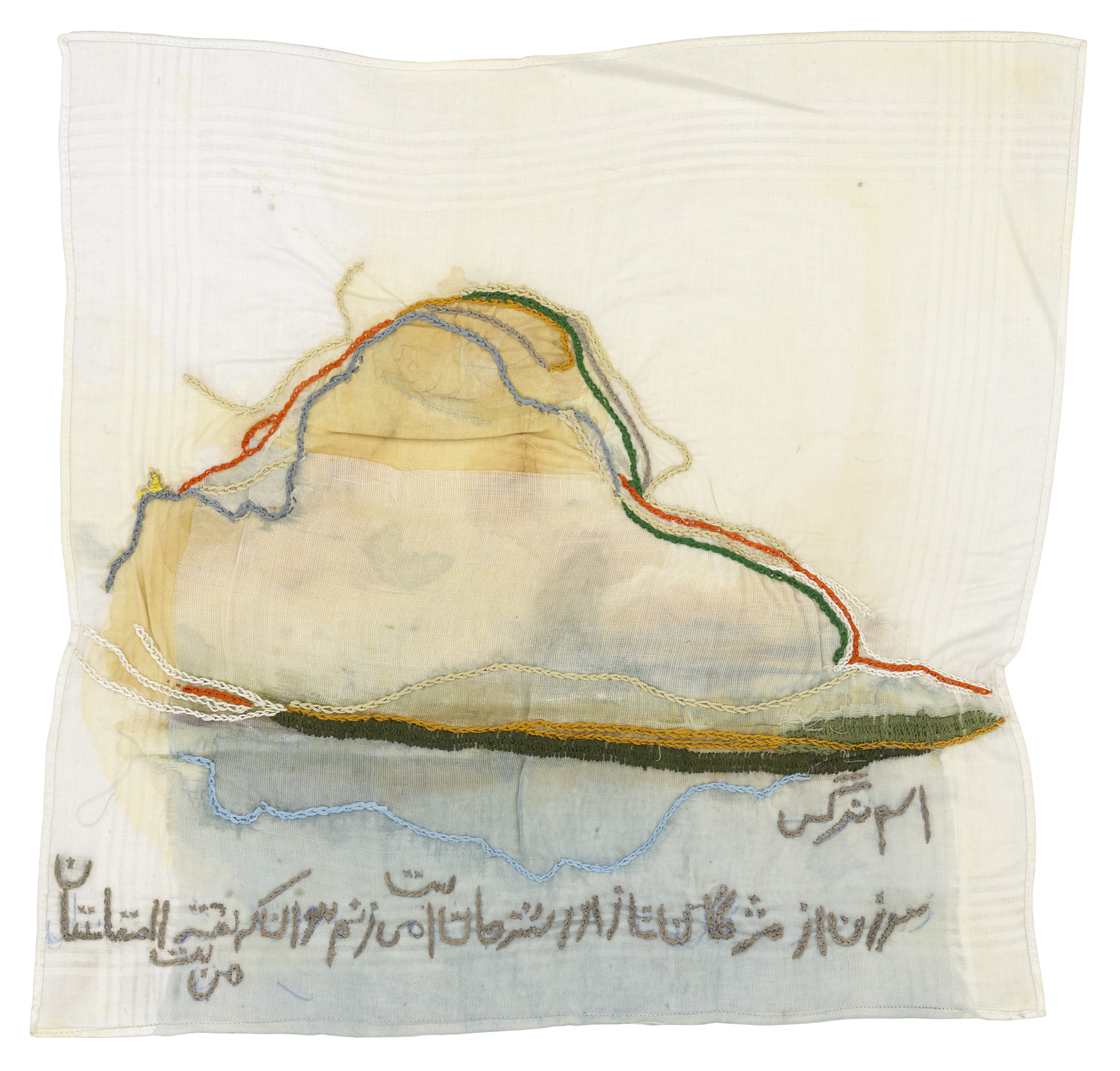
Anne Riggs & Nurgus, I wish for peace (2017–18, watercolour, ink, pencils, fabric, embroidery thread, 39 cm x 38 cm)
Women's voices, 2017-2018
‘Making Marks: Australia and Afghanistan’ was a 2017 arts exchange project between artists in Australia and women undertaking literacy and vocational classes at the Organisation of Promotion Afghan Women’s Capabilities (OPAWC) in Kabul.
Each work is created on a handkerchief that is a collaboration between two women, Australian artists who created an artwork that was sent to Kabul, where the Afghan women responded with embroidery, often adding words to express their hopes for the future. (Only first names are used for the Afghan artists to preserve their anonymity from the Taliban.)
[The Australian artists] “felt a responsibility to connect to Afghan women living in circumstances of war and immense hardships. By presenting and exchanging our personal worlds of art and text we were creating a meeting place – despite the challenges of difference – in the space of an artwork.”
Gali Weiss, artist and project coordinator
Trooper Cooper, 2010-2011
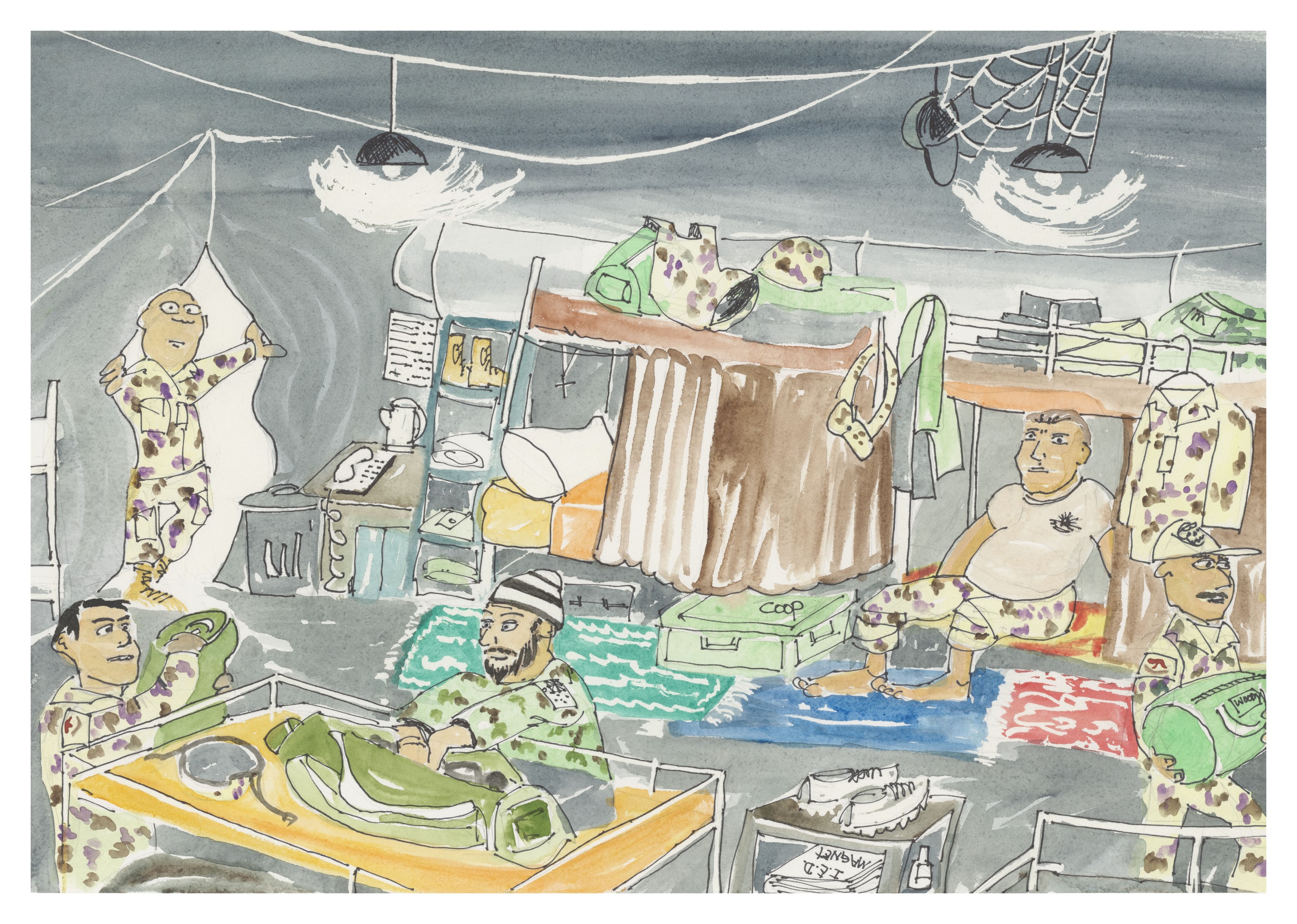
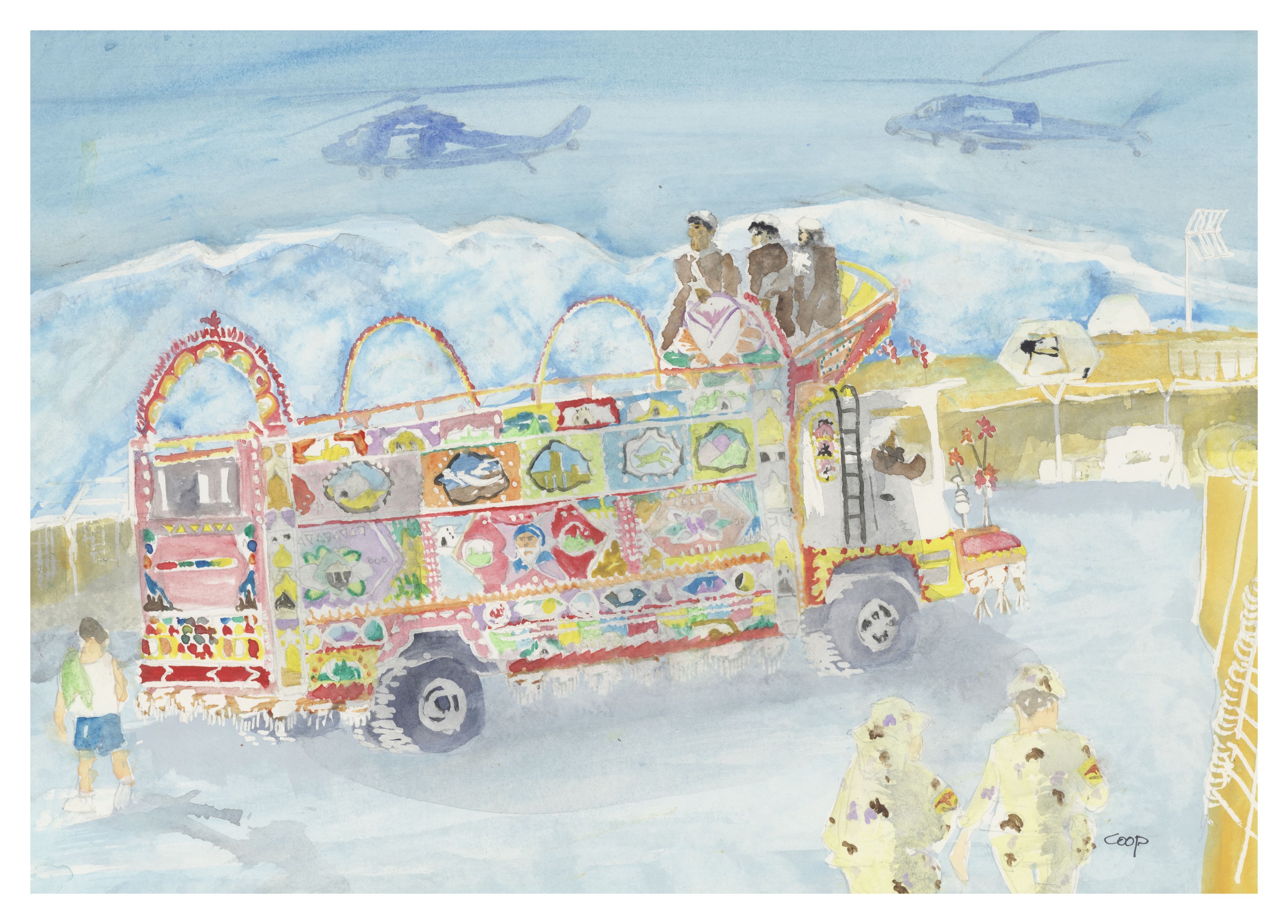
Trooper Robert Cooper deployed as an ASLAV gunner with 2 Cavalry Regiment as part of MTF-2 (Mentoring Task Force – Rotation 2), based in Uruzgan Province in 2010–11. He meticulously documented his service; afterwards he created 346 watercolours depicting his experience of war, from before he left until he returned home. He donated the entire series to the Memorial, an invaluable record. In addition those exhibited, a digital display enables visitors to explore more.
His works include depictions of military action, but also what daily life was like in the military and in Afghanistan. The examples here show accommodation while on patrol – sharing a tent in Uruzgan – and the common sight of a ‘jingle truck’, the highly decorated trucks that travel throughout Afghanistan and Pakistan, each an expression of their owner’s personality and background.
![Robert Cooper, not titled [Alpha Patrol] (2011, watercolour, gouache, pen and pencil on paper, 30 cm x 41 cm) AWM2020.205.40.22](/sites/default/files/styles/in_content_square/public/images/2026-07/1280-awm20202054022-7.jpg.webp?itok=W88BAKsJ)
Robert Cooper, not titled [Alpha Patrol] (2011, watercolour, gouache, pen and pencil on paper, 30 cm x 41 cm) AWM2020.205.40.22
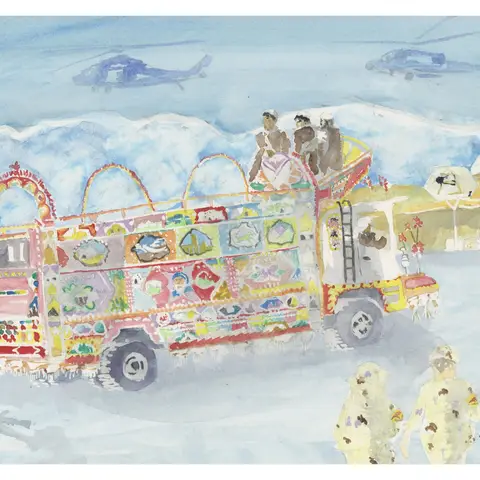
Robert Cooper, A jingle truck (2011, watercolour, gouache, pen and pencil on paper, 30 x 42 cm) AWM2020.205.40.124
Kat Rae, 2021
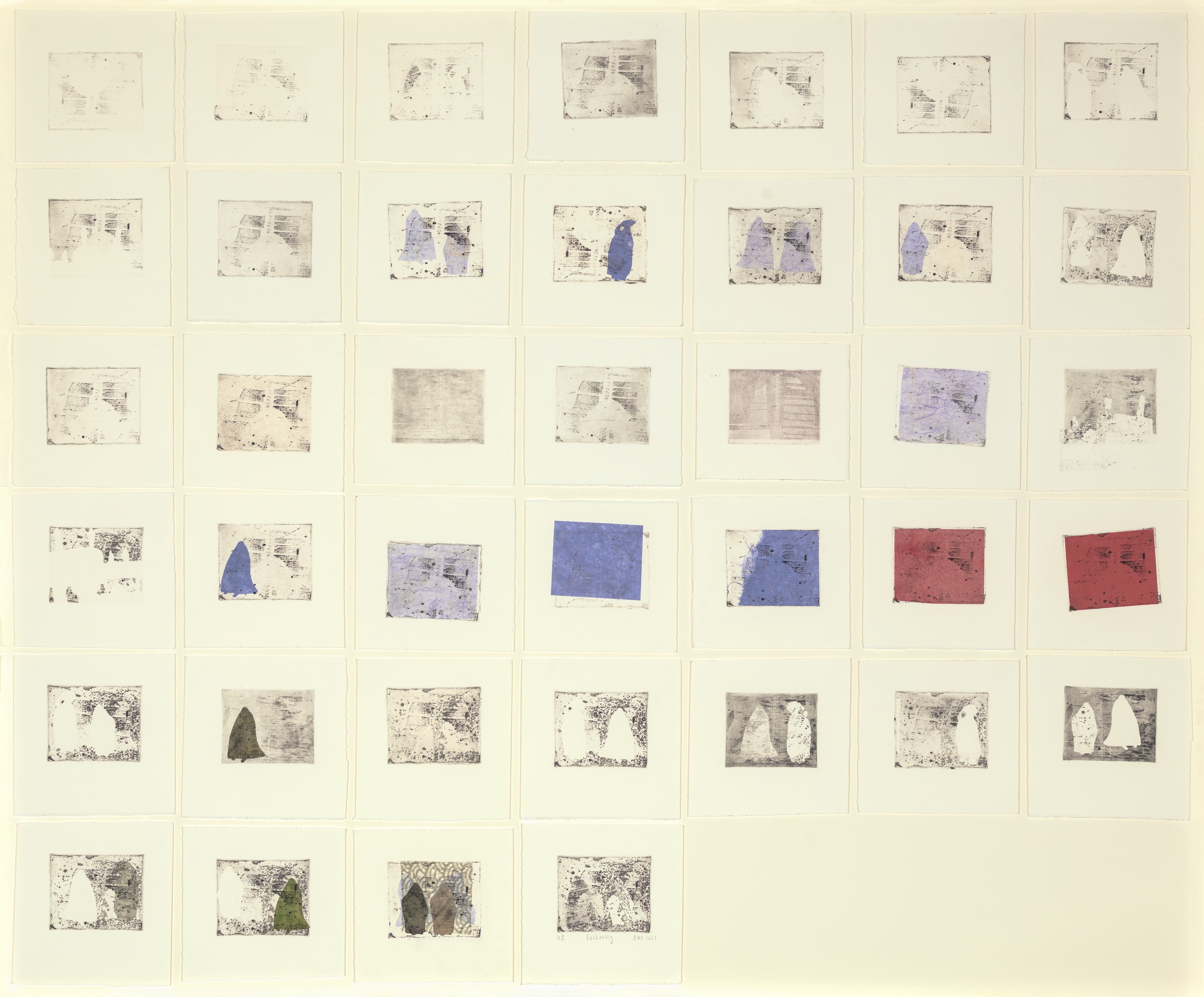
After 20 years of service in the army, with deployments to Afghanistan and Kuwait, war veteran Kat Rae was studying to become an artist when the Inspector-General of the Australian Defence Force Afghanistan Inquiry Report was released in 2020.
The 39 prints represent the Afghans who the report found were allegedly unlawfully killed by Australian Special Forces soldiers. Rae combined images of the redacted report and the Australian War Memorial, contrasting the alleged events with the high esteem in which many Australians hold military service, to express the challenge she believes the nation faces in response.
She felt the complexity of etching techniques reflected that situation, alternating between printing with the plate and then further exposing it to acid; each time the acid further ate away the metal plate, altering the next print.
“I saw a ribcage and spine in the redacted statements laid over a hollow in an image of the Australian War Memorial. Was that a grainy aerial photograph of a foreign war zone? The acid-burnt holes grew like multiple shotgun wounds across the work’s landscape. I added women in burkas who represent war’s ‘collateral damage’. The Brereton Report finds us ‘all diminished’. Despite the sickening gravity of what happened, my artwork urges us to courageously reckon with the unvarnished truth.”
Kat Rae
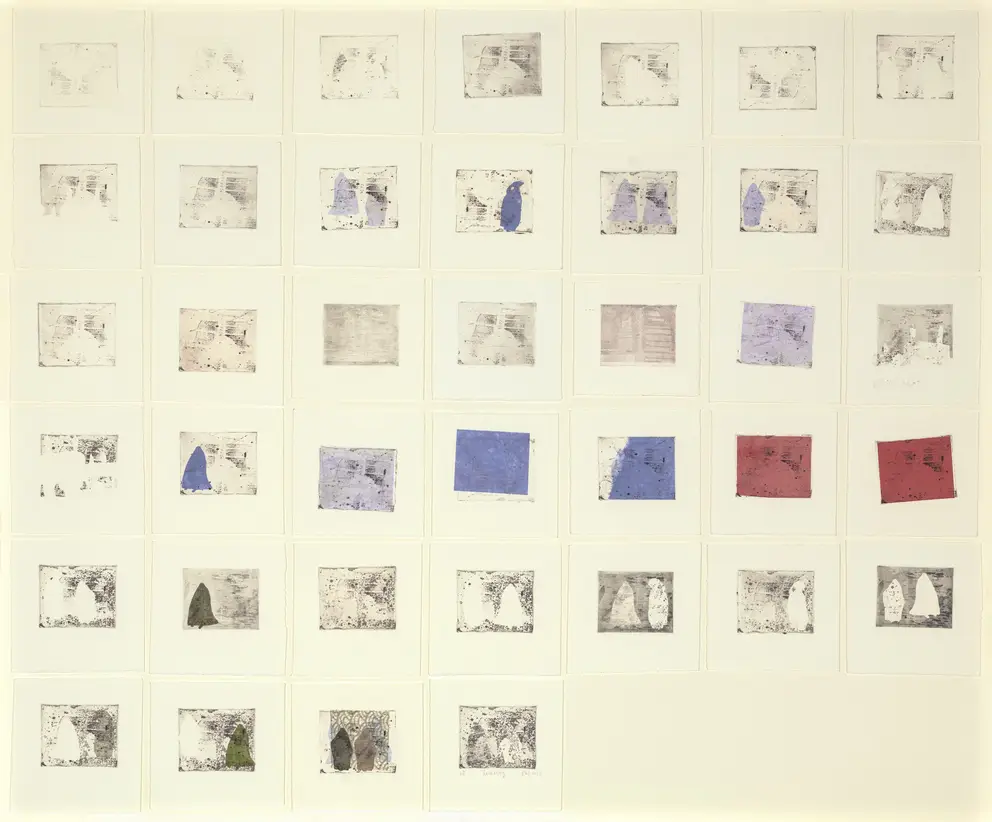
Kat Rae, Reckoning (2021, 39 photographic etchings with chine collé and stencilling on Somerset, overall: 1342 mm x 1603 mm) AWM2022.1307.1
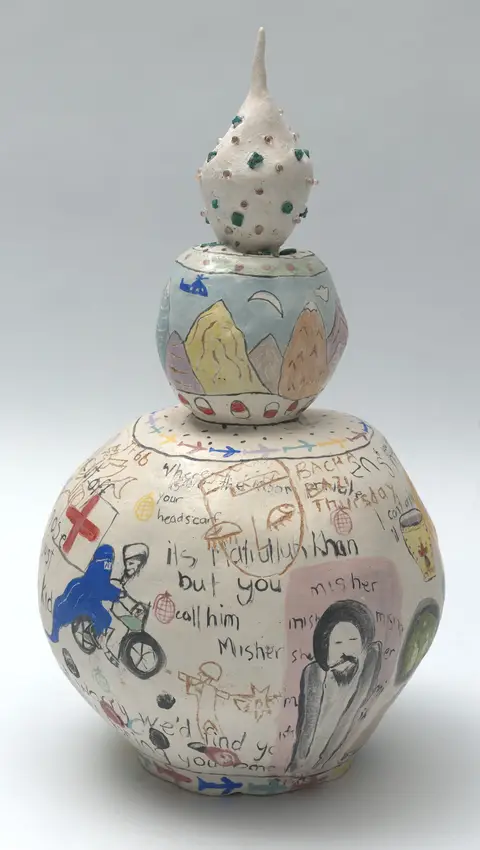
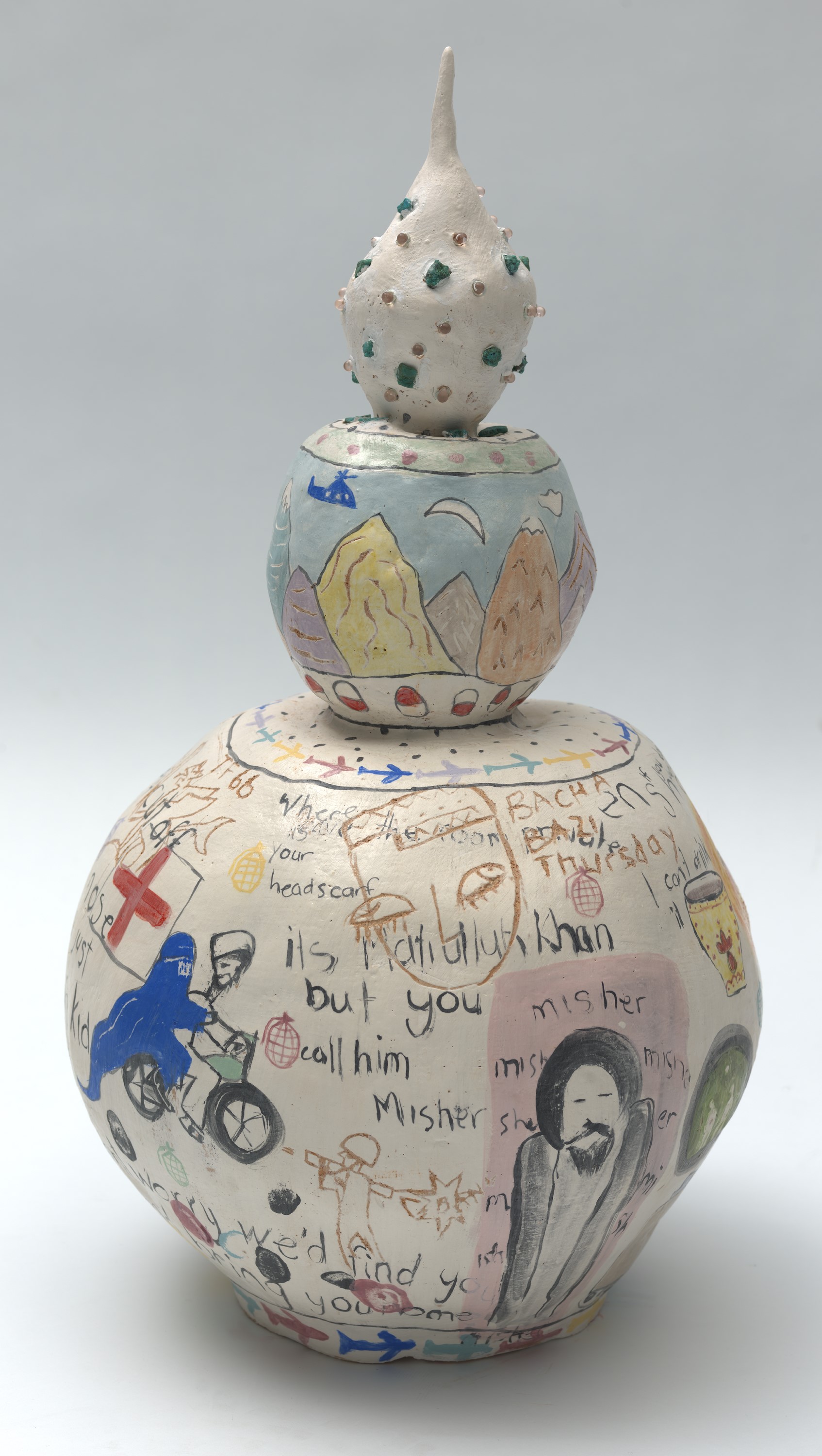
Natalie Duncan, Memory Jug – Afghanistan (10 October 2017, Ceramic, glass, stone, 60 x 34 x 34 cm) AWM2018.1267.1
Natalie Duncan, 2018
Natalie Duncan deployed to Afghanistan as a combat photographer in 2009 – the first time she had left Australia. Here she expresses the memories of a complex, overwhelming experience of war – each illustration on the ceramic surface an individual memory. Among them: “Watching the boys go outside the wire for days and knowing there’s a hundred ways an IED could be hidden beneath their feet”; “Getting rocketed, and sleeping through it”; “Wishing I didn’t have boobs as I put on my Kevlar”; “Freezing on Piquet”; “Being able to pick the ones on their third or more rotation”; “Little ones with half melted faces”; and “The only woman I saw, floating in a sea of blue material on the back of a motorbike”.
She created Memory Jug - Afghanistan for the Memorial's 2018 Napier Waller Art Prize, in which it was highly commended.
“It was inspired by the war rugs that you see in Afghanistan … I can’t weave, I make ceramics, so I put my own war rug on the ceramic, and each little illustration is from a memory of my time there.”
Natalie Duncan