What is big, green, and powerful enough to lift a stripped-down Black Hawk helicopter?
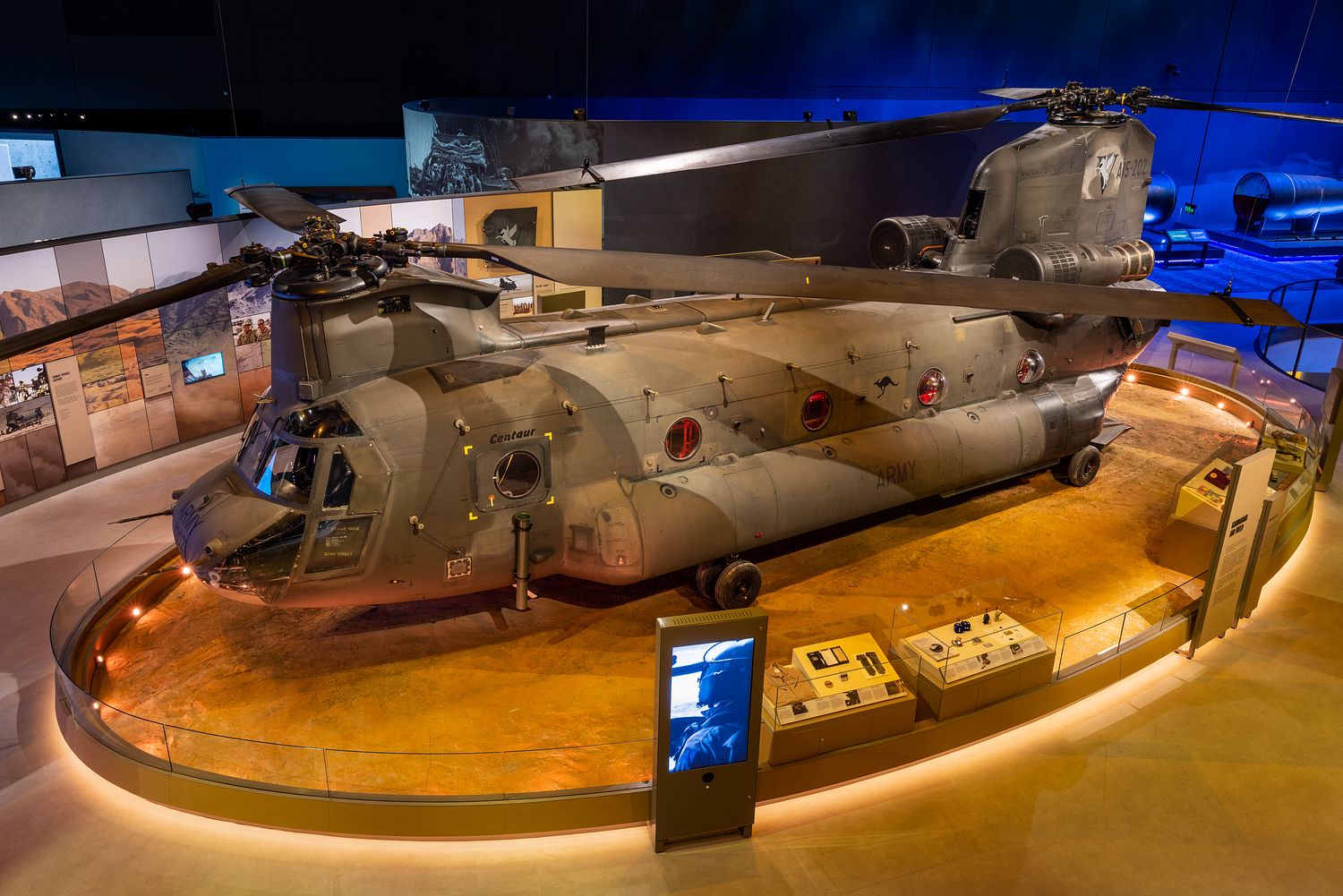
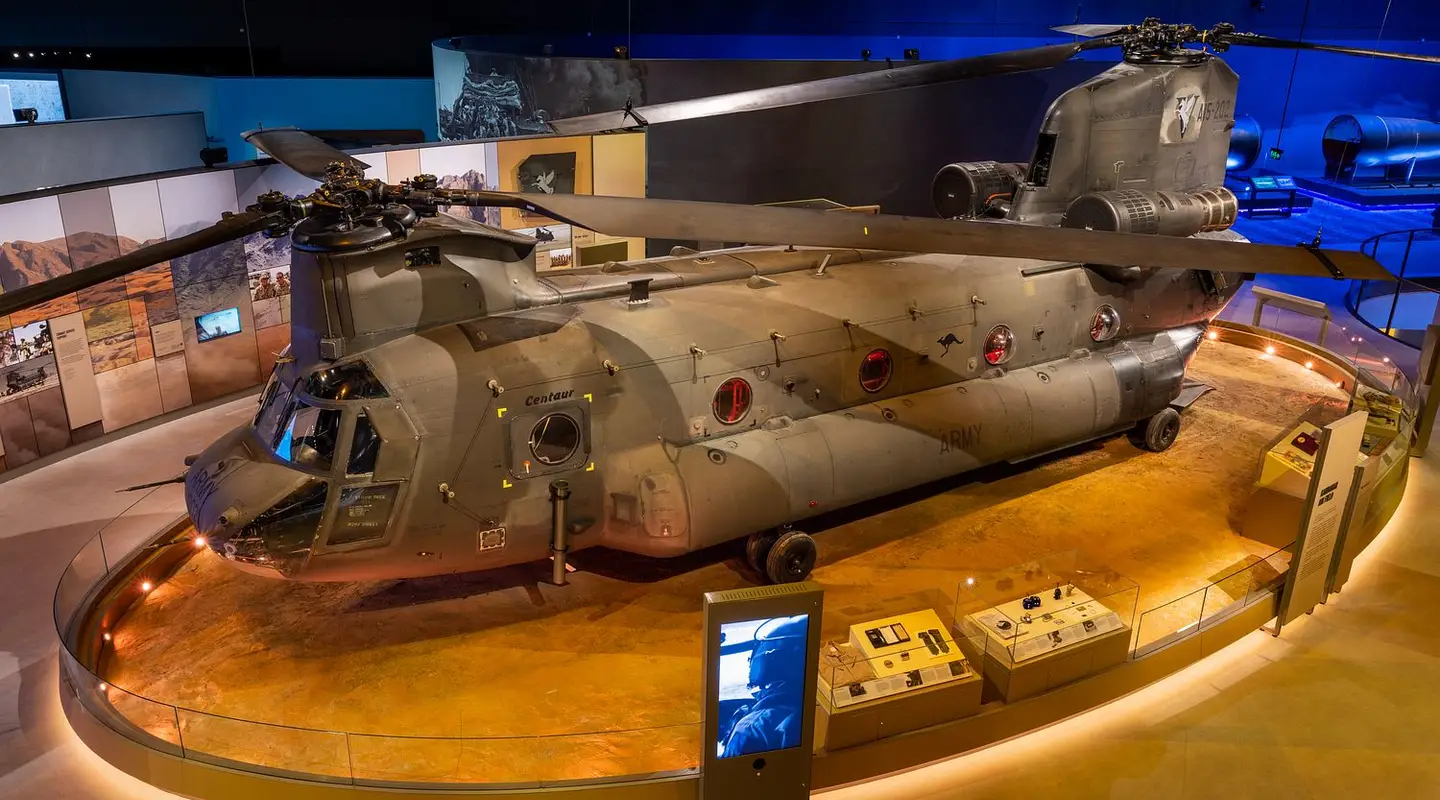
The Australian Army Boeing CH-47D Chinook A15–202.
“202” was one of the first two Australian Chinooks that deployed to Afghanistan in 2006. It subsequently completed three other rotations to Afghanistan and was damaged during a Special Forces operation, hit by three rounds, in 2009. A15–202 served with the 5th Aviation Regiment from 2000 to 2016. On its retirement from the army, the aircraft’s final flight was from Townsville in northern Queensland to Canberra, where it became part of the Memorial’s collection.
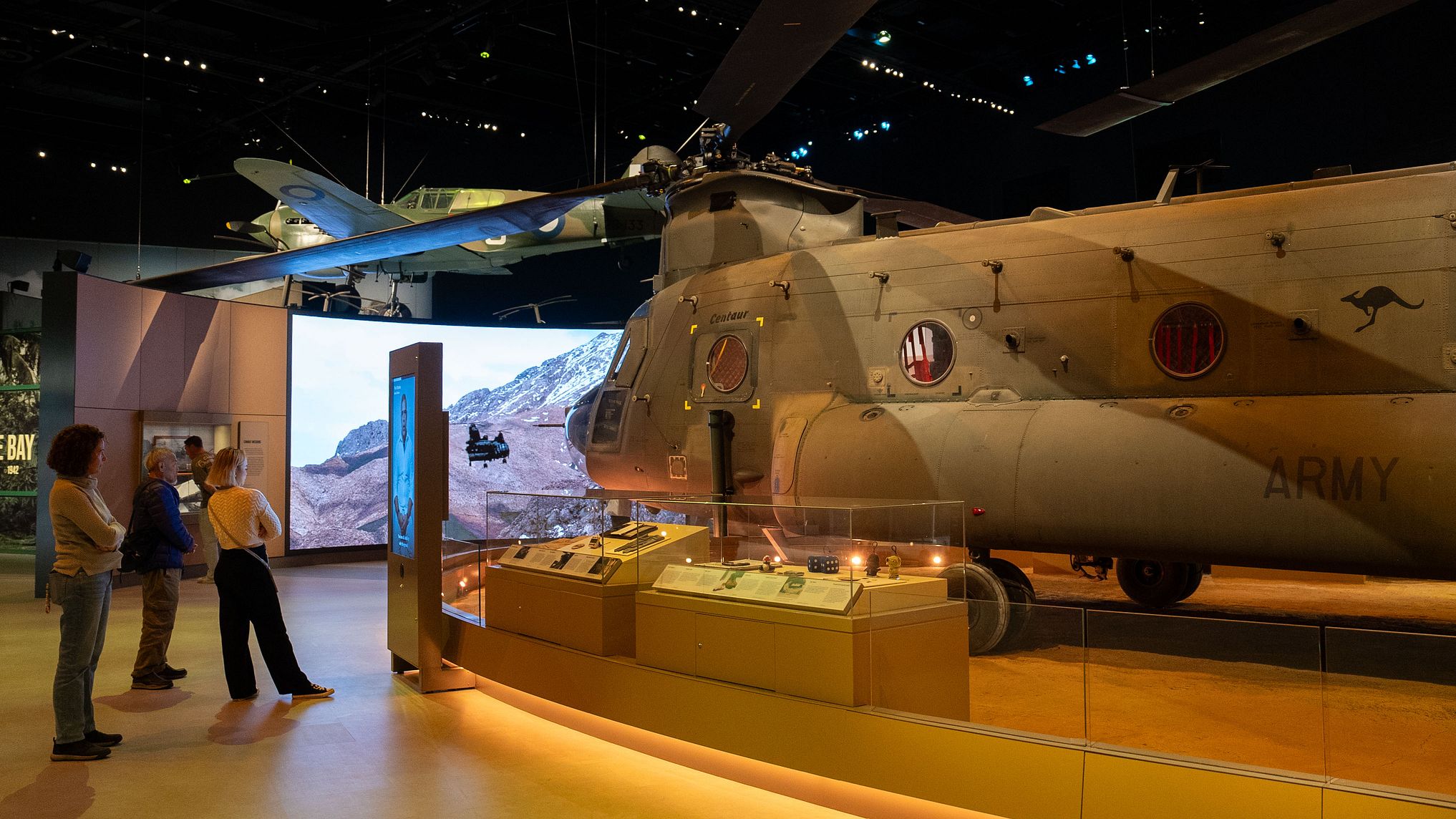
A15-202 is the centrepiece of the new exhibition Kandahar Workhorse: Chinooks 2006–2013. Emblematic of the war in Afghanistan, the sight and sound of a Chinook is well known to all who deployed to that conflict, and to anyone who has served in the Australian Defence Force since the mid-1970s, when Chinooks were first operated by the Royal Australian Air Force.
"When you get into a Chinook you can feel the engines, you can feel the heat, you can smell the hydraulic fluid. You’re a part of that piece of machinery. You really feel everything that goes on around you."
Sergeant Scott Norton
For the crews who operated them, Chinooks were more than powerful machines. Long hours in the air meant finding practical ways to manage the demands of the job.
Veteran Rod Henderson recalls one such solution: a drink cooler fitted with a cushion that became a makeshift seat for crew members operating the minigun. The crew called it a ‘fatigue management device’.
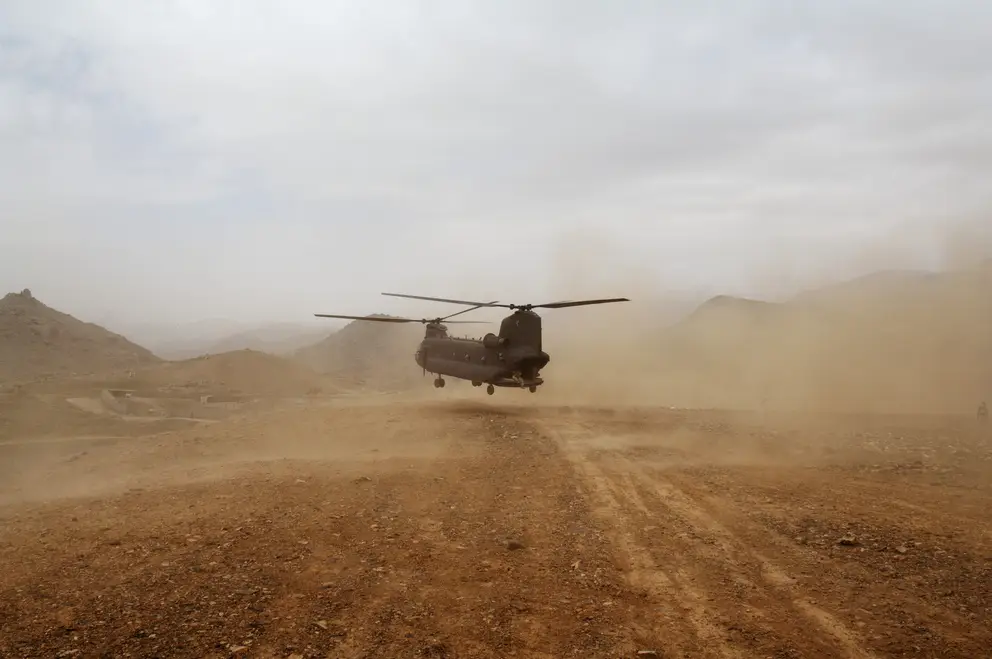
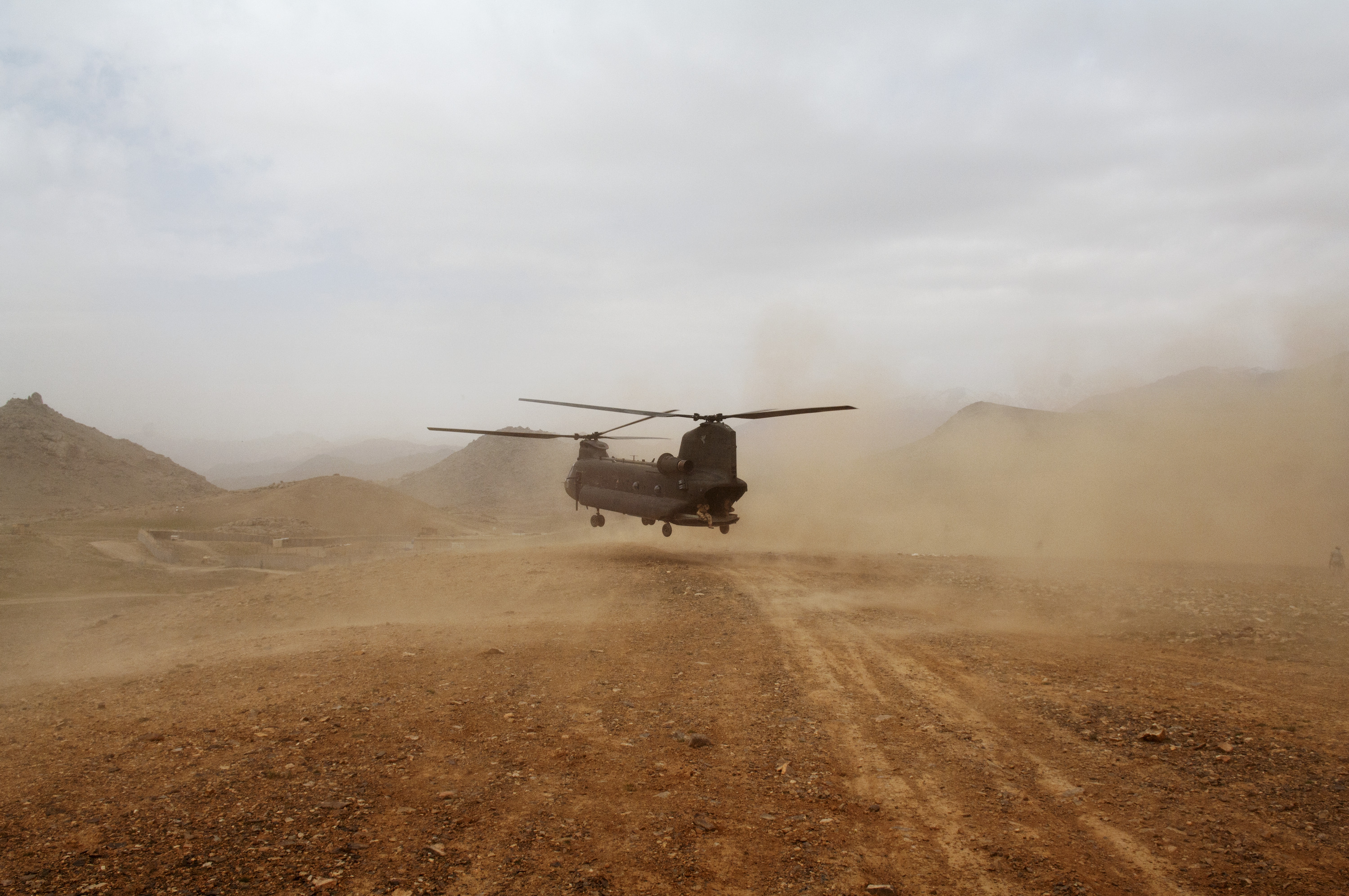
Australian Chinook A15-202 in Zabul province, Afghanistan, 30 March 2007. Photograph by Sean Hobbs, official war photographer to Iraq and Afghanistan 2007. AWM P05730.454
The Australian Army first deployed a detachment of Boeing CH-47D Chinooks to Afghanistan in 2006. These medium-lift helicopters achieved a reputation as fast, versatile and reliable workhorses.
Based at Kandahar, the Australian Chinooks and personnel supported NATO-led International Security Assistance Force (ISAF) efforts across southern Afghanistan. Conducting combat and logistic operations by day and night – carrying troops, supplies, vehicles and equipment – they endured high-altitude flying conditions, searing summers, freezing winters, enemy fire, rocket attacks and dust. Day-to-day the biggest threat in Afghanistan was the environment.
“The dust in Afghanistan was not like sand. It was quite fine, talcum powder-like. You would lose all visibility to the ground.”
Captain Alexis Tooms
Pegasus V
Townsville-based C Squadron, 5th Aviation Regiment, was home to the Australian Army’s fleet of six Boeing CH-47D Chinooks. Each year between 2006 and 2013, two Chinooks from the squadron, with personnel from the regiment and Army Aviation, were sent to Afghanistan.
The rotations varied from four to eight months. Maintaining the cycle of preparing, deploying to (and receiving people and aircraft from) Afghanistan was challenging, with personnel regularly away from family and friends.
Simultaneously, the 5th Aviation Regiment also operated other aircraft, including Black Hawk helicopters. In addition to its Afghanistan commitment, the regiment sent personnel to Solomon Islands, while aircraft detachments deployed to Timor- Leste and Papua New Guinea.
Operation Bastille and Falconer
Earlier in the decade, three Australian Chinooks had been sent to the Middle East in 2003 as part of Australia’s commitment to the United States-led invasion of Iraq. They were there to support Australian Special Forces, and the deployment was shrouded in great secrecy.
Personnel underwent an intense, punishing physical training regime prior to deployment. When the aircraft arrived in the Middle East, however, they were considered ill-equipped for combat operations in Iraq, and instead undertook transport tasks in Jordan. This deployment, however, did provide invaluable experience for those personnel who went to the Middle East before their commitments to another war zone.
"A fantastic coalition asset"
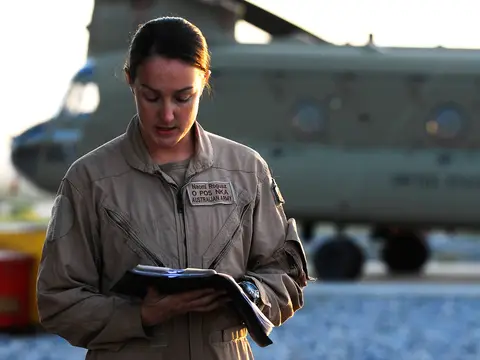
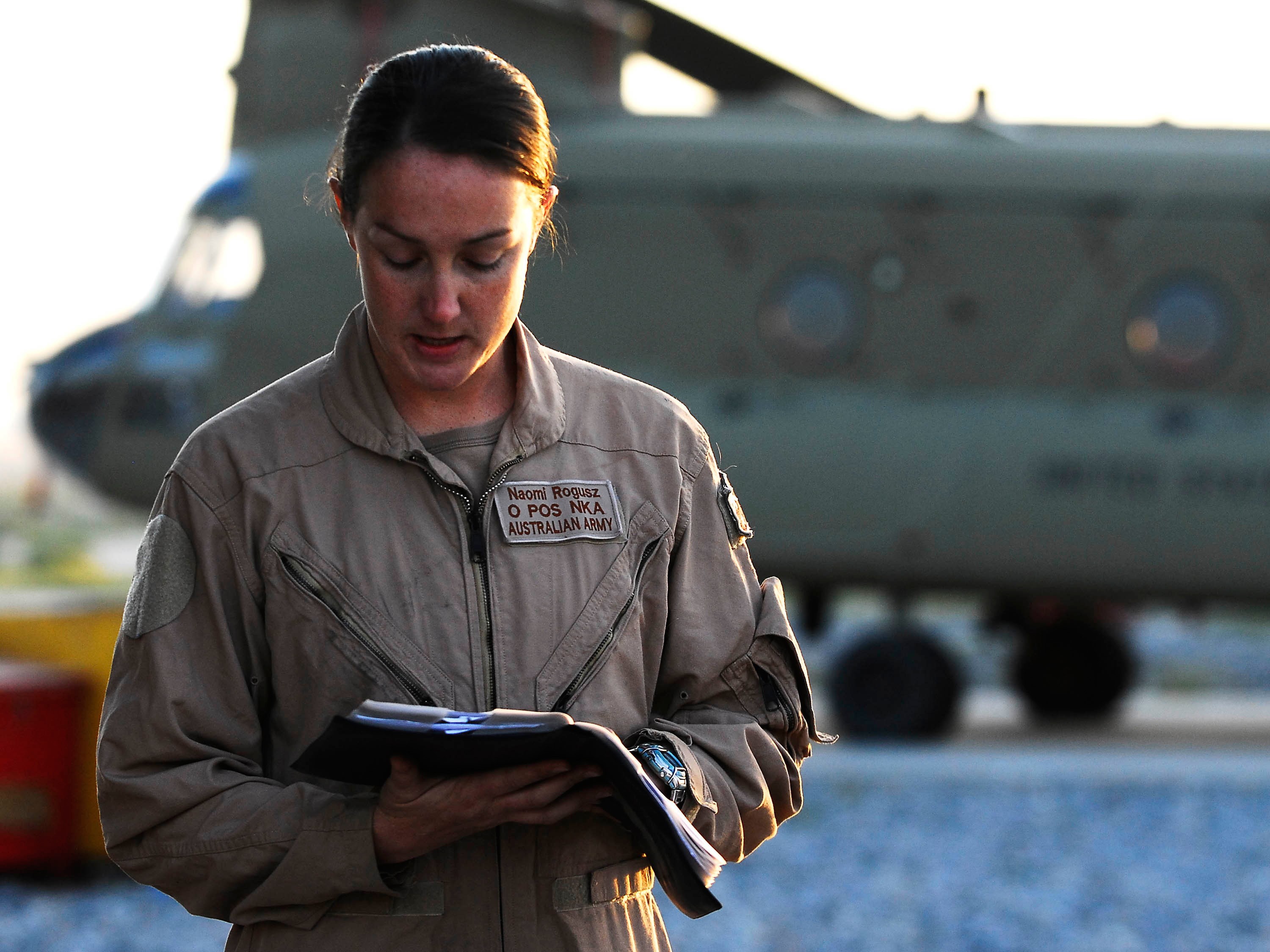
Chinook pilot Captain Naomi Rogusz in Afghanistan, 18 June 2009. Photographer: Dave Connolly, courtesy of the Department of Defence. 20090618adf8083167_189
Three years later, in January 2006, the Australian government announced that two Chinooks and 110 personnel would deploy to Afghanistan as part of Australia’s commitment to that conflict. The deployment was undertaken in recognition of the United States forces’ need for transport helicopters.
Having learned a great deal from the Middle East deployment in 2003, preparations were already underway. Australian Chinooks were upgraded to incorporate state-of-the-art navigation, communication and electronic warfare systems. They also incorporated ballistic protection, mini-guns, and later the GPS tracking system, Blue Force Tracker. Such upgrades made the Australian Chinooks the “aircraft of choice”.
The first Australian Chinooks of Aviation Support Element (ASE 1), known as “Rotation 1”, arrived at Kandahar Airfield in March 2006 and became part of a larger American force.
Kandahar Airfield
Kandahar Airfield – or KAF – was the base for the NATO-led International Security Assistance Force in southern Afghanistan.
A remnant of the former Soviet occupation of Afghanistan – and later used as a civilian airport – KAF was a sprawling multinational base with contingents from Britain, Canada, France, the Netherlands, Singapore, Slovakia, Romania, the United Arab Emirates, and the United States. During the conflict, KAF became one of the busiest military airfields in the world; by mid-2011 it housed 35,000 troops. It was often hit by Taliban or insurgent rockets, by mortar fire, or by suicide bombers.
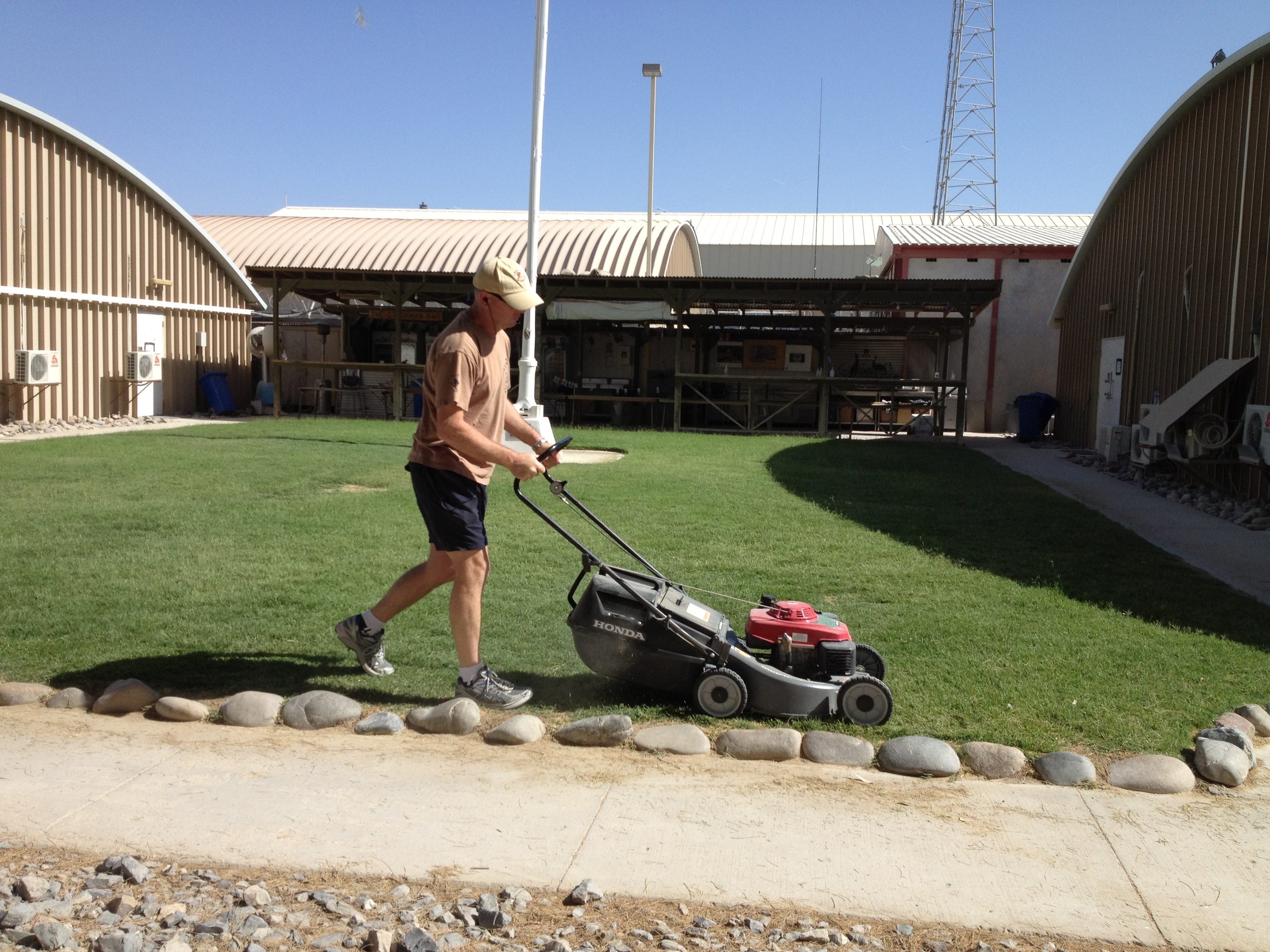
The Australians were in the southeastern corner of Kandahar Airfield in an area called Camp Baker. Named in memory of Corporal Michael Baker, who had died during a Black Hawk training accident in 1996, Camp Baker became home to the Chinook detachment and other Australians based at Kandahar. Conditions were initially basic, but new facilities were quickly built, and a grass quadrangle became the heart of the camp. It was widely known for having the “greenest grass in Kandahar”.
Facilities at KAF included restaurants and cafes along what became known as The Boardwalk – as well as gyms, medical centres, an Afghan weekend market, and the infamous “stinky ponds” waste-water treatment plant.
At KAF, Australian elements at various times included the Chinook detachment, a Heron unmanned aerial vehicle detachment, Special Forces soldiers, communication and force support teams, medical personnel, and members of the RAAF.
Call signs "Patriot" and "Brahman"
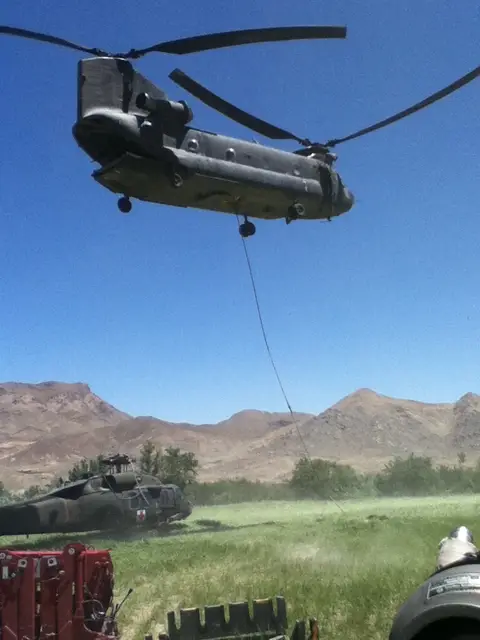
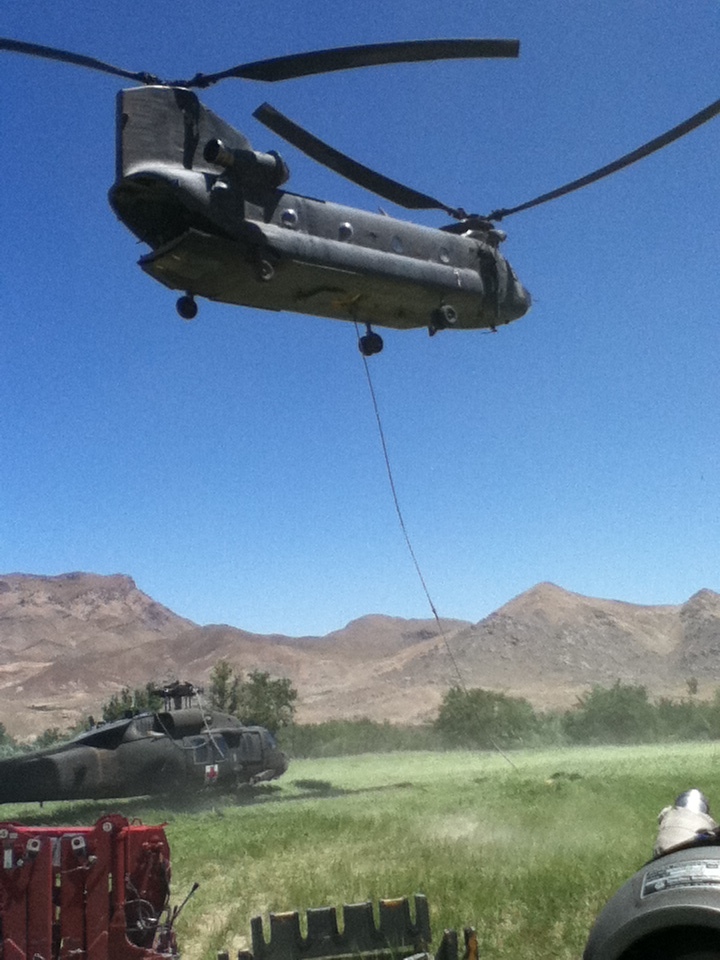
Australian Chinook A15-102 prepares to transport a downed American Black Hawk helicopter, Zabul province, 30 May 2011. Photographer unknown. AWM2021.181.2.4
The Australian Chinooks were part of a larger pool of American and NATO aircraft operating as part of an American aviation task force. The Australians were given the call sign “Patriot” for their first three deployments in 2006 and 2007. Their Chinooks provided air support for ground forces in Kandahar, Uruzgan, Helmand, Zabul and Paktia provinces. Tasks included carrying Special Forces on combat missions, transporting food and fuel between bases, shuttling soldiers and civilians, assisting in the recovery of downed aircraft, and conducting aeromedical evacuations.
The third Australian Chinook rotation, Aviation Support Element 3 (known as Rotation 3) deployed to Afghanistan in 2006–07 with a small group of medical personnel. They worked in the trauma hospital at Kandahar, as well as on American aeromedical evacuation flights recovering wounded people from the battlefield. While those flights were usually conducted by American Black Hawk helicopters or British Chinooks, Australian aircraft also carried the wounded, injured and deceased. On 30 March 2006, the crew of Chinook A15-202 conducted a flight that saved the life of a critically injured Afghan girl.
In 2008 the Chinook detachment was renamed the Rotary Wing Group (RWG) and used the call sign “Brahman”. There were eight RWG rotations between 2008 and 2013, with 60 to 70 people per group.
Combat missions
Australians flew many combat missions in Afghanistan, particularly during their early rotations. Those missions were dramatic and dangerous, and often involved Special Forces.
Direct actions, air assault or air mobile support (known as “DAs”) involved carrying troops into action – “infill” – and back again – “exfill”. After just over two months in Afghanistan, in June 2006 the Australian Chinook detachment flew its first DA with American forces. It was the first Australian helicopter combat mission since the Vietnam War. Flying in A15–104, one of the Australian pilots noted the action in his logbook simply as “DA”.
A dramatic early combat mission was DA Nile in July 2006. The Australian Chinooks, carrying Australian and Coalition Special Forces, mounted a night assault against a compound; their mission was to kill or capture a Taliban commander, code name “Objective Nile”.
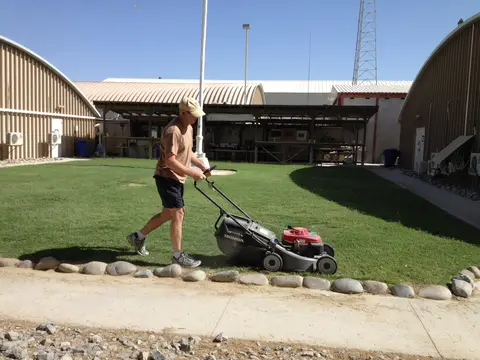
Sergeant Andrew Reid at Camp Baker, 2012. Photograph by Sergeant Rod Henderson.
An intense battle ensued. DA Nile has been described as “one of the most astonishing operations conducted in Afghanistan”.
Other combat missions carried out by the Australian Chinooks included Operation Rattey, conducted with Australian Special Forces in Daykundi Province in June 2008, and Operation Tyruna in August 2009, in which Chinook A15–202 carried British soldiers in Helmand Province.
Only a few days earlier, A15–202 was one of four CH-47s involved in Operation Castnet, a Special Forces action in the Mirabad Valley of Uruzgan Province. A15–202 had just inserted Australian commandos into a “hot landing zone” when it was hit by enemy fire and began to leak aviation fuel. An American Chinook was also damaged. Both aircraft made it back to the multinational base at Tarin Kowt.
Combat service support
Australian Chinooks conducted various types of missions in Afghanistan. Known as “hash and trash”, combat service support was their most common mission type. They delivered soldiers, ammunition, food and water, mail, equipment and anything else needed to supply forward operating bases and patrol bases across southern Afghanistan. Flight routes to different bases were colour-coded like intersecting transport routes. The Brown Ring from Kandahar included Tarin Kowt, and the Purple Ring from Kandahar stopped at Camp Bastion.
Combat support
Combat support involved the delivery of equipment for troops to support their combat operations in the field. This work included slinging heavy loads, such as damaged vehicles or shipping containers, on hooks beneath the Chinook. On 21 May 2006, for example, Chinook A15-104 evacuated injured Australian SAS soldiers and recovered their IED-damaged Long Range Patrol Vehicle, known as “One Fitty”. The vehicle is on display in the Memorial's War in Afghanistan exhibition. Chinook A15-104 is on display at the Australian Army Flying Museum in Oakey, Queensland.
Two from two
In addition to the command, operations and aircrew, the Chinook detachment also included groundcrew to fuel and arm the aircraft as well as technicians and craftsmen of the Technical Support Troop (TST) who maintained and repaired the aircraft, and specialist aviation logistics staff.
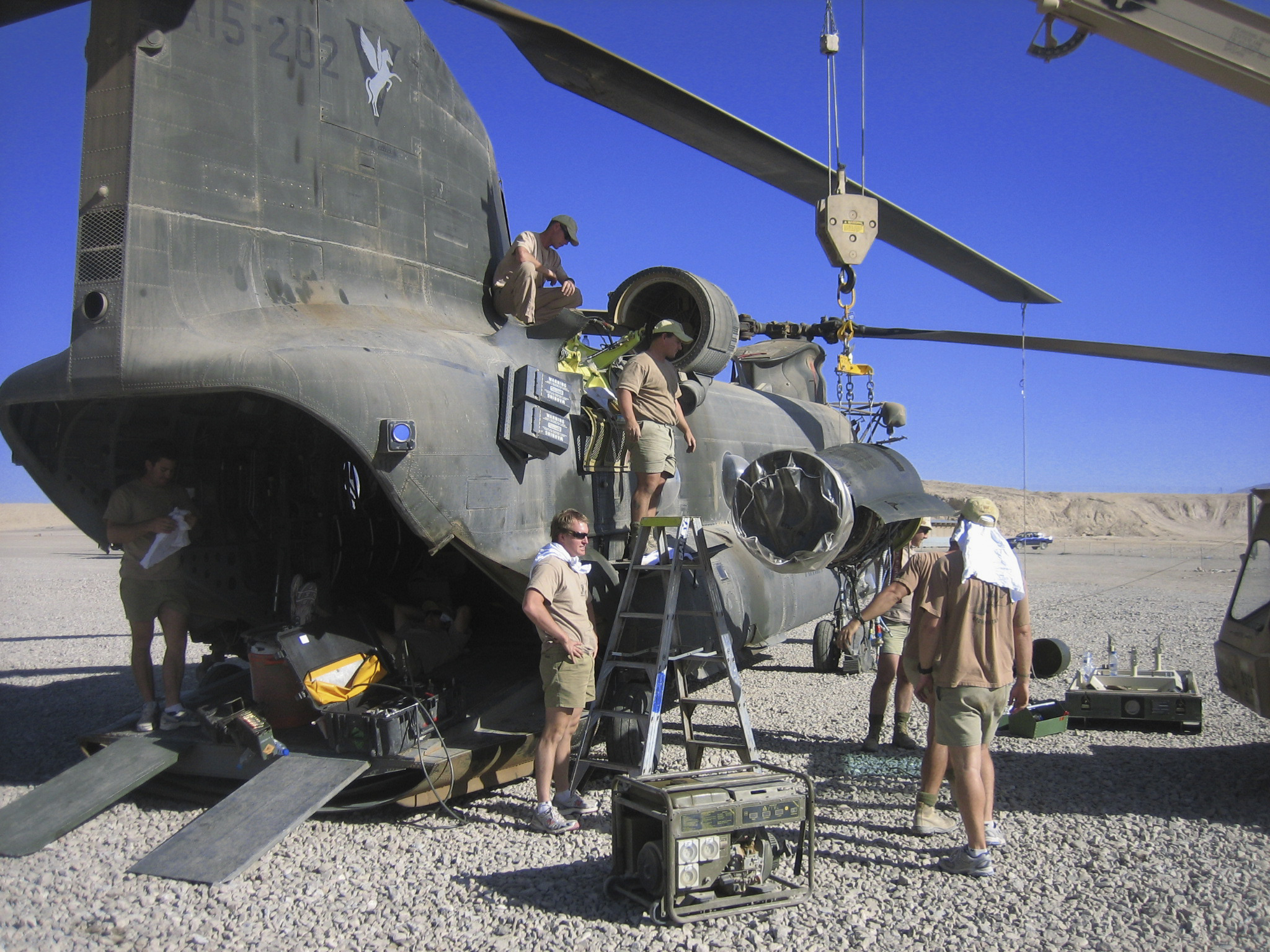
The maintainers of the Technical Support Troop took great pride in doing their best to keep both Australian Chinooks – “two from two” – ready for tasking. Battle damage and broken landing gear were repaired, along with damage from bird strikes, dust and a hailstorm.
Aircraft maintenance was often conducted in the open at Kandahar and, on occasion, at Tarin Kowt. As Corporal Jeremy Summers remembered, “early in the year it would be freezing” (in winter) and they would be trying to work with gloves on.
Then in summer with soaring temperatures, the “actual skin of the aircraft would get ridiculously hot. And you couldn’t climb the aircraft with bare hands because it [the metal] would burn.” Jeremy Summers deployed to Afghanistan four times.
When necessary, maintenance work was done in the field, beyond the fortified airfields at Kandahar or Tarin Kowt. It was essential to be able to make complex in country repairs, and the ability to carry out deep maintenance on Chinooks in-country was developed. In winter, when most personnel returned to Australia, a small group known as the “Night Watchmen” remained at Kandahar to maintain the facilities and equipment during the coldest weeks.
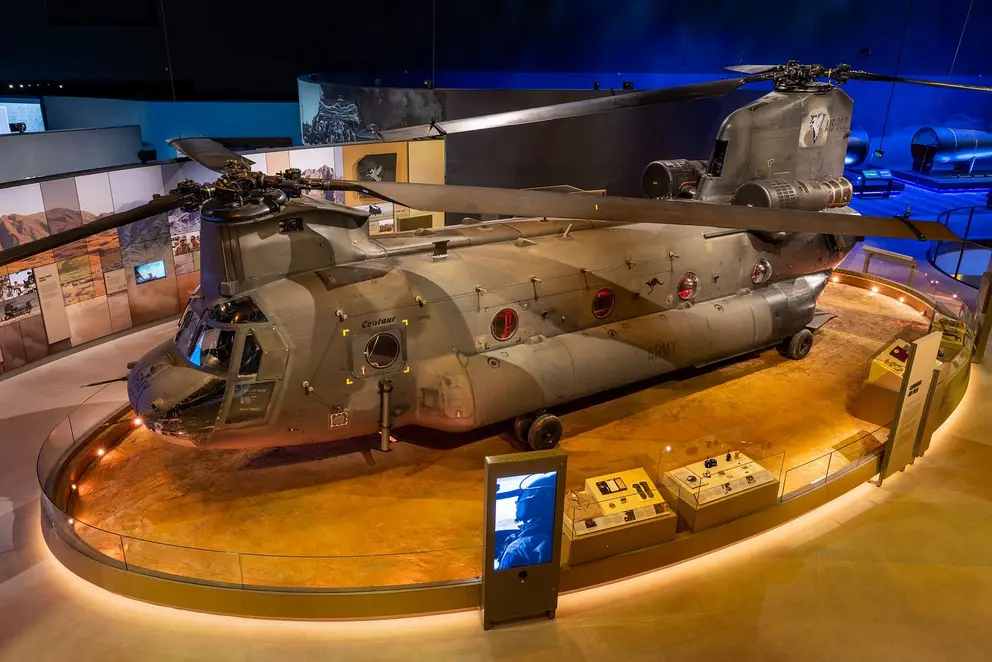
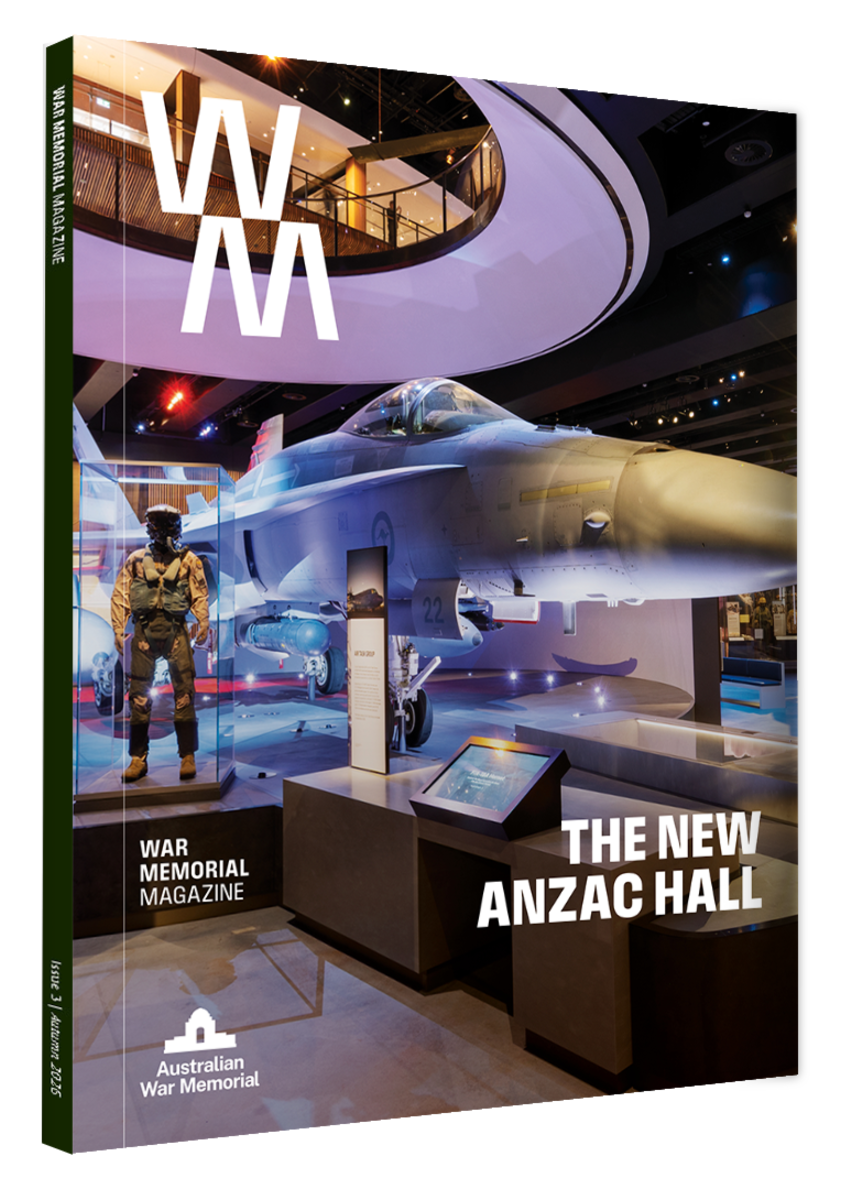
Kandahar Workhorse: Chinooks 2006-2013. Photograph taken by Ian Roach. AWM26.PR.034
Lieutenant Marcus Case
Flying in Afghanistan was dangerous. On 30 May 2011, Chinook A15-102 was conducting a Combat Service Support resupply mission to forward operating bases in southern Afghanistan. On board the aircraft that day for an in country familiarisation flight was 27-year-old Lieutenant Marcus Case. A pilot from the 6th Aviation Regiment, Case had recently deployed to Afghanistan as a Heron unmanned aerial vehicle operator.
In-flight, A15-102’s task changed to a mission involving the recovery of a downed American Black Hawk in Zabul Province. A15-102 recovered the disassembled Black Hawk in sections, but on the last run the Chinook developed major oscillations and began to pitch up and down violently. The pilots managed to land the Chinook, but it rolled over and caught fire. Case was thrown from the ramp but remained tethered to the aircraft. He died from his injuries.
Chinook A15-103
A year later, on 22 June 2012, Chinook A15-103 was transporting personnel around Kandahar Province when it made an emergency landing at a forward operating base. The aircraft hit hard, collapsing the right-side landing gear, which caused the forward rotor blades to strike the ground. Fuel began leaking and there was a danger the aircraft could catch fire. All 27 on board – the five aircrew and 22 US soldiers – survived.
A veteran of the 2003 Middle East commitment, A15-103 had already deployed multiple times to Afghanistan. In 2010 it was hit by ground fire during an operation. Some passengers were wounded but the aircraft made a safe landing. Following its crash-landing in 2012, however, the aircraft was considered unrepairable. The wrecked A15-103 was afterwards used as a training aid at Kandahar.
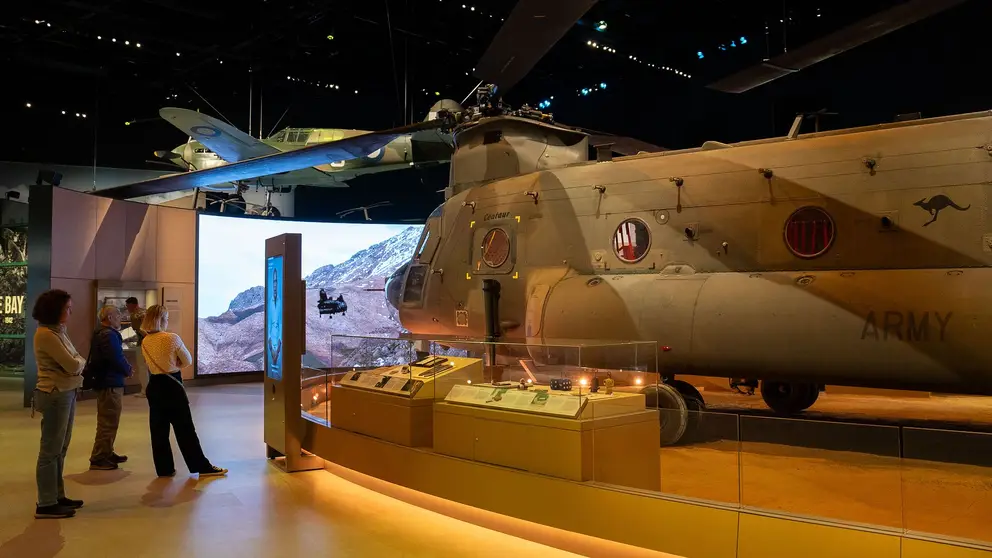
The Chinook on display.
Challenges for exhibition team
Australian Chinooks completed over seven years of operations in Afghanistan, with 11 rotations and hundreds of individual experiences. Four of the six Australian Chinooks are now known to have been hit by enemy ground fire; two Chinooks crashed, and one Australian was killed. How do you research, interpret and represent in a museum such a broad range of service and varying experiences?
The official histories of Australia’s war in Afghanistan are yet to be published; the documents are still closed to the public, and the Memorial’s Chinook-related collection was limited. We knew the exhibition would be based around A15–202, but what should or could be displayed? How would we learn about the topic?
These were some of the questions Emily Hyles and I asked ourselves in late 2021 when we took on the responsibility for curating what became Kandahar Workhorse.
During the three years that we worked intensively on the curatorial development of the exhibition, we met more than 100 Chinook veterans and family members. This engagement was vital to building our knowledge of the subject and our confidence, and helped our approach to the exhibition’s themes and the stories we wanted to tell.
Exhibition themes
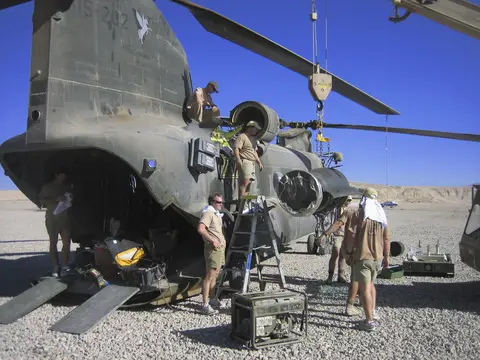
Ground crew work on replacing one of A15-202’s engines, Kandahar Airfield, October 2009.
Photographer unknown. AWM2022.175.16
We set about developing an exhibition that highlights the personal experiences of pilots, aircrewmen, maintainers and ground crew. We described the mission types, including combat missions, as well as life at Kandahar.
On display are 177 separate objects, nine multimedia (films and digital object labels), and an aircrewman mannequin. Sixty-six people are mentioned by name in the exhibition, including family members as well as service personnel.
Personal stories
Easily rating among the highlights of developing this exhibition has been meeting and getting to know members of the Chinook community.
Among this group are the nine veterans we interviewed for three new films that have been produced for the exhibition. These films allow the veterans themselves – the pilots, aircrewmen, groundcrew and maintainers – to talk to visitors about their own experiences in their own words.
Some amazing people
With the withdrawal of Australian combat forces from Afghanistan, RWG8 completed its rotation in October 2013. The Australian Rotary Wing Group had flown over 5,600 mission hours, carried more than 30,000 passengers, and transported 5.5 million pounds (nearly 2.5 million kilograms) of cargo in support of Coalition and Australian troops across southern Afghanistan.
Visitors to Kandahar Workhorse will discover previously untold Australian stories of bravery and loss, professionalism and humour. As we were regularly reminded by Chinook veterans, the exhibition needed to be about people, not the aircraft.
At the end of the day, it [the Chinook] is machinery. What makes it operate is people. And you get to find and meet and know some amazing people.
Warrant Officer 1 Lee Maloney

About the author
Dr Karl James
Dr Karl James is the Head of Military History at the Australian War Memorial, Canberra.