Art, war and the human experience.
Discover the story behind Coming out on the Somme and the artist who chose to show war differently.
In this video, art curator Anthea Gunn explores how Will Dyson, the first Australian official war artist to visit the Western Front, captured the lived experience of soldiers during the First World War. Rather than focusing on dramatic battle scenes, Dyson documented exhaustion, hardship and the human cost of war.
Take a closer look at Coming Out on the Somme to better understand why it remains significant and how it reflects Dyson’s perspective as an official war artist.
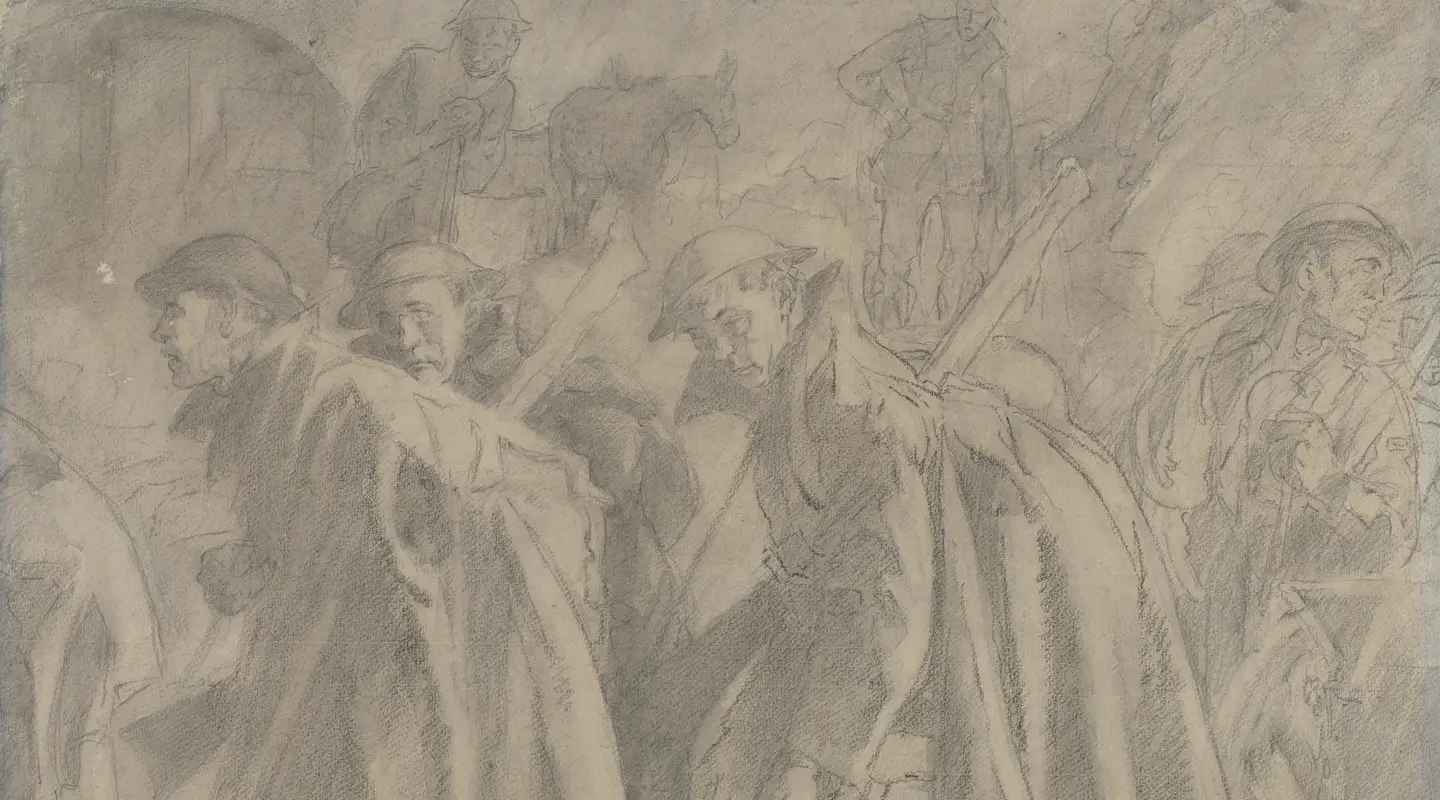
This work is called Coming Out on the Somme.
The work was created by Australia's first official war artist, Will Dyson, on his first trip to the Western Front in December of 1916.
At that time, the Australian forces were bedded down in the trenches to get through the winter before the fighting would ramp up in the summertime, and that's when exchanges of territory would happen between the German and the Allied forces.
In the summer of 1916, the Australians had advanced over the area which included the village of Montauban, which is where Dyson found himself in December, and he saw these men come out of the trenches, which is what the title refers to, and they walked about six kilometres across all that ground that had all been stirred up because it had all been fought over in the months before, which meant it had been pounded with artillery, so that horrible Somme mud.
And then what they're going to look forward to is a few days in this village of Montauban, which had also just been bombed.
So, this work, while its overall sort of just grey, as your eye lingers on it, you are drawn into it, and slowly so many of the lines are drawing you to these men's faces, and especially this gentleman at the centre.
And Dyson wanted to capture the sense of how the men were just utterly detached and just trudging back from the front lines, and so I think he nailed that.
When you look at these faces, you see that I think people that are just overwhelmed by the experiences, you know, what they're living through, and they've just got their heads down and just taking one step at a time and just trying to get through it.
And so, the way that Dyson has created this sort of overall sort of trudging sense of greyness, I suspect that's probably how they were feeling.
Dyson clearly wanted that record of how awful war was. That very common theme that we see from everyone that experienced the First World War was it should be the war to end all wars. Sadly, that wasn't to be the case.
And the other significance of this drawing is that it's actually one of the first things that was created with the idea of the Australian War Memorial in mind.
This drawing meant that they had to kind of have a place to store things, and it started to fulfil this intention that many people shared, that there needed to be a museum of some kind where Australia's First World War experiences would be captured.