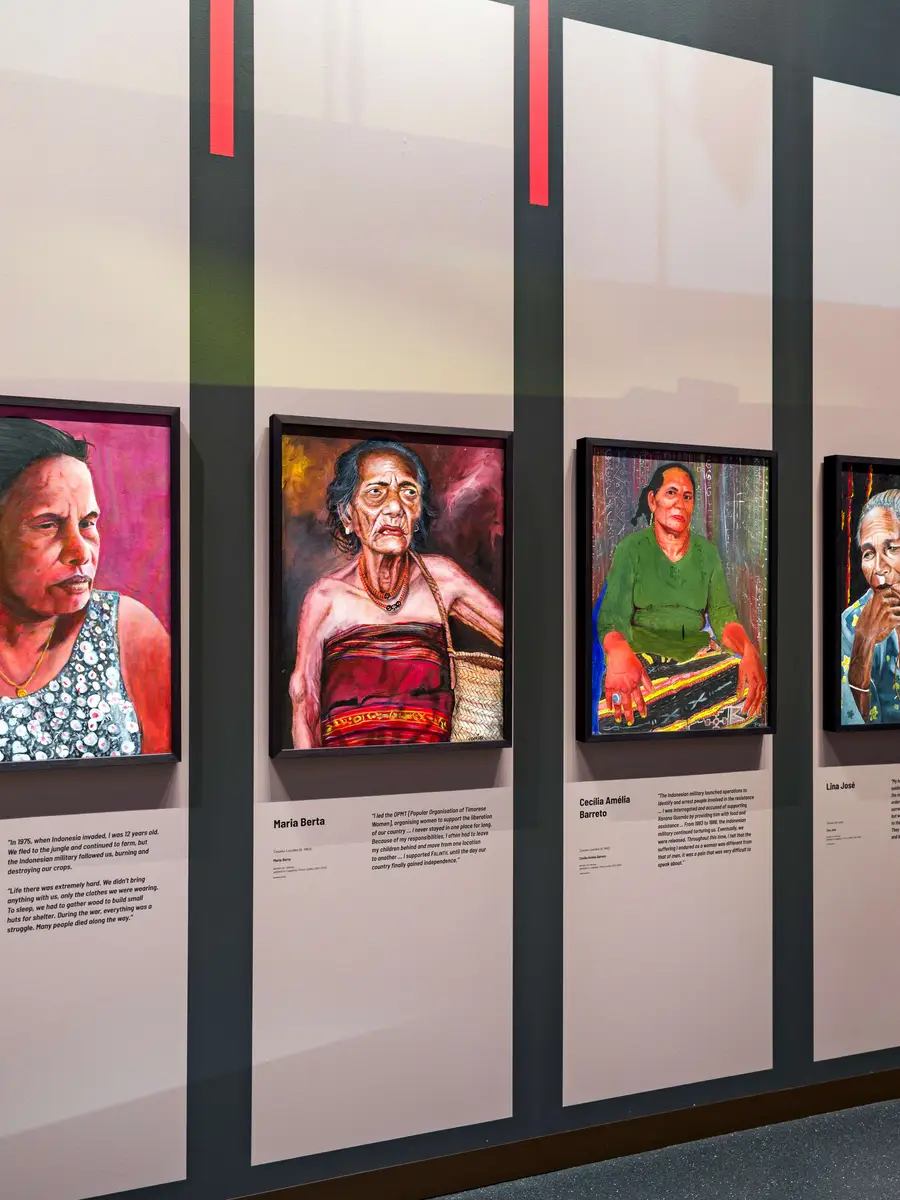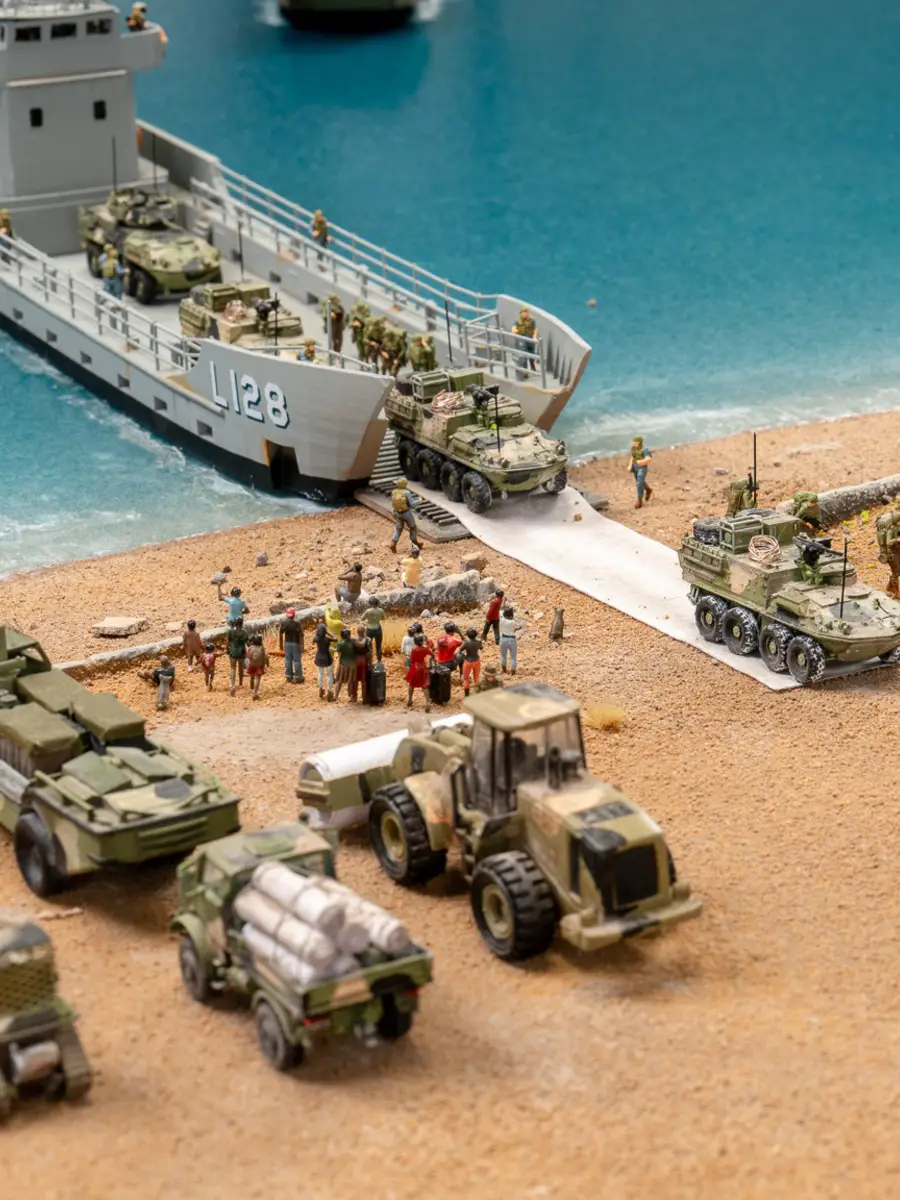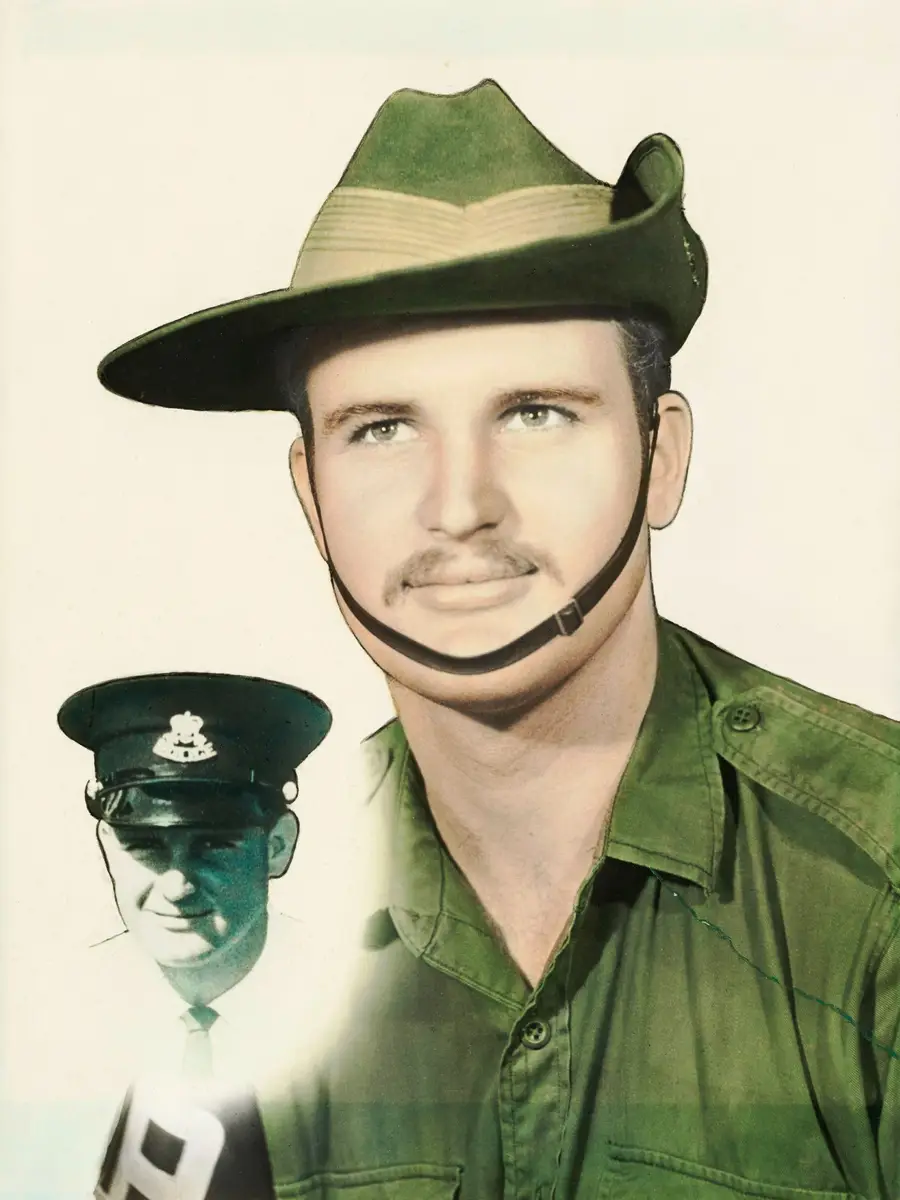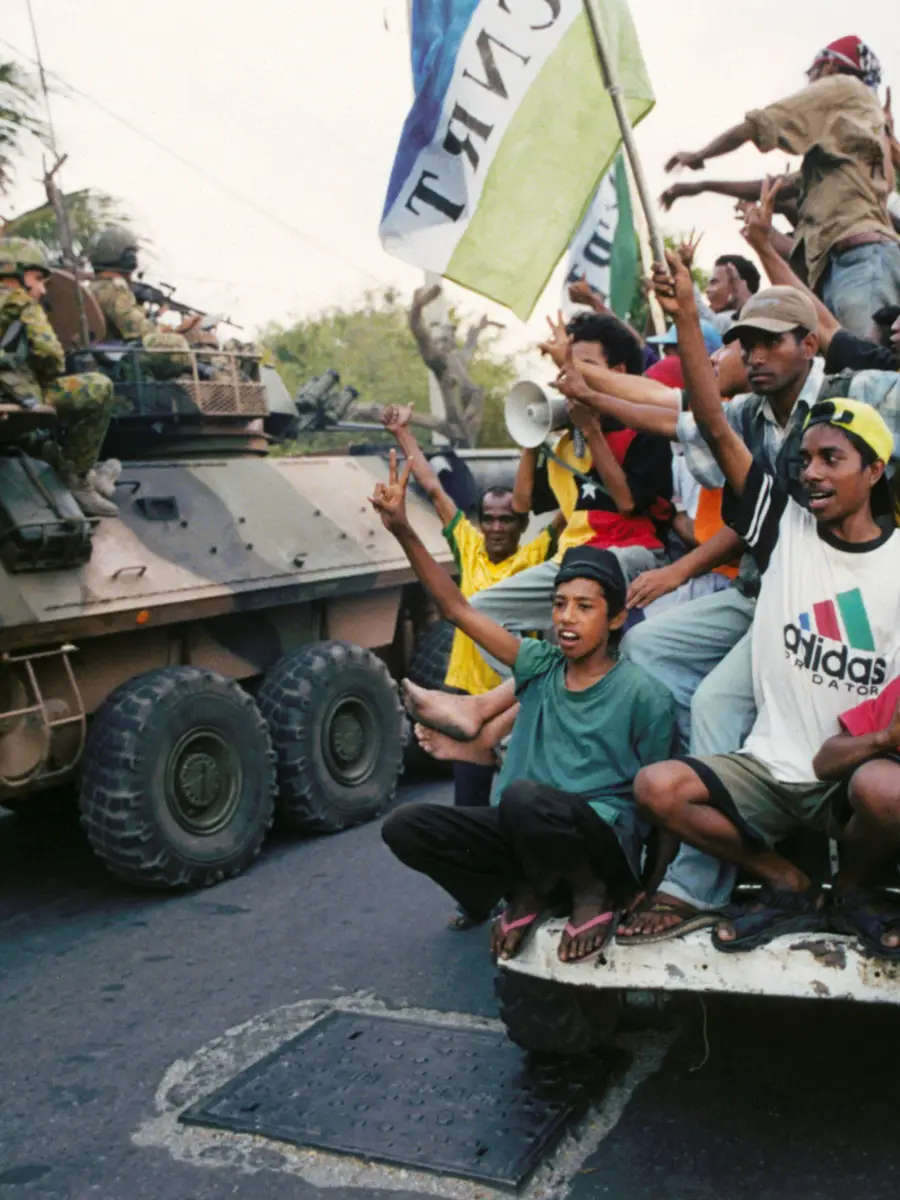
What does it really take to make and keep peace? From Rwanda to East Timor, discover the stories behind peacekeeping, the dangers faced by those who serve, and the lasting impact on the communities they strive to protect.
Voice Over:
Through Their Eyes shares real-life experiences of war, some of which may involve sensitive or distressing subject matter. Themes may include violence, death, trauma and loss.
We aim to share these stories with care and respect, but please take your wellbeing into account while listening. If you need support at any time, visit our show notes for resources.
The Australian War Memorial acknowledges the traditional custodians of Country throughout Australia. We recognise their continuing connection to land, sea and waters. We pay our respect to Elders past and present.
We also acknowledge the veterans who have served, those that are still serving; and the families that love and support them.
This episode is brought to you by the support of Leidos Australia.
John Barrington:
The voices you’re about to hear are those who have served on peacekeeping missions, lived through conflict, or witnessed firsthand the impact of efforts to build and maintain peace.
Anab Mohamud:
What we found as toys to play with, or things to use for games were bullets on the floor. Collecting them and coming together and showing each other how many we've collected or how many numbers we have. And that was, for us, the most joyous, funnest, happiest moments as children because we didn't know nothing else at that moment.
David Savage:
In these countries we can we can always leave. They've got nowhere to go. And that's why protecting them and doing whatever you can for them is so important, because that's all they have.
Don Barnby:
When they saw our headlights through the mist, they were fearful that we were Indonesian police or military vehicles. When they knew it was the UN, they just erupted in a cheer. There was about 2000 people waiting, and faces were coming out of the mist to come up and hug us.
Michael Maley:
If you've never lived in a country where fear is pervasive, you simply don't understand how corrosive that is of day-to-day life. People constrain their thinking. They constrain their discussions and conversation. Life becomes condensed into a much-reduced version of what we enjoy in a free country.
Norman Laing:
We went from town to town and individual to individual, and these people that we were confronted with, were scared and broken. We were men in uniform, and we had to repair the trust and the human connection with these people to assure them that we were there to support them. That was our role.
Mohammed Abdur Rahman:
You are a lawyer. You are a peacekeeper. You are a teacher. You are a social worker. You are a diplomat. It was part of your training.
Tamara Sloper-Harding:
The friendships that developed not only gave us an insight into what was going on out in the districts from a work point of view, but it also helped us understand the culture of the people and relate to them on an equal level as friends, rather than these people who've come in to save them. Go in there to enable them to live their lives freely themselves.
John Barrington:
I’m John Barrington, and these are the stories of the people who lived through conflict, served in its aftermath, and worked to build and maintain peace. Welcome to Through Their Eyes.
When people think of military service, they may often think of this as fighting wars or defending our own nation. However, another important role that Australians have served in, for nearly 80 years has been as peacekeepers. Ending a conflict is one thing, building a lasting peace is another. AWM historian, Doctor Dr Sutton explains the role peacekeepers play in the space between the two.
Dr David Sutton:
So, there's actually no official UN definition of what peacekeeping is. But, you know, at its most simple, peacekeeping operations are operations where troops or police or other government workers are sent to somewhere in the aftermath of a conflict to help prevent the renewed outbreak of war, and sometimes to actually help bring an end to that war, as part of a neutral multinational force.
It's usually needed when there's been a conflict that's been ongoing, that’s really been a difficult problem to solve. And the international community uses the powers of the UN, although not always the UN, there can be regional peacekeeping operations to do what they can to help people in the aftermath of war.
In it's very basic. it's the world coming together to help people to recover from war and conflict. And it's something that Australians have done for a very long time.
At the Australian War Memorial, we use the umbrella term peacekeeping. But there's also lots of different types of peacekeeping under different terms like peacemaking or peace enforcement. When we worked on the gallery here at the Australian War Memorial, we used the broad term peacekeeping because that's something we know people understand, but we also understand that there are nuances and some differences as well.
There's a huge amount of tasks and jobs and roles that peacekeepers can perform. Traditionally speaking, I guess you'd say the main one is what we call military observing. So that's when troops from a multinational force observe a ceasefire between warring parties. They will often be along a ceasefire line or some area which has been demilitarised. Now their job is to basically observe.
So, if they see someone crossing that ceasefire line, they're not necessarily meant to fire at them in nor to stop the renewed outbreak of war, just to report it. Those reports that they make go up the chain, where the leadership of the two warring parties can then have a negotiation, and that's hopefully where mediation can happen and you don't see a renewed outbreak of war. Instead, it gets solved at that higher level. So, it's a buffer between two warring parties to help bring an end to that conflict.
But of course, peacekeeping is incredibly complicated. So, in modern peacekeeping operations, peacekeepers can be election monitors, because having free and fair elections in the aftermath of war can be a great way of ensuring that, you know, war doesn't break out again.
Peacekeepers can be engineers helping to build infrastructure to help bring a country into a better place where people are less likely to have to fight over resources. Peacekeepers can be de-miners helping to remove mines or teach communities how to de-mine in the aftermath of conflict. They can be fully armed, going in and enforcing peace between parties. Or they can be, like I said, performing that observer role. There's a huge range and it's such a complex mission.
What we often find is that peacekeepers come from the military or the police, where they go in with a certain type of training and then find themselves in a really complex place, in quite an intractable conflict, in a part of the world they've probably thought they'd never end up in. So, peacekeepers often have to think on their feet. They're often unarmed, although that's not always the case. They can be soldiers, diplomats, police. There's a huge task before them. But working as part of that multinational team helps them achieve those quite often amazing goals.
Australia actually contributed peacekeepers to the field for the first time in September 1947, in what we consider to be the world's first peacekeeping operations. There's a bit of discussion about what exactly the first peacekeeping operation is. A lot of UN documents say it begins with a deployment to the Middle East in 1948. But if you look at what the Australians did in September 1947, when they're deployed to the Netherlands East Indies, or modern-day Indonesia, it has all the hallmarks of that military observer role, actually creating that craft and that process in the field as part of a multinational force in the aftermath of war. And that fits the definition of peacekeeping that we hold here at the Australian War Memorial.
The involvement in Australian peacekeeping has changed massively over time. There's a huge range that Australians have done. You also see different shifts and trends in Australian peacekeeping. At the end of the Cold War, there's a massive kind of change in the scope and nature of global peacekeeping operations, and that's reflected in the type of operations that Australians are going on. So, at the end of the Cold War, the fall of the Berlin Wall in 1989, for instance, you see a lot more large-scale peacekeeping operations getting through the UN Security Council, which previously a lot of peacekeeping operations had been blocked or stalled through the Soviet Union or America, you know, kind of getting on each other's toes. So, you see these quite big, ambitious deployments to places like Namibia, Cambodia, Somalia and Rwanda.
Then from around the turn of the century, you see a bit of a shift in Australia to the Pacific, where they're not necessarily UN operations, but these are operations in our immediate region where we can see Australia working with other Pacific nations or Asian nations to help solve problems in places like Bougainville and Solomon Islands.
You also see a huge amount of peacekeeping operations to East Timor from 1999 right through to 2012, 2013. So the scope and the size and the type of roles Australian peacekeepers have performed over the years has changed massively. Since that first deployment in 1947, not a single day has passed without an Australian peacekeeper serving somewhere in the field. So, it's a constantly evolving role that Australians are playing, and it's a history which is being written as I sit here and record this.
John Barrington:
Peacekeepers are often required to confront the immediate impacts of conflict, and to serve on the front line of humanitarian crises, where the consequences of violence are most acutely felt. Australian soldier Bob Syron was faced with that horrifying reality in Rwanda.
Rwanda is a small, lush and mountainous country in East Africa, known as the Land of a Thousand Hills. In 1994, the country was devastated by genocide. Over the course of around 100 days, extremists from the country’s Hutu majority population orchestrated the killing of the Tutsi, a minority group within Rwanda, as well as others who opposed the violence. Around 800,000 people were killed.
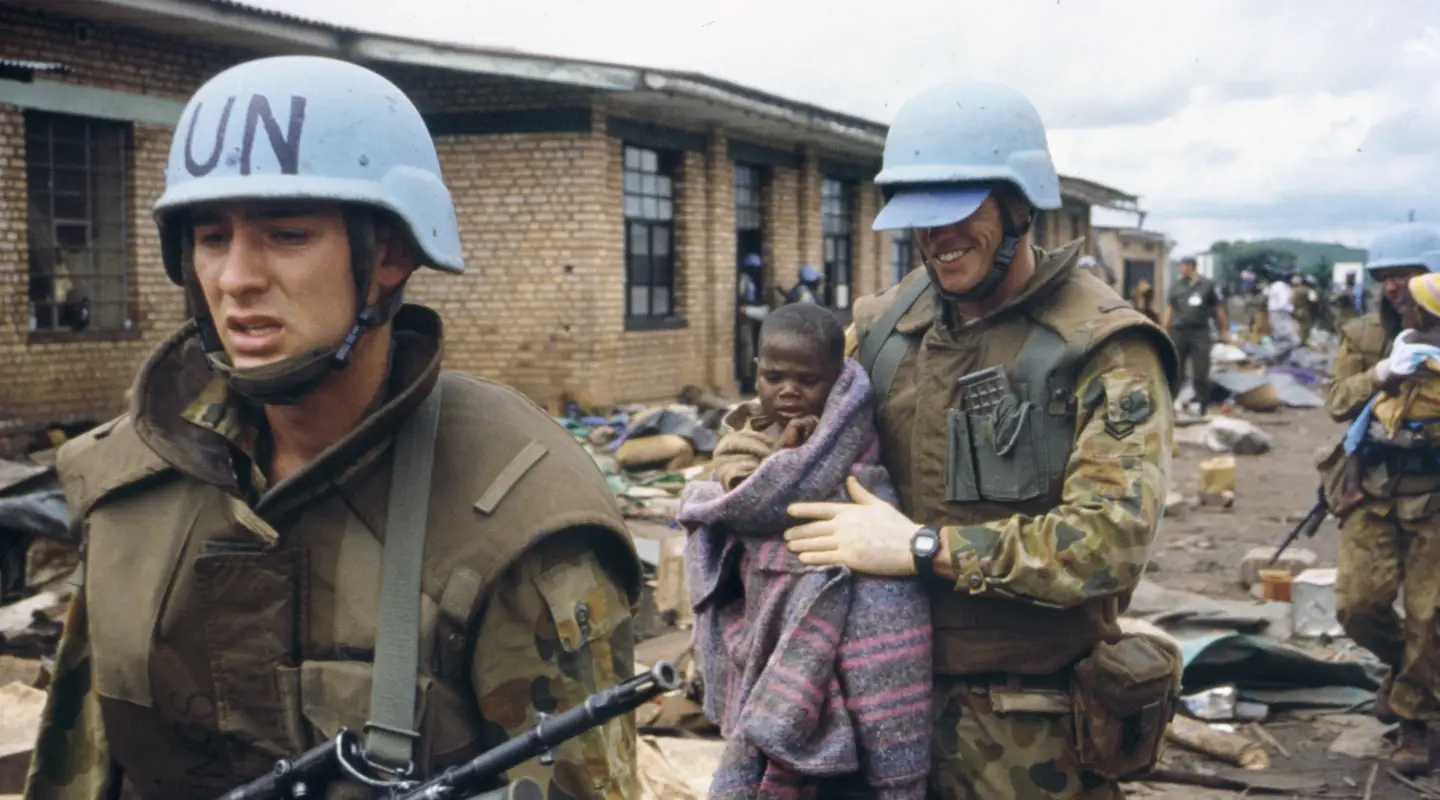
Bob was deployed to Rwanda with the Australian Army as part of the United Nations mission. He served with an infantry force tasked with protecting Australian medical teams as they treated UN personnel and Rwandan civilians in a country still reeling from the violence.
Bob Syron:
My first impressions arriving in Rwanda: we arrived at some ridiculous time in the morning. It was quite a long flight. The first thing that hit you when you jumped off the plane was the smell of aviation fuel. Then secondly, it was a smell that I'd never smelt before. And that was the smell of, you know, rotting flesh. So, arriving at the airport. The airport had been completely shot up. Bullet holes everywhere. In the background, you could hear bombs exploding. People, people moaning. People, you know, just dying all over the place.
Once we were issued our rifles, our gear, first light, we jumped on the Unimogs and began to travel to what we call the base camp, the old military barracks at Kigali. And traveling there, there were bodies, you know, on the sides of the roads, wrapped up in blankets or cloths. Some weren't wrapped up. And that smell became even stronger once we arrived at the main base camp in Kigali. It was kind of a wakeup call. The first thing I experienced was being the forward scout, I was in the lead vehicle and we were driving down the roads, and we didn't know who they were: Rebel soldiers, RPA, RPF. But these guys were on the backs of tray-back four wheel drives with their rocket launchers and rifles, and they would drive at us doing 100km an hour playing chicken with the vehicles. And right at the last second they’d either veer right or left from those vehicles. And because I was up in the front of the vehicle standing in the manhole as a forward scout. These guys veered off to the left and they drove straight into a crowd. And I remember seeing old fellow ride past me on his push bike, and they just hit him so hard that he did triple somersault through the air. And he was screaming as he was somersaulting and just landed on the ground and they just kept driving into the crowd. And I just couldn't comprehend that had just happened. That was my first welcome to country in Rwanda.
Our role as infantrymen in Rwanda was specifically to provide security and protection for the medical support force. Once we arrived there, we set up the security perimeters, putting up razor wire, securing areas that were unsecured. Once all those jobs were done, our role became being escorts for individual medical officers or medics, because every time the medics would walk from the main camp to the hospital, which was a good, you know, 150m or so, the African soldiers would either threaten, make gestures of cutting people's heads off or blowing them up, pulling out grenades, pretending to pull the pins out, pulling out knives, pretending to cut their throats. And I was aware that one of the female medics was actually barrelled up in one of the hallways by an officer and tried to strangle her, which pretty much shook her right up. So, we had to step up our escorting duties and providing that extra security for the medics. But it went beyond that, it ended up being ready-reaction force, we became security for King Basel Hospital, were individual protection for the medics going down on the borders. Actually, we even became assistance in, when we went down to the borders into the refugee camps, assisting with bandaging, first aid and helping the medics because there were just thousands and thousands of people that needed help.
A young boy, George, who used to come and hang out with us. He could speak fluent English in three months. And George would teach me to speak the language. Anyone that was educated, they were the main targets that they killed. And there was one particular day where they wanted to take George away. So, we ended up having Mexican standoff with this officer. The officer said, “what country you from?”.
And I responded, “Australia”.
And he said, “I heard you Australians are very disciplined.
And I said, “Yes, we are.”
And he said, “We're more disciplined than you Australians.”
And he shot one of his own soldiers in the chest three times. Boom, boom, boom. At 2 or 3m away. I looked at Corporal Eckert we looked at each other and we said, “Did that just happen?”. Like it was just something out of a movie. That's just one example of many examples of how unpredictable it was over there. And you just didn't know if you were going to be shot in an instant. That's how it was. And because we were so restricted in our rules of engagement, that also played in the back of your mind as well.
So you, it was a case of they had to fire first before you could fire your rifle to defend yourself, because your life had to be in immediate danger, otherwise we'd be prosecuted at the highest level under federal law. I can understand those rules of engagement. At the same time, in my mind I thought they’re silly. What a silly rule. You basically have to be shot at first before you can fire a round. We're one of the hardest trained forces in the world. All that training that you put into play and then to be handcuffed, it's pretty hard to take. And especially with thousands and thousands of people just being slaughtered, not being able to truly do the job that we were trained to do. I believe we could have saved a lot more lives if we were more aggressive in that regard.
So, whenever I interact with the local people, I would take the time out to say hello and ask them where they're from and, you know, learn different language words, and understand their customs and their beliefs. So, there was that side of it. And then the other interaction with children as, when I would go down to the borders, was the interactions with wherever you would go, people just ambush the vehicles run up to you and their hands be shaking like this. “Please don't kill me. Please don't kill me.” Or “please help me, please help me”. You know, you just couldn't help everybody.
And then going into the refugee camps, when we were down on the borders, you'd wake up every morning and you'd have a thousand piercing eyes looking at you through the barbed wire you know, begging you for food or water or. Most of the time I avoided eating any food or drinking any water in front of them. I didn't think it was appropriate. And I'd always do that in privacy.
But some of these injuries these kids had and the women, the women were just so incredibly strong. I don't think enough credit has been given to the women.
One particular day, I was Kigali Hospital and a woman had been brought in on a stretcher, and in her left arm she had a baby on her breast and in her right arm she was carrying her right leg that had been blown off from a landmine. And she was covered in blood, but she was lying sideways and I'm sitting there and she went past and she was looking at me as soon as she got in and, when she was coming past, she smiled at me and gave me this smile. That just blew me away. A woman breastfeeding her baby. She's holding a right leg she was so strong she could give me a smile. They kept their families together. They stayed strong in amongst all the horror and destruction and all the death.
The most challenging thing for me was, not being able to help everybody. Most of all was the way that they killed, I couldn't get my head around. I just couldn't understand why and how human beings can be so savage and brutal. They didn't discriminate. Whether you were three-month-old baby, whether you were five years old, or whether you were an adult. Even after being after their three months, the killings were still just ongoing and continuous. The rebel soldiers were going into the refugee camps at night and just doing random killings.
It's affected me deeply. Fellows in the battalion from the other companies, you know, they were like coming up and says, hey, Bob, what was it like, mate? You would tell them your stories and tell them the things that you would experience and had seen. And the response was, no, mate, that didn't happen. People weren't believing them. And then I went home for leave, to go and see, my parents. And my own mother, she said to me, you've changed. I don't really like the way that you talk. You're not the same person. And the way that it affected me was, everything had changed. Nothing was the same. I didn't I didn't see the world like I did in my younger years and my happy years. I just had no time for people that complained about trivial things and for me, they were no longer significant. And I was angry. And all I'm thinking about is the bodies, the mutilation. And I went downhill very quickly. And I eventually ended getting help and counselling and was made permanently and totally permanently incapacitated by Department of Veterans Affairs.
I think it's incredibly important to tell these stories, because a lot of people don't know. A lot of people hadn't even heard of Rwanda, and a lot of people still don't know of Rwanda. Or “Oh, that was only peacekeeping, wasn't it?”. You know, comments like that. And my response was, “Peacekeeping? Yeah, it was peacekeeping”. They killed somewhere between 800,000 to a million people in that space.
I think people perception of peacekeeping are a little bit mixed up. That you jump on a plane, and you go on a nice holiday somewhere, and you go and spend time with the locals. That's not the case. Peacekeeping is just simply a name. It can be, if not just as dangerous as, you know, warlike operations. Throughout history, peacekeepers have been killed.
The most rewarding experience for me was saving lives and helping people who needed help. The only thing I hope for the future is peace, harmony and respect. That’s all.
John Barrington:
What Bob witnessed in Rwanda stayed with him long after he returned home. Decades later, he has found a sense of peace through returning to Country and creating traditional Aboriginal woodwork.
Bob experienced Rwanda as someone sent there to help in the aftermath of genocide. For Frida Umuhoza, Rwanda was home.
Frida Umuhoza:
So, I grew up in a small town called Nyanza. I had three brothers. I had two sisters. My family, my grandparents and my cousins were all living in the same area. So really growing up was a happy time. I started school at the age of six. And when I started school, that's when I discovered that I was actually from the Tutsi ethnic. And I had no idea. My parents didn't prepare me. You know, the principal of the school would come into the class. That's when I was asked to stand, counting how many Tutsis are in the class and how many Hutus are in the class, and how many Batwa are in the class.
And that's when I went back home, and I asked my mother about it because we were made fun of. We were then referred to as snakes and cockroaches. That's when I discovered that, you know, I was in the wrong place and wrong tribe. So really, if you were born in a family where your grandparents, great grandparents were referred to as Tutsis, then when you went in the school, you were counted as a Tutsi. But when you look at us, there's not really much differences between our appearances and features or whatever. When you go in that country, you may not be able to really tell.
A genocide is not something that you woke up in happening just within a day. It's a very long process. In our case, in Rwanda, it took years and years of preparation. It's a process. It's like a seed that is planted in people's minds. Nobody is born racist. It's that seed that is watered by propaganda, brainwashing, dehumanisation. And you know, we couldn't have rights and people being arrested and killed. And all those stages we lived before it came to a time of determining when to wipe out the Tutsi tribe.
We knew we weren't liked, we knew we wanted love, we knew we had no rights. But coming to an understanding of them killing entire family or entire community, it didn't cross our mind. Or people hoped, yeah, there might be some killings, but not to the extent of the genocide. Because what the genocide is really is the intent to completely wipe out that one group.
From time to time they would be killings in different areas of Rwanda, killing the Tutsis. So, people did think of leaving. But as it got closer to 1994, we were already locked in. Because then roadblocks were set. Every hundred metres there was a roadblock. So, there was no way you could leave your area to go to another area, let alone leaving the country.
On the 6th of April, when the Hutu president, Juvénal Habyarimana was assassinated, then it was officially announced over the radio that now work, which they called it work, should start, meaning killing all the Tutsis, now it's official. Then you started hearing people screaming and running and seeing people fleeing from one. You know, we had nowhere to go. People were coming from east to south, south to east, you know, but was running, not really having a place to go. That's the time that we realised now what we've been hearing, what we grew up hearing, is now being put into action.
I can't really put in words all the emotions that you, you have when you hear you are on the list that are people that are supposed to be killed. And they were saying that no one should survive, not even babies in their mother's wombs. My family wasn't even able to get out of our village. Like I said, there was roadblocks everywhere. We did run inside our village from one forest to another, from one bush to another. We hid for months, but we couldn't get out of our village.
And you’re scattered with your family. And when it was night, you wished it was day. When it was day, you wishing it was night. Not only because you were cold and hungry and fearful, but also because when it was night, they used dogs to search into the bushes. During the day, you know, there was whistles, they used whistles, they had clubs, they had machetes. So, it was an awful, awful time of just trauma.
So, we'd been hiding for almost a month, and then we were then told by a man who hid us, and he came and he said to us, there had been an announcement. And now we're talking about May now. And, you know, the genocide against the Tutsi’s had started earlier in the month of April. And then the announcement, a fake announcement was made to say that the killing had stopped, but it was a lie. So, we were then told by this man who hid us to tell us to go back to our own home. But we had no home. Our home had already been demolished. So, we went to my grandfather's home. But when we got there, half of his home was also demolished. But probably around or a little bit more than a hundred people had returned. And my father also returned. My mother and my brothers returned and my sister were there. So that's how we all ended up at my grandparents’ house.
So, the attackers arrived a week after when we got home and they took us on a roadblock. A roadblock was like a killing centre. In my village to be shot you had to pay because remember we were referred to as snakes and cockroaches. And so, they said snakes and cockroaches don't deserve a bullet. They were killed by machetes and clubs and spears. And so, we had no money to pay for a grenade, we had no money to pay for a better death. So, we were then told to go back to my grandpa's house.
And we went back on that Wednesday. And then on a Friday night, there was a young man who was friends with my brother who came and told us, the killers had just had a meeting, and they had decided that the following morning was the day that they were going to come and attack and kill my family and other families around us. And my grandfather said, “We're not going to go anywhere. We're not running. We have been running enough time. We're going to stick together and die together”.
And we stayed in that house really scared all night, knowing that the following day, in the morning will be our last day. It's very hard to put in words what you feel when you know that few hours from then you're going to be killed, and you have no money to pay for a better death.
My mother, my grandparents, both of my grandparents, a few of my aunties, a few cousins and my three brothers and my sister were inside the house. And that early morning, we then heard the neighbours children screaming and crying, women running, crying. We were told to come out of the house, out of the room where we were praying and taken to a ditch. I was raised Catholic, so my grandfather told him that we wanted a small moment to pray our last prayer. We knelt down, but before we even finished praying, they started beating us, saying that Tutsis have no God, that their god was killed before they came to kill us. So, and my grandfather led us into a song, a hymn, that said, we are created deadly bodies, but our spirits will never die. And he made us sing that song. As we marched towards that ditch. When we got to the ditch, they gave us a chance to choose whatever weapon you wanted to be killed with. Now that means between a club, a machete, a knife, a spear, or a tool with nails. So, I picked a young man with a big club, because I knew that with a club, they would beat you at the back of your head a few times, and you’ll be gone. So, I thought for me, that was better than a machete. And that's a young man that I chose, his name was John. Told to lay facing, our faces on the ground.
And we laid in the ditch that was muddy because it had been raining all night. The very first person that was hit was my grandfather. They hit him with a club, I had a hoodie and I covered my head and laid facing down, my eyes closed. And I was hit at the back of my head with a club. And that was the last thing I remember, and heard. And I was unconscious for a very long time. I don't know how long I was unconscious for, but when I woke up then my sister that was just 16 and next to me, was taking her last breath. When I woke up, realised that they were already burying. And I thought if I showed that I was still alive, they'll put me on the side and kill me in a really bad way. So, then I decided to keep quiet and be buried alive.
They completely covered the ditch and left. And that is how my entire family was killed. I was in that ditch with my entire 15 members of my family for many, many hours until I started crying and screaming under the ground. And a woman who was taking bananas in that area heard my voice and went and called a young man that came in and dug me out of the grave. And I was the only one that came out of the 16 people.
I was then hidden by another Hutu for a few weeks, and the Rwandan Patriotic Army, liberated the country to stop the genocide. And we were then, as survivors, put in safer places.
I think my brain was trying to protect me. I was in a little bit of denial of, no, this has not happened. I'm going crazy. This hasn't happened. I knew that my family had been killed. I saw my family being killed, but I think my brain was playing tricks on me. But on that day when I got in the safe place that I was taken with other survivors, I sat on the floor and cried for the first time. Because then it was more like a realisation of my entire family is gone. I will never see them again. And I'm all by myself. I have no home. I have no one left at 14. And then my mom's brother, who had been living in exile, got to know that I had survived, and he took me in. And then he passed me on to his cousin's family.
But every single night, every single day, I had nightmares for years and years,. I had nightmares, I had suicidal thoughts, I had depression. And I just then just day and night, I just couldn't comprehend how a human being can do such a thing to another.
What made things or makes things very difficult for us was that you were killed by neighbours, Hutu neighbours, people that we knew very well, people that we grew up with. People that my family had served, people that my family had lived side by side, the same people that my mother was good to.
The country was just in shambles. The people were broken. There was nothing left for us. A whole generation was gone. There was lots of orphans that we had to grow up with. No parents, no families. Our children have no uncles, our children have no aunties, and we will live the rest of our lives, you know, having those memories, because there is big, important part of our, of our lives that was taken away from us.
The genocide against the Tutsis was one of the worst genocides in the world. It's not just a small country history. It should be talked about in the world history as well, because the people that I'm talking about, the families that I'm talking about, my family, were not just a number. They were human beings, they were members of the communities. It's important that it's talked about and remembered, so that the next generation knows what happened.
My hope for the future is that we live in a world that is free from genocide from one another. And that we raise a generation that is not bystanders. We raise a generation that is educated about these things and that they get to be people that fight ideologies of the genocide.
None of us could imagine what Rwanda is today. My country has done a lot of work of reconciliation and people living side by side. And I think my government of Rwanda has had a big hand and a big work, to have people refer to themselves as Rwandans instead of Hutus and Tutsis and Batwa. And people are not given jobs because they are Hutus or Tutsis. They are given jobs because they can do the work, and the fact that we were able, even as survivors, to be able to live in the same country and try to rebuild our lives, I think that has been important to the next generation.
John Barrington:
Frida carries the memory of a community that disappeared almost overnight due to violent conflict. Her story, reflective of so many others, brings into focus what is at stake when peace breaks down, and why taking action to establish it again can become desperately urgent. Those sent to serve in these environments can also find themselves caught in the violence too.
In 2006, Major Matina Jewell was serving as an unarmed United Nations military observer in the Middle East when war escalated around her. Matina joined the Australian Army when she was just 17 years of age and served for 15 years, where she deployed on five missions around the world. She had been serving in the Middle East, in both Syria and Lebanon for almost a year, when she found herself caught in the middle of the war between Israel and Hezbollah. It was her role to serve in a multinational team at a remote patrol base and observe a ceasefire between the warring sides.
Matina Jewell:
So, these patrol bases are very isolated. They’re very, very small bases, no bigger than the size of a tennis court. You spend the day patrolling those regions around you, looking for violations of the peace agreements between Israel, Lebanon and Syria.
The peacekeeping was really challenging. You had to have a whole different set of skills so that you could pull out the tool bag. At the same time, with the UN, I had this whole new set of experiences that was really exciting for me. The challenges to work with foreign nationalities, like even just some of those basic things of language skills, you know, and the ability to really impact the humanitarian aid that I’d always set out to want to do in my career.
I was actually up on the rooftop of Khiam, and I just happened to be looking south when I saw this 1,000-pound aerial bomb that had been fired by an Israeli fighter jet. And it was at eye level for me, no more than 30 metres away.
I had just enough time to tell my teammates to get down as the bomb impacted into the Hezbollah base. This fireball erupted over our heads, and then the shrapnel started to rain down on top of us. We all somehow managed to scramble to the bunker. Not one of us really had a scratch on us, and it was crazy to think that we’d all survived.
After two days of trying to get through to headquarters, I was told by my UN headquarters, “Israel’s about to conduct one of the largest air strikes of the entire war.” I didn’t foresee that my driver was about to do evasive manoeuvring, and so I was actually thrown forward into the bulletproof windscreen of my armoured vehicle, which broke my back in five places.
I then spent the next two days lying on a tile floor without any pain relief, without morphine, while the UN’s now kind of scrambling just to come up with an alternative medevac process to get me to a hospital.
But once I got to Cyprus. Yeah, I was told that my teammates had all been killed at Patrol Base Khiam. Another 1,000-pound aerial bomb, again from another Israeli fighter jet. But this one was actually laser-guided, and that bomb instantly killed all four of my teammates that were manning that base.
Unfortunately, as a result of my military service, I’ve suffered from post-traumatic stress disorder and just horrific flashbacks of that war. They live with you for the rest of your life. And as a veteran, you just somehow learn to deal with those incidents that have now shaped and moulded you to become the person that you are today. But you’ll carry those experiences with you for the rest of your life.
John Barrington:
Peacekeeping can place those who serve in extraordinary and dangerous situations. The impact of those experiences can last long after the immediate danger has passed. For Australian soldier Shannon French, that became clear after his deployment to East Timor.
East Timor had been under Indonesian rule for almost 25 years when, in 1999, its people were finally given the chance to vote on their future. They voted overwhelmingly for independence. But in the lead up to, and aftermath of the vote, anti-independence militias launched a campaign of violence, looting and destruction.
Many East Timorese were killed, and hundreds of thousands were forced from their homes. An Australian-led international force was sent in to restore peace and security, before the United Nations took responsibility for supporting East Timor through its transition to independence.
Shannon deployed there in 2000 as a lead scout. Often at the front of his patrol, his role demanded constant vigilance, but also extraordinary restraint.
Shannon French:
I was a forward scout in 8 Platoon, Charlie Company, 6 RAR. The biggest part for most soldiers was the first contact with the kids and seeing them just in rags and no shoes, and, you know, the pain and the suffering and the scaredness in their eyes. Just seeing that fear and that uncertainty and what they’d been through in their eyes, it spoke volumes to us.
Every soldier there felt the pressure on their trigger finger, that you could cause an international incident if you made the wrong move. So literally, the militia could be shooting at you and run away, and if you shot them in the back, you were getting charged for murder. And that was pushed on us quite heavily before we deployed. So even after seeing all the kids, you had all this anger inside, but also you had to hold this great restraint at the same time.
I just couldn’t come home and relax. I just couldn’t shut off. I was up all night, just having adrenaline surges all the time, just checking the house, checking everything, you know, just to make sure people were safe. Ringing people up to make sure they were safe, you know.
And I just didn’t realise that I had a problem until I had to go to the psychologist or the psychiatrist, and I got diagnosed with hypervigilance because of being a lead scout, being on edge for such a long time. It was really hard to be at a party and listen to people talking about football and stuff, and just their pressures of not being able to find a car park at the shopping centre, when in your head, you’re still angry. You still want to take vengeance. You’re still thinking about those kids over there.
For me, it was going back to Timor and helping other people was the answer. In finding those kids, I was able to track them down, especially the ones that had been crying at the base and support them financially through schools.
And one is now a geologist. One’s a university lecturer. Seeing them heal and seeing them grow, and let them know that you did your job, did your best that you could do, and look at what you’ve done. Look at what we’ve done together. All those hard nights and those patrols, all we wanted to do was just collapse, but we didn’t. And we pushed through, and we pushed through, and it wasn’t all for nothing, you know, even though at the time we thought it was.
John Barrington:
Seeing what became of those children gave meaning to some of the hardest parts of Shannon’s service. It’s a question that sits at the heart of peacekeeping: after the danger, uncertainty, and horrific events, what difference can it make?
The year before Shannon arrived in East Timor, Australian Federal Police officer, Senior Sergeant Don Barnby was there as part of the United Nations mission overseeing the independence referendum.
By then Don had already spent decades in service. He’d served with the Australian Army in Vietnam, before joining the Australian Federal Police, AFP, and deploying on peacekeeping missions to Cyprus and Bougainville.
In 1999, Don decided to come out of retirement to return to the AFP, where he headed up training for the Australian police contingent heading to East Timor. Their job was to help protect electoral officers and support the vote that would determine East Timor’s future. Don was there in the lead up to the referendum and remained as the situation deteriorated around them. Violence spread across the territory. Don and his fellow officers were unarmed, witnessing attacks on the people they had been sent to support. They had little power to intervene.
Don Barnby:
Our role in Timor was to advise and assist the Indonesian police in Timor, and also to carry out a referendum prior to the independence referendum, and also to secure and safeguard the ballot boxes after the election. We were joined by approximately 250 other police from all nationalities: UK, New Zealand, Ireland, Pakistan, India. It was a full UN operation.
The violence was not minimal, but it was more clandestine when we first arrived there. When we first arrived, we did patrols out to the villages every day, and we were approached by villagers all the time with stories of atrocities, beatings, rapes, murders.
And then probably about two or three weeks into the tour, we were tasked with conducting a referendum. We needed to know how many people in each area were going to be eligible to vote. We registered about 2,900 villagers that were eligible to vote. They were so anxious to get this thing done. So, yeah, that took up a big time. I think the registration period lasted for about 22 days. During that, we were also continuing our patrols out to villages. Violence was reasonably obvious. Not towards us at that stage.
We found evidence that if villagers were overtly friendly to UNAMET, to the UN people — and it was all police at that stage; there was no military in our area — we'd heard on the grapevine later, and we saw evidence of it, that their house was burnt down. They were beaten up by the militia and the TNI at that stage.
There was no violence towards us. That certainly changed.
East Timor had been under Indonesian rule since 1975, and they were an incredibly oppressive regime, and brutal. I remember on quite a few occasions, adults, mums and dads, they'd come up to me and say, “We are prepared to spill our blood to secure independence for our children.” And that's pretty strong. And they weren't throwaway lines, not like people say, “I'd die for my kids.” Well, they did die for their kids. And they were prepared to go through a period of violence to secure that vote.
They were just lovely people. They're just so friendly. And you could see the desire within their actions, their movements, their demeanour. We were welcome. They knew what we were there for, because that's part of the patrol — we were explaining our purpose. And they were anxious, eager and passionate about what we were doing and, hopefully, the result.
The morning of the election, 30 August 1999, we got up about three o'clock in the morning, picked up our workers, our local Timorese workers. And I picked up my DEO, Sandra Chestnut. We had a fair drive. It was about 12, 14 kilometres up the mountain. We sort of expected to have about, oh, a matter of hundreds of villagers that had come in that night to wait for us. Little did we realise that as our headlights came through the fog, we were greeted with, I would estimate, 2,000, at least 2,500 people.
They had come along their little jungle paths and roads during the night, previous day, and camped there because they knew if they came on the day of the election, of the referendum, they'd probably be intimidated or worse by the militia on their way there. So as they saw the UN badge on the side of the Land Rover, the cheers went up. They just rushed us. Sandra and I just had tears in our eyes. Yeah, they were just so glad that we had done what we said we were going to do.
So, then we started forming little lanes with string and rope. We set up the boxes, little cardboard boxes that they put their votes into. And then I went out through an interpreter and explained to them how it would happen. So, we did that, and everything went reasonably well.
About probably 1500 metres away, there were groups of militia on motorbikes. And miraculously, all the old homemade weapons had been transformed into modern automatic weapons. And they were riding up and down, yelling out abuse in Timorese or Bahasa or Indonesian, threatening the villagers: “Go, you'll be killed.” And, you know, “This is not allowed,” and all this sort of stuff.
The perimeter cordon was supposed to be 500 metres. They weren't allowed to come anywhere near it. They weren't voting, obviously. I think polling finished about 4:30 or five o'clock. So, then the militia leader, the leader of the group, came up to me incredibly angry and armed with an automatic weapon. I think it was an M16. We had a toe-to-toe.
I was negotiating with him to move his truck and his people away from that intersection. The argument went on for about an hour, and this bloke had this gun shoved up my nose, literally. And I thought, if he sneezes, he'll blow me head off. So, level of frustration, anger, tension. And then we drove the 12 Ks back down the mountain, and meanwhile they were firing automatic weapons over our vehicles into the trees. They chased us all the way down the mountain. I wouldn't have a clue what they intended to do because, you know, we were heading away from them. They were chasing us all the way back down to Gleno. So when I got down there, we got all the helpers inside, got the ballot boxes inside, and then it all went pear-shaped for the next seven days. Was when the violence shifted from intimidation to overt violence towards us and hate.
The bravery and courage shown by the East Timorese during that entire period was humbling. It was overwhelming. It was humbling.
I think the result was announced on the fourth of September. I think it was fourth or fifth. That's when the militia absolutely went nuts. They all brandished weapons, machetes. They'd bang the sides of the vehicles as we drove through the marketplace. The fact that we weren't allowed, or weren't able, to do what we wanted to do — protect the villagers — we were unarmed. But having said that, the fact that we were unarmed probably saved us, because if we had gone armed, these militia were crazy, they were mad, and bloodlust was up. And if we had been armed, all it would take would be for one of the police to go for the gun in a confrontational situation. There would have been casualties.
When I got back, I was out of the police force, finished my contract and got out. What UNIMET went through during that period was well known. It was publicised around the world. It was in the media. There were fewer people saying, “Did you enjoy your holiday?” That didn't happen as often as it did after other missions. But yeah, that was the popular belief, narrative, when you came back to Australia.
It was 2019, five of us decided to go back because it was the twentieth anniversary, celebrating the vote. Because after the referendum, that was, I think, 78.5 per cent for kicking Indonesia out of East Timor. The night before we were due to catch the plane to Darwin and then up to Timor, I had a bad night, couldn't sleep.
And the next morning I said to Dave Savage, I said, “Mate, I don't think I could do this.” Because we had told, repeatedly told, the East Timorese in our respective areas that we will stand by them when the Indonesians become violent. We will try and assist and help you. We won't leave you. Well, we were all pulled out. I think UNIMET finished on the 13th of September. And then there was a small gap, and then INTERFET was deployed. But in that interim period, lots of people were murdered, kidnapped; violence, places were burnt down, Dili was wrecked.
So, I was apprehensive because we were pulled out, were evacuated.
The other four guys finally talked me into flying. And when we arrived in Dili, it was quite weird. We were all apprehensive. What are we going to do here? How's it going to be? How are they going to accept us? And everybody else on the civilian flight was ushered off, and we were asked to stay on. And we thought, “Did we stuff-up our visas or something? What happened here?”
And one of us looked out the side window of the plane, back towards the terminal, and there were these two lines of schoolkids dressed in traditional dress. This is a tearjerker. They were all dancing and, you know, whatever. And then we were ushered off the plane. The greeting that we got after being apprehensive was just mind-blowing. And then we were taken into the terminal and we were hugged. And I had hug overload because, you know, we were just hugged by everybody.
I was 69 years old, and in a lot of these native communities and cultures, they always go to the older-looking person, thinking that they're the wisest. This young journalist from the Dili newspaper sought me out in the terminal while we were waiting for bags to come off. And she started interviewing me about why we're back and what happened and what does it mean, and all this sort of stuff. I don't think I gave much of an interview. It's a bit like now. I was quite emotional.
I mean, we — and she started crying because they lived through all this. She would have been in her twenties, so she would have known this as a young kid back in 1999. So anyway, we got transport. All our fears and concerns about our return were washed away in that first meeting at the airport and subsequently back in Dili. And everywhere we went, Dili had changed. They'd rebuilt. There was still evidence in Dili at that stage of places that had been burnt down.
And the word had got around, and people were coming up to us, hugging us. Yeah, it was quite overwhelming, and in a lovely way. I got a whole heap of photographs that were taken while we were there in 1999, and I'd got them all blown up to about A4 size, of people's faces. And one of the things I wanted to do while I was in Gleno and Ermera was to show people these photos and get them to tell me what had happened to these people after we left.
So we went into the headquarters, and there was a big table. So, I put all these photos down. I explained it through the interpreter to these people. The interpreter turned out to be a young girl. She was in the police force at that stage, and she was next to me, looking over my shoulder at one of the photos. And Ironically, one of the photos taken after the election around our headquarters in Gleno, when we were under siege, there was a crowd of Timorese people. She was in that photo, as a 14-year-old girl. The guy that was next to her, she married him about 15 years later. It was an emotionally charged scene. A lot of the Timorese that were subject to the violence during that period in 1999, a lot of them were now in the local police force, had been recruited and joined the police force. And ironically, I went to the local police station in Ermera, and the sergeant came out and he knew me. He was one of my interpreters back in the day in 1999. So, it was just an incredibly positive day.
A lot of people don't realise these people had suffered under the Indonesians for years, and now they were independent. And that is just an incredible thing. And this is unbelievable. I said, “Twenty years ago, screams and gunfire, and today singing and music.” It was just the change, the metamorphosis — the whole of East Timor was different. It was a free country, though there are a lot of issues in East Timor at the moment, and I realise that, economic as well as others.
But people are going around leading normal lives. People are in shopping centres. They're at school singing and laughing and, you know, playing games. The whole trip, it was an incredibly worthwhile visit back. I'm glad I was persuaded in Sydney to jump on the plane.
Of all the situations and jobs that I've had in my life, 40-plus years from being in the Army, Vietnam, and then the police force, several UN missions — Cyprus, Bougainville and Timor — none of them come anywhere near the feeling that I have for that involvement, and that deployment to Timor. I don't think many people could probably say in their life something that they volunteered to do and were involved in changed the lives of hundreds of thousands of people, and gave a country freedom that they didn't have prior to that. That was an incredible thing the UN was involved in. Thank God for their involvement and their willingness to be involved in East Timor at that stage.
And most of it was down to the bravery and courage of the local people. They got freedom. They're free.
John Barrington:
For Don, returning to East Timor offered a glimpse of what peacekeeping can help achieve. The violence he witnessed hadn't been forgotten, but the country and its people had begun building a different future. And perhaps that's what makes peacekeeping so meaningful.
For those who serve, peacekeeping can offer something beyond the traditional role of the military. It’s an opportunity to protect people, restore stability and help communities rebuild. Few Australians understand that better than Sir Peter Cosgrove. A former chief of the Defence Force and Governor-General of Australia, Cosgrove commanded the Australian-led international peacekeeping force in East Timor in 1999. He leaves us with a final message.
Sir Peter Cosgrove:
There is no more noble additional calling for a soldier, a sailor, an airman or women than to help others in need. After all, if you’re not defending Australians but you’re defending somebody from another nation, isn’t that just as worthy?
Peacekeeping is, in its own way, one of the most satisfying duties a military person can be engaged in. We need our men and women to fight wars. Wars to protect Australia, wars to protect our interest if necessary; heaven forbid. Wars to protect our neighbours, again; heaven forbid. But opportunities to go and help people to restore life and liberty are Heaven Sent and they will always provide Australia’s sons and daughters with a feeling of fulfillment and satisfaction that they were able to help. It’s to be embraced. SO, in saying this, I ask for blessings upon them all. The men and women in uniform and you the Australian families who provide them.
John Barrington:
This episode was researched and produced at the Australian War Memorial and featured Doctor David Sutton, Anab Mohamud, David Savage, Donald Barnby, Michael Maley, Norman Laing, Mohammed Abdur Rahman, Tamara Sloper-Harding, Bob Syron, Frida Umuhoza, Matina Jewell, Shannon French, and Sir Peter Cosgrove.
Many of the people and stories featured in this episode can also be found in the new Australian War Memorial gallery, Australian Peacekeeping: 1947 to today.
If you’d like to explore any of these stories further, read diaries and letters, or view objects from the Memorial’s collection, you can find links in our show notes.
Voice Over:
This episode is brought to you by Leidos Australia.
In Rwanda, Australian peacekeepers arrived in the aftermath of genocide. In Lebanon, an Australian military observer found herself caught in the middle of a war. And in East Timor, peacekeepers witnessed both the violence surrounding a nation's fight for independence and the hope of a new beginning.
Through firsthand accounts from those who served and those who lived through conflict, this episode explores the personal cost of peacekeeping, the challenges of rebuilding after violence and the lasting difference it can make.
Collection items and related stories
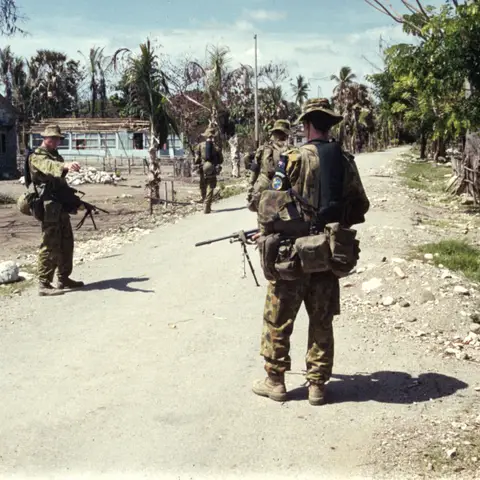
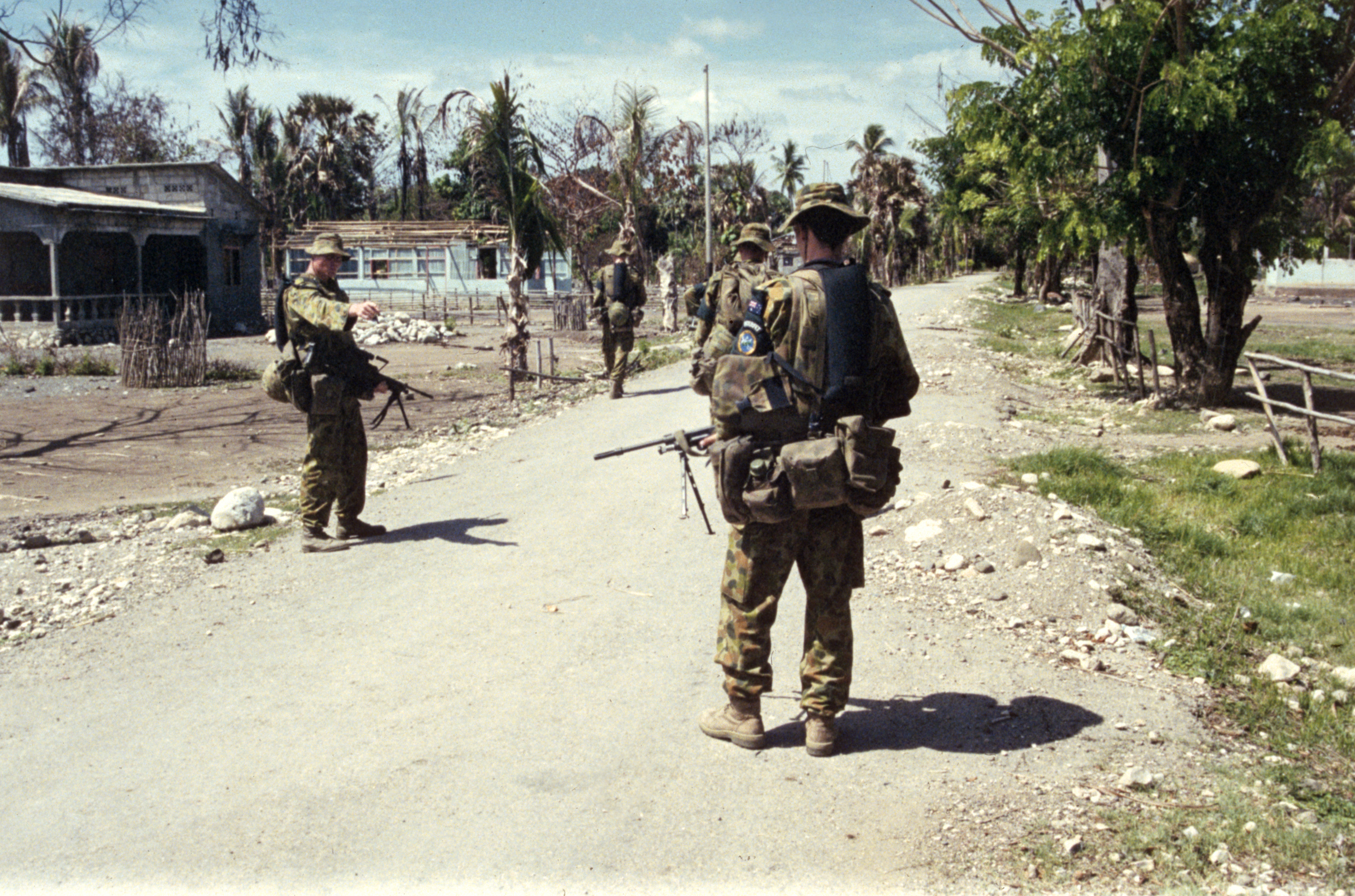
Gunner (Gnr) Craig Hall (left) of the 108th Battery, 4th Field Regiment, part of the International Force for East Timor (Interfet), talking to Gunner Sage (back to camera) as they begin a patrol of an area between Suai and Matai.
Explore more about Australian Peacekeeping
- Read the WM article on the development of the new gallery, Australian Peacekeeping: 1947 to today
- Find out more about Australians as peacekeepers in a WM article
- Discover more about peacekeepers and their missions in the AWM's Special Exhibitions Gallery video, 'The courage for peace'
- Learn about Australians and Peacekeeping
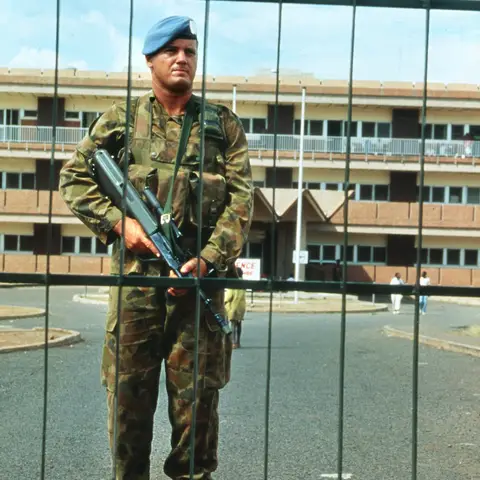
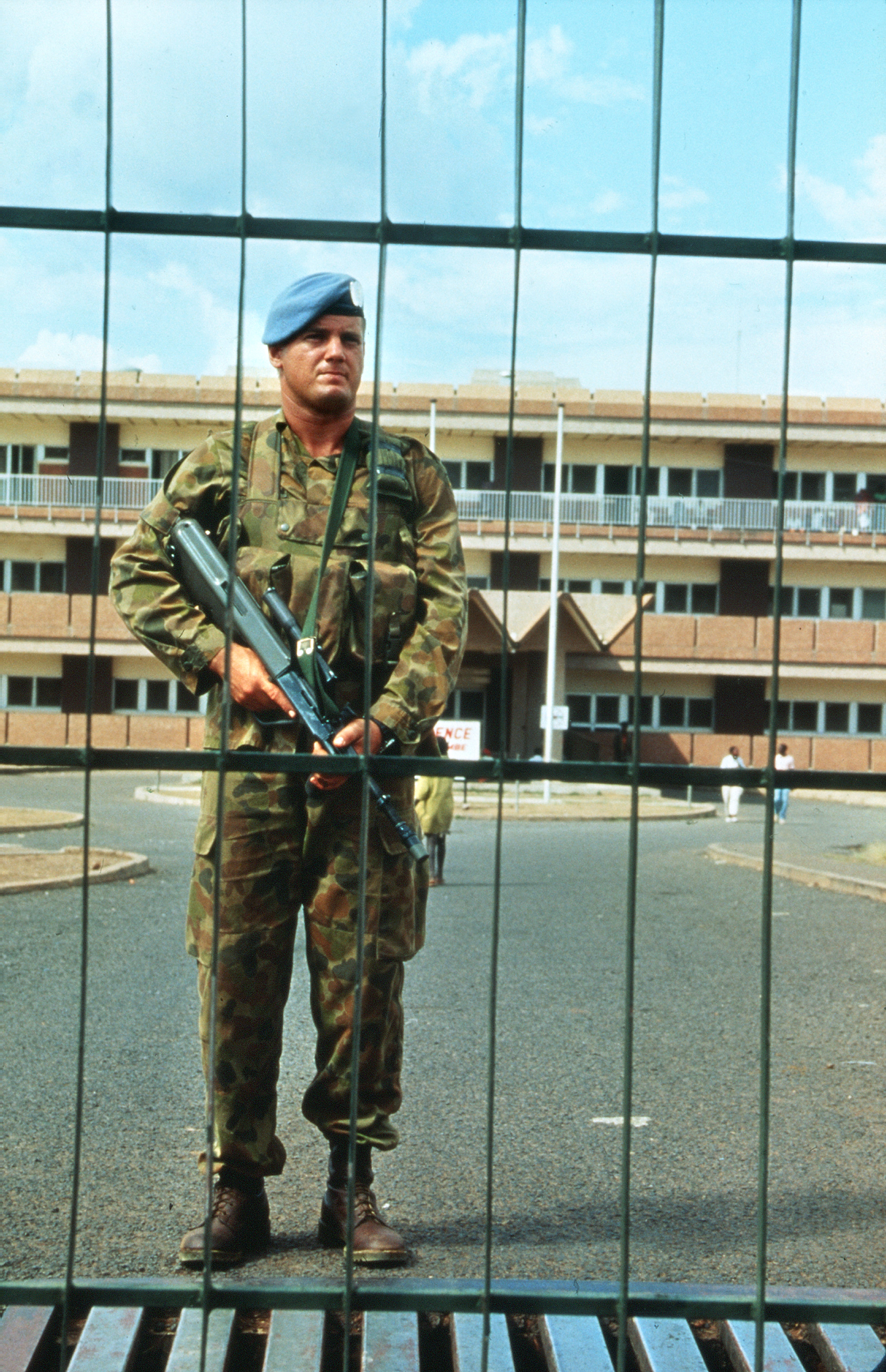
Private Robert Syron, a member of 2nd/4th Battalion, The Royal Australian Regiment (RAR)
Explore Private Bob Syron's story
- See Bob Syron in uniform during his service in Rwanda in this AWM collection photograph
- Discover how Bob uses traditional Aboriginal woodwork to reconnect with country and heal from his experiences in this ABC News article
- Hear more about Bob's experiences in Rwanda in episode 2 of the AWM's documentary, A New Anzac
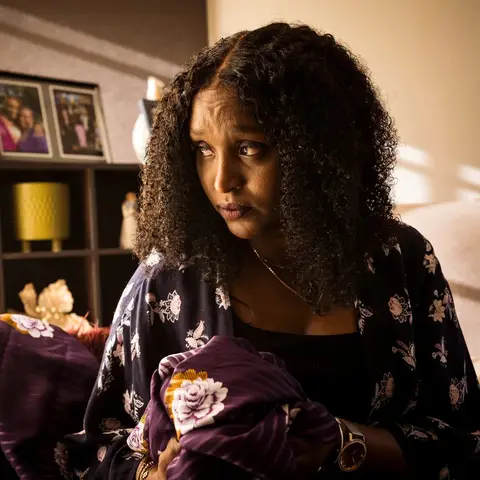
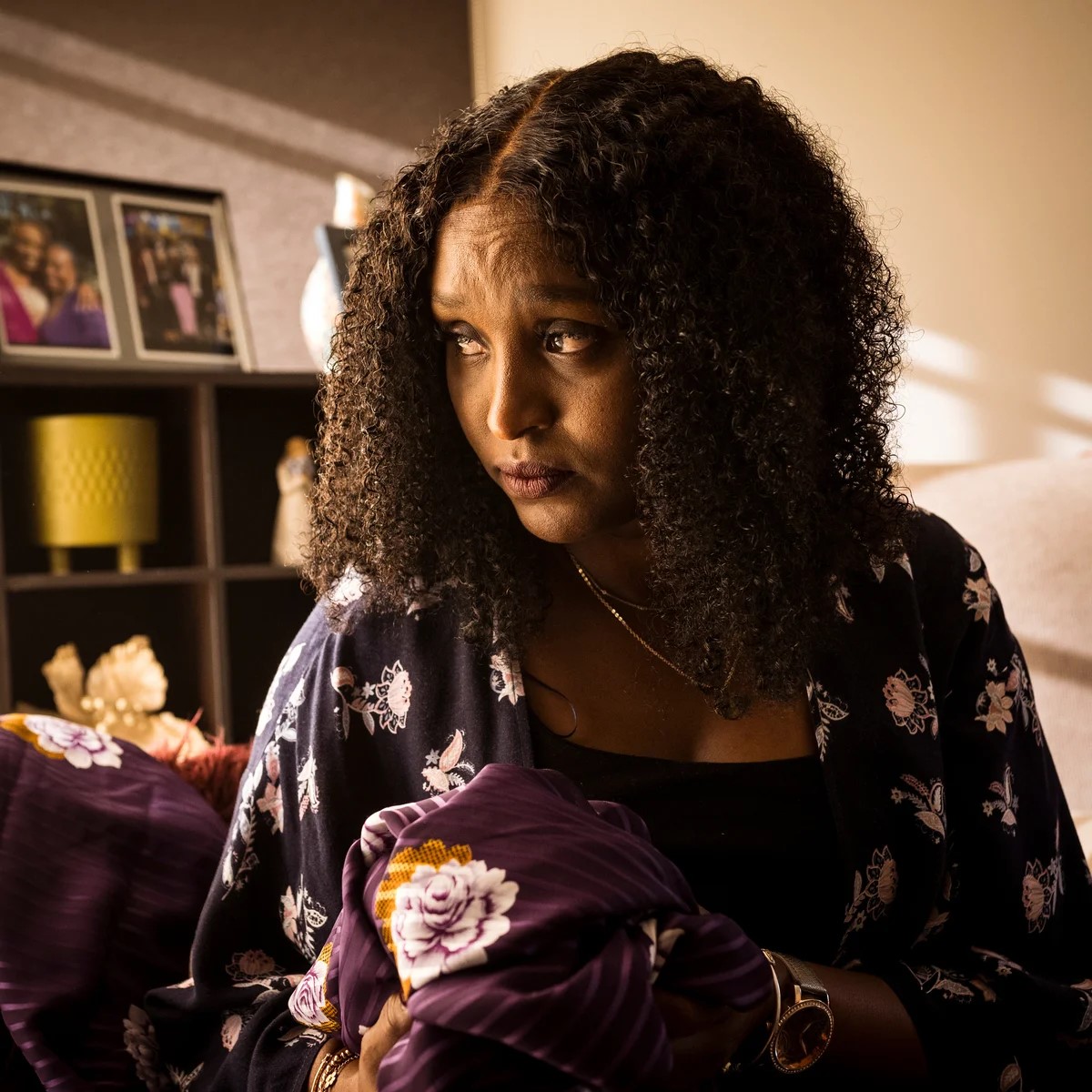
Frida Umuhoza. Photo credit: The Guardian
Explore Frida Umuhoza's story
- Learn more about Frida's story of survival and resilience alongside other perspectives in the WM article; 'New perspectives - Australian Peacekeeping Gallery'
- Discover the United Nations story 'Buried at 14, She Survived to Warn the World'
- Read Frida's autobiography 'Frida: Chosen to Die, Destined to Live'
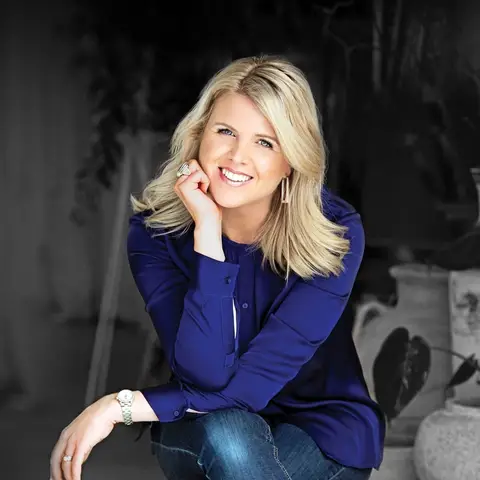
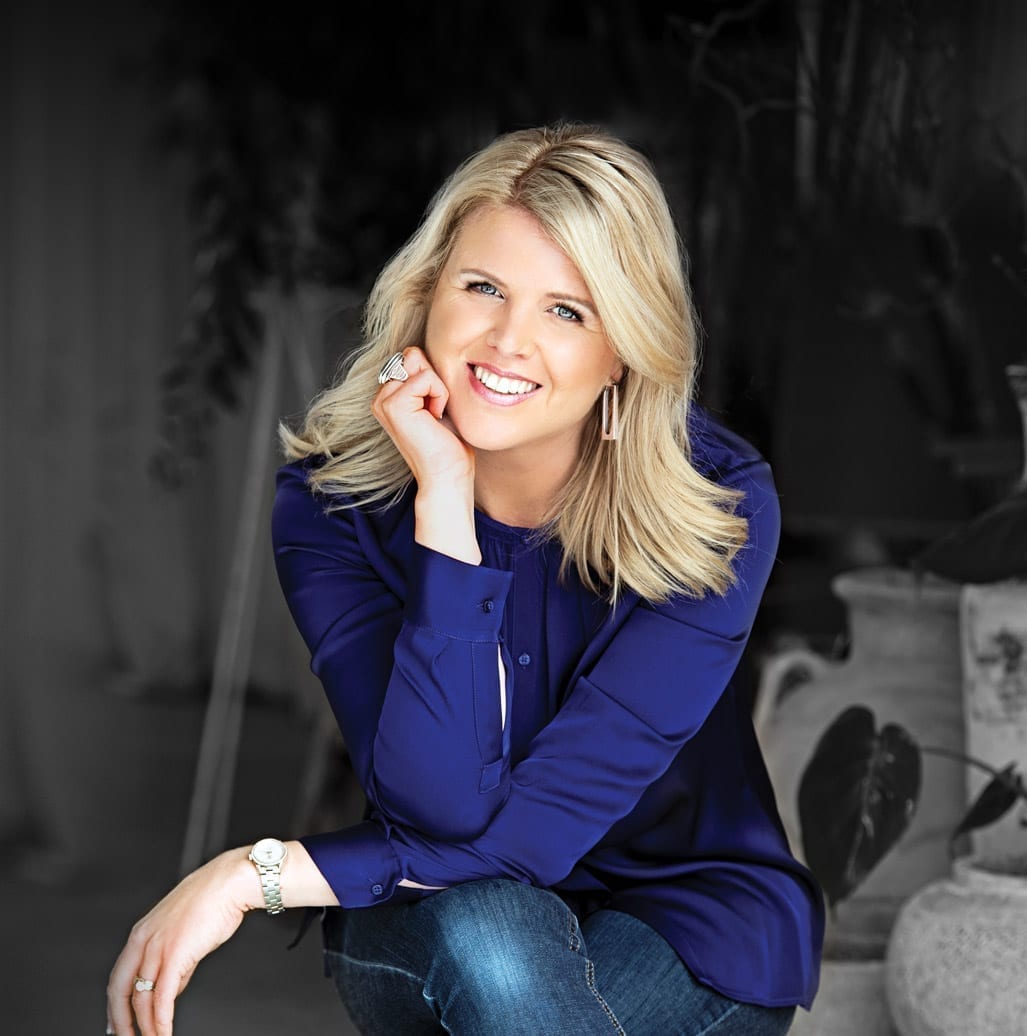
Major Matina Jewell
Explore Major Matina Jewell's story
- Explore more about Matina's current work as change champion, advisor and ambassador on her website
- Read Matina's autobiography, 'Caught in the crossfire: an Australian peacekeeper beyond the front-line'
- Watch Matina share her personal story of service and sacrifice in the AWM's series 'In Their Words'
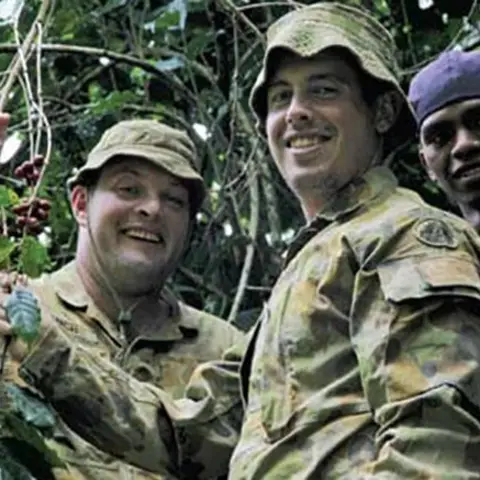
Shannon French. Photo credit: The Shrine of Remembrance
Explore Australian soldier Shannon French's story
- Discover how former Australian peacekeeper Shannon French continues to support the people of Timor-Leste, years after serving there, in this SBS News article
- Read about Shannon French's experiences as a peacekeeper in East Timor in this Shrine of Remembrance article
- Explore how Shannon French's experiences in East Timor inspired him to give back to the communities he encountered during his service in this ABC News article
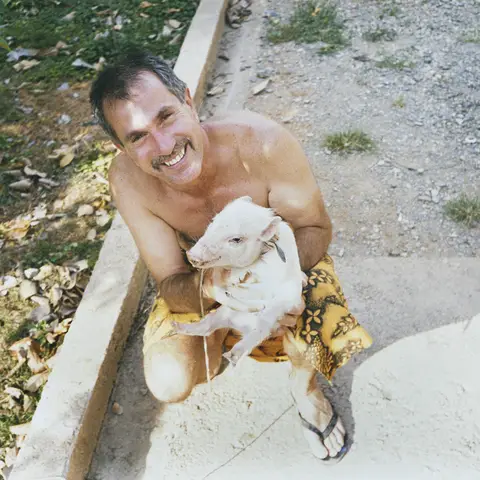
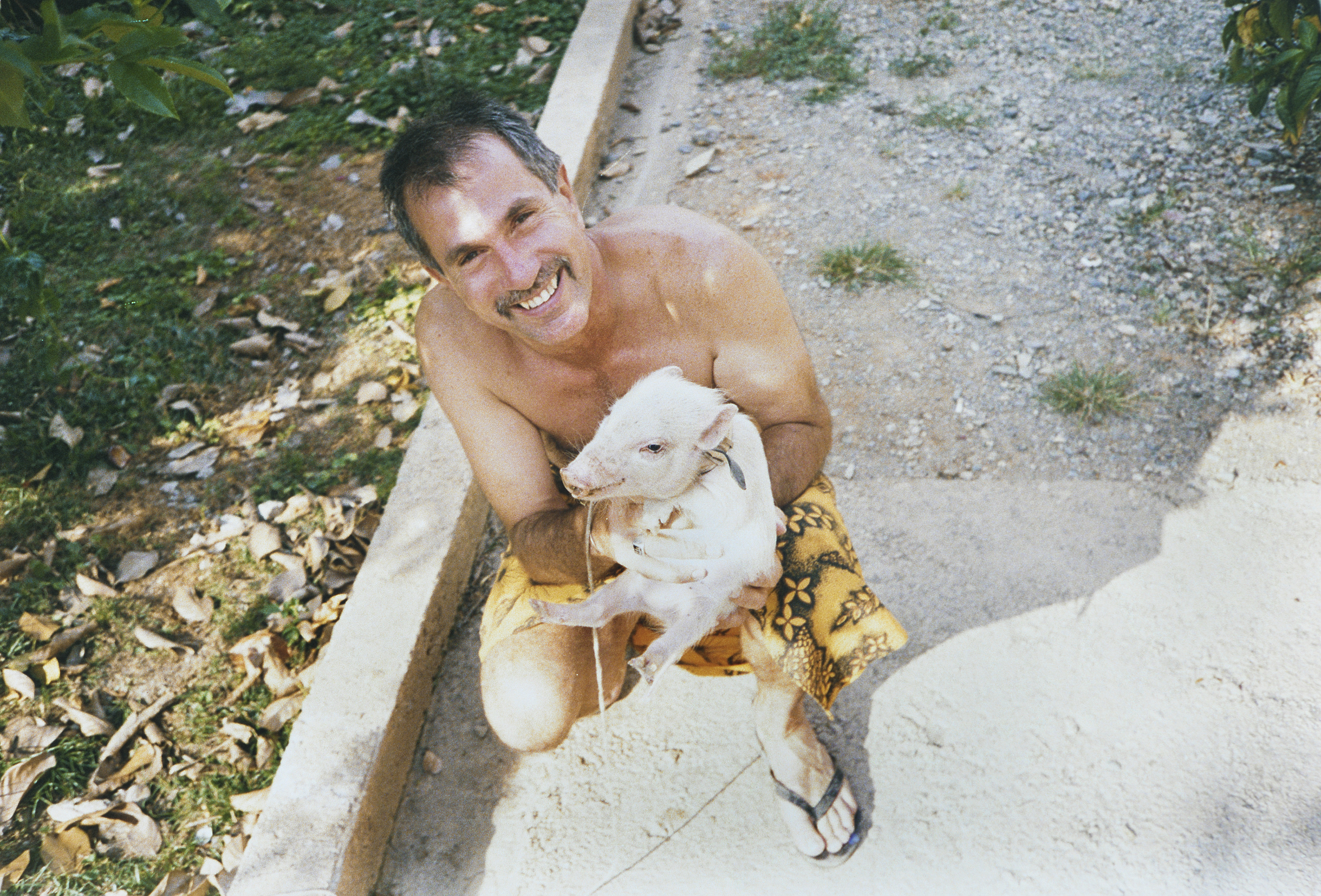
Informal portrait of Australian Federal Police (AFP) Officer Don Barnby, a member of the United Nations Mission East Timor (UNAMET), holding a pig
Explore Senior Sargeant Donald (Don) Barnby's story
- Explore Don Barnby's story in the AWM article 'It was pretty full on'
- Listen to Don Barnby speak about his service in Cyprus, Lebanon, Bougainville and East Timor in his 2001 oral history
- View photographs of Don Barnby and his colleagues serving with UNAMET in East Timor in the AWM's collection
Voices
- Dr David Sutton
Senior Historian, Military History, Australian War Memorial - Robert (Bob) Syron
Australian Army veteran and Rwanda peacekeeper - Frida Umuhoza
Rwandan genocide survivor - Matina Jewell
Former Australian Army officer and UN military observer - Shannon French
Australian Army veteran and East Timor peacekeeper - Donald (Don) Barnby
Former Australian Federal Police officer and UNAMET peacekeeper - Sir Peter Cosgrove
Former Chief of the Defence Force and INTERFET Commander
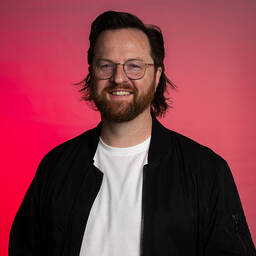
About the host
John Barrington
John is the host of Through Their Eyes. Drawing on his experience presenting and reporting for 3RRR Melbourne, Good Shout Stories, triple j HACK, ABC Radio and The Project, he brings a fresh perspective to Australian War Memorial storytelling, connecting you with the people and experiences behind Australia’s military history, inspired by his father's Second World War service. As your guide through the podcast, John helps reveal the human stories and overlooked perspectives, making history accessible and relevant.